




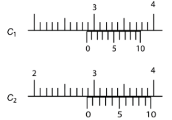
There are two Vernier callipers both of which have $1\,cm$ divided into $10$ equal divisions on the main scale. The vernier scale of one of the callipers $({C_1})$ has $10$ equal divisions that correspond to $9$ main scale divisions. The vernier scale of the other calliper $({C_2})$ has $10$ equal divisions that correspond to $11$ main scale divisions. The readings of the two callipers are shown in the figure. The measured values (in $cm$) by callipers ${C_1}$ and ${C_2}$ respectively are:
(A) $2.87$ and $2.87$
(B) $2.87$ and $2.83$
(C) $2.85$ and $2.82$
(D) $2.87$ and $2.86$
Answer
 Verified
612.9k+ views
Hint: A vernier calliper is a measuring instrument consisting of a main scale with a fixed jaw and a moving jaw with a vernier attached. Here we have to first find the vernier scale division and then the main scale division to calculate the reading.
Complete step by step answer:
The vernier calliper least count function is determined by dividing the smallest reading of the main scale by the total number of vernier scale divisions.
For any form of scale the least count is an important determining parameter. Least count of vernier callipers is the difference between one smallest main scale reading and one smallest vernier scale reading which is $0.1\,mm$ or $0.01\,cm$. The least count is therefore important since it is specifically related to an instrument’s precision, and in some situations precision and least count are used interchangeably while they have separate definitions.
For a calliper if the least count is known, then we can use the following formula to conveniently find any length-
Length=MSR + (VSR×L.C)
Where MSR=main scale reading
VSR=Vernier scale reading and
L.C= least count
Now we can find the solution-
MSD $ = \dfrac{1}{{10}}\,cm = 0.1\,cm$
For first vernier calliper, $10$ VSD $ = 9$ MSD
VSD $ = \dfrac{9}{{10}}$
MSD $ = 0.9 \times 0.1 = 0.09\,cm$
Reading = main scale reading up to coinciding main scale division $ - n \times $ VSD = $3.5 - 7 \times 0.09 = 3.5 - 0.63 = 2.87\,cm$
For second vernier calliper, $10$ VSD$ = 11$ MSD
VSD $ = \dfrac{{11}}{{10}}$
MSD $ = 1.1 \times 0.1 = 0.11\,cm$
Reading $ = 3.6 - 7 \times 0.11 = 3.6 - 0.77 = 2.83\,cm$
Hence, option (B) is the correct answer.
Note:While taking reading on a vernier scale we should check the alignment of the main scale and the vernier scale. There may still be error due to the human eye. So, the main scale reading formula helps in overcoming these errors and least count helps in overcoming these errors.
Complete step by step answer:
The vernier calliper least count function is determined by dividing the smallest reading of the main scale by the total number of vernier scale divisions.
For any form of scale the least count is an important determining parameter. Least count of vernier callipers is the difference between one smallest main scale reading and one smallest vernier scale reading which is $0.1\,mm$ or $0.01\,cm$. The least count is therefore important since it is specifically related to an instrument’s precision, and in some situations precision and least count are used interchangeably while they have separate definitions.
For a calliper if the least count is known, then we can use the following formula to conveniently find any length-
Length=MSR + (VSR×L.C)
Where MSR=main scale reading
VSR=Vernier scale reading and
L.C= least count
Now we can find the solution-
MSD $ = \dfrac{1}{{10}}\,cm = 0.1\,cm$
For first vernier calliper, $10$ VSD $ = 9$ MSD
VSD $ = \dfrac{9}{{10}}$
MSD $ = 0.9 \times 0.1 = 0.09\,cm$
Reading = main scale reading up to coinciding main scale division $ - n \times $ VSD = $3.5 - 7 \times 0.09 = 3.5 - 0.63 = 2.87\,cm$
For second vernier calliper, $10$ VSD$ = 11$ MSD
VSD $ = \dfrac{{11}}{{10}}$
MSD $ = 1.1 \times 0.1 = 0.11\,cm$
Reading $ = 3.6 - 7 \times 0.11 = 3.6 - 0.77 = 2.83\,cm$
Hence, option (B) is the correct answer.
Note:While taking reading on a vernier scale we should check the alignment of the main scale and the vernier scale. There may still be error due to the human eye. So, the main scale reading formula helps in overcoming these errors and least count helps in overcoming these errors.
Recently Updated Pages
Master Class 12 Economics: Engaging Questions & Answers for Success

Master Class 12 English: Engaging Questions & Answers for Success
Master Class 12 Social Science: Engaging Questions & Answers for Success
Master Class 12 Maths: Engaging Questions & Answers for Success
Master Class 12 Physics: Engaging Questions & Answers for Success
Master Class 11 Social Science: Engaging Questions & Answers for Success
Trending doubts
One Metric ton is equal to kg A 10000 B 1000 C 100 class 11 physics CBSE
Difference Between Prokaryotic Cells and Eukaryotic Cells
Find the value of the expression given below sin 30circ class 11 maths CBSE
Two of the body parts which do not appear in MRI are class 11 biology CBSE
Draw a diagram of nephron and explain its structur class 11 biology CBSE
10 examples of friction in our daily life