




The xerophytic plants conserve water by storing it in
(a)Intracellular spaces
(b)Normal parenchymatous cells
(c)Intracellular spaces and parenchymatous cells
(d)Parenchymatous cells specialized for this purpose
Answer
 Verified
627.9k+ views
Hint: The plants growing in drought conditions have some cells with thin cell walls and these cells are larger as compared to other normal cells of the plant. These cells contain a large vacuole in their cytoplasm that works as a water storage body.
Complete step-by-step answer:
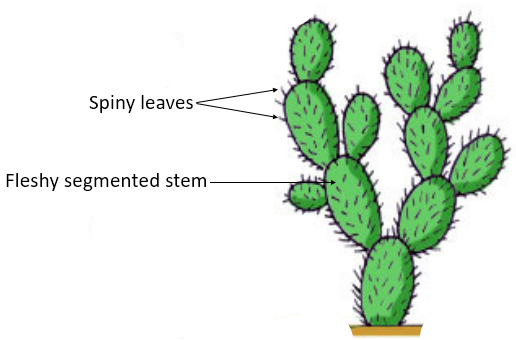
Aquiferous parenchyma is one of the types of parenchyma tissue found in the plants growing in xeric i.e. dry conditions. These are specialized parenchyma cells and their main function is the storage of water. The cells are large and have a thin cell wall. Within these cells, a large vacuole is located that stores water. The capacity of water absorption and retention is increased by the presence of a mucilaginous substance in the cytoplasm and vacuoles of these cells. The stored water is utilized by the plants when there are long periods of drought conditions. Besides having such specialized parenchyma cells, the xerophytes also have some other adaptations according to their habitat. Some such adaptations are – possession of spines in place of flat leaves, reflective color to reduce the effect of sunlight and decrease the amount of water loss by transpiration, the thick cuticle for the protection against biotic and abiotic factors of the desert. A xerophyte has been shown in the figure below –
So, the correct answer is ‘Parenchymatous cells specialized for this purpose’.
Note: Parenchyma is the main representative of the ground tissue of the plants are the cells in this tissue are specialized as per the requirement of the plants. They can be photosynthetic, can be specialized for the storage of food, can store water as we discussed already, and can provide large intercellular spaces for gases to aerate the roots. Based on their functions, they have different names accordingly.
Complete step-by-step answer:
Aquiferous parenchyma is one of the types of parenchyma tissue found in the plants growing in xeric i.e. dry conditions. These are specialized parenchyma cells and their main function is the storage of water. The cells are large and have a thin cell wall. Within these cells, a large vacuole is located that stores water. The capacity of water absorption and retention is increased by the presence of a mucilaginous substance in the cytoplasm and vacuoles of these cells. The stored water is utilized by the plants when there are long periods of drought conditions. Besides having such specialized parenchyma cells, the xerophytes also have some other adaptations according to their habitat. Some such adaptations are – possession of spines in place of flat leaves, reflective color to reduce the effect of sunlight and decrease the amount of water loss by transpiration, the thick cuticle for the protection against biotic and abiotic factors of the desert. A xerophyte has been shown in the figure below –
So, the correct answer is ‘Parenchymatous cells specialized for this purpose’.
Note: Parenchyma is the main representative of the ground tissue of the plants are the cells in this tissue are specialized as per the requirement of the plants. They can be photosynthetic, can be specialized for the storage of food, can store water as we discussed already, and can provide large intercellular spaces for gases to aerate the roots. Based on their functions, they have different names accordingly.
Recently Updated Pages
Master Class 12 Economics: Engaging Questions & Answers for Success

Master Class 12 English: Engaging Questions & Answers for Success
Master Class 12 Social Science: Engaging Questions & Answers for Success
Master Class 12 Maths: Engaging Questions & Answers for Success
Master Class 12 Physics: Engaging Questions & Answers for Success
Master Class 9 General Knowledge: Engaging Questions & Answers for Success
Trending doubts
One Metric ton is equal to kg A 10000 B 1000 C 100 class 11 physics CBSE
Difference Between Prokaryotic Cells and Eukaryotic Cells
Two of the body parts which do not appear in MRI are class 11 biology CBSE
Find the value of the expression given below sin 30circ class 11 maths CBSE
1 ton equals to A 100 kg B 1000 kg C 10 kg D 10000 class 11 physics CBSE
Draw a diagram of nephron and explain its structur class 11 biology CBSE