




The working principle of the spring balance is
A). Newton’s laws of motion
B). Hooke's law
C). Ohm’s law
D). None of the above
Answer
 Verified
642.6k+ views
Hint: Imagine a spring is expanding or compressing due to the presence of external force. We will feel an opposition to obtain the equilibrium state of the spring. This opposing force is exactly equal to the external force on the spring. Using this concept, we measure with the help of spring balance.
Complete step-by-step answer:
The spring can either be extended or compressed by applying an external force on it. When we apply an external force on spring it will produce an opposite balancing force to keep the spring in stable condition. For the same distance of extension and compression, the balancing force produced by the spring will be the same.
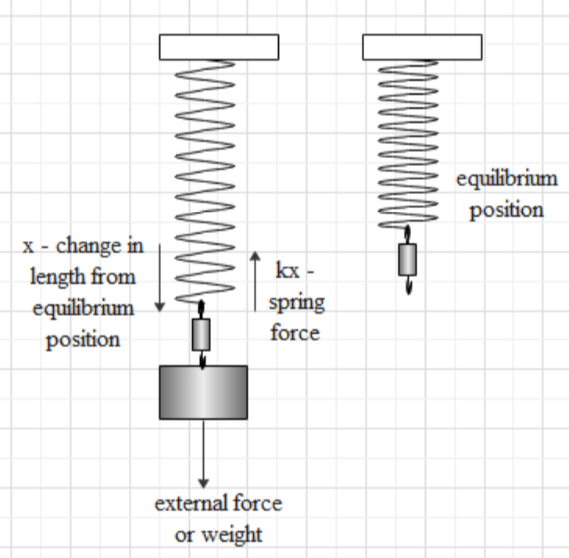
Suppose to extend the spring at X distance and external force applied is ${{\text{F}}_{\text{ext}}}$. The spring will produce an opposite balancing force to keep the spring stable is ${{\text{F}}_{\text{bal}}}$.
${{F}_{bal}}\propto X$
${{F}_{bal}}=kX$
A balanced condition
${{\text{F}}_{\text{ext}}}\text{=}{{\text{F}}_{\text{bal}}}$
${{F}_{ext}}=k{{X}^{{}}}$ ………..(i)
Where, $k=$ proportionality constant called the spring constant.
The last equation is called the hooke's equation. For various, the distance applied force should be varied too.
Note: In this question, students will be confused between two option (A) newton’s laws of motion and option (B) hooke's laws. Because spring is part of the mechanics of physics and in the mechanics part mainly newton’s laws of motion are used. But, if you remember the equation of the spring balance you can eliminate the option(A).
The option(C) ohm’s laws, we know that this law is part of electrical physics so we will eliminate this because our question is from mechanics physics.
Complete step-by-step answer:
The spring can either be extended or compressed by applying an external force on it. When we apply an external force on spring it will produce an opposite balancing force to keep the spring in stable condition. For the same distance of extension and compression, the balancing force produced by the spring will be the same.
Suppose to extend the spring at X distance and external force applied is ${{\text{F}}_{\text{ext}}}$. The spring will produce an opposite balancing force to keep the spring stable is ${{\text{F}}_{\text{bal}}}$.
${{F}_{bal}}\propto X$
${{F}_{bal}}=kX$
A balanced condition
${{\text{F}}_{\text{ext}}}\text{=}{{\text{F}}_{\text{bal}}}$
${{F}_{ext}}=k{{X}^{{}}}$ ………..(i)
Where, $k=$ proportionality constant called the spring constant.
The last equation is called the hooke's equation. For various, the distance applied force should be varied too.
Note: In this question, students will be confused between two option (A) newton’s laws of motion and option (B) hooke's laws. Because spring is part of the mechanics of physics and in the mechanics part mainly newton’s laws of motion are used. But, if you remember the equation of the spring balance you can eliminate the option(A).
The option(C) ohm’s laws, we know that this law is part of electrical physics so we will eliminate this because our question is from mechanics physics.
Recently Updated Pages
The given figure shows two endocrine glands marked class 11 biology NEET_UG

Match columnI with columnII and select the correct class 11 biology NEET
Match column I with column II and select the correct class 11 biology NEET_UG
Which floral family has left 9 right + 1 arrangement class 11 biology NEET_UG
Which is not a variety of sheep A Lohi B Beetal C Nellore class 11 biology NEET_UG
Match column I with column II and select the correct class 11 biology NEET_UG
Trending doubts
Draw a diagram of a plant cell and label at least eight class 11 biology CBSE
Difference Between Prokaryotic Cells and Eukaryotic Cells
One Metric ton is equal to kg A 10000 B 1000 C 100 class 11 physics CBSE
Two of the body parts which do not appear in MRI are class 11 biology CBSE
1 ton equals to A 100 kg B 1000 kg C 10 kg D 10000 class 11 physics CBSE
10 examples of law on inertia in our daily life