




The working of a common balance and physical balance is used on the basis of "Principle of moments". A meter scale of uniform density is being balanced at the centre. If a mass of $2kg$ is suspended at an edge of the scale, then what should be suspended on other side at ${{\dfrac{1}{4}}^{th}}$ length of the scale to maintain the horizontal position of the scale?
$\begin{align}
& A.400kg \\
& B.40kg \\
& C.4kg \\
& D.2kg \\
\end{align}$
Answer
 Verified
620.7k+ views
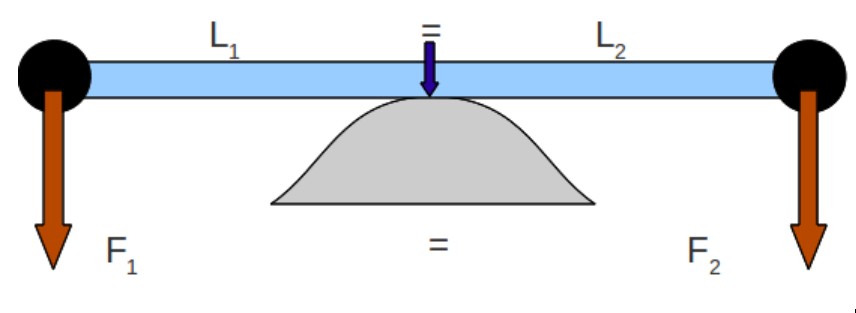
Hint: A beam balance is working on basis of the principle of moments according to which in the equilibrium, the anti-clockwise moment because of the weight of an object on left pan of the beam is similar to the clockwise moment because of to the standard weights on the right pan of the beam.
Complete step by step answer:
First of all let us discuss the principle of moments at first. The principle of moments states that if in equilibrium the total sum of the anti-clockwise moment is equivalent to the total sum of the clockwise moment.
The equation of the principle of moment is given as,
${{F}_{1}}\times {{L}_{1}}={{F}_{2}}\times {{L}_{2}}$
In which the force is given as the gravitational force,
Therefore,
${{w}_{1}}\times {{L}_{1}}={{w}_{2}}\times {{L}_{2}}$
That is,
${{m}_{1}}\times g\times {{L}_{1}}={{m}_{2}}\times g\times {{L}_{2}}$
Simplifying,
${{m}_{1}}\times {{L}_{1}}={{m}_{2}}\times {{L}_{2}}$
Here $m$ is the mass and $L$is the length of the scale in which equilibrium is attained.
${{L}_{1}}=\dfrac{1}{2}$
Substituting the values will give,
$\begin{align}
& 2\times \dfrac{1}{2}={{m}_{2}}\times \dfrac{1}{4} \\
& {{m}_{2}}=4kg \\
\end{align}$
So, the correct answer is “Option C”.
Note:
When a system is in stability or balance, then it is said to be in equilibrium as all the forces experiencing on the system cancel each other out. Common balance is defined as the balance which is having each arm as suspended. The unknown mass is kept in one arm and the known mass in another until they both become equivalent. Therefore this balance is working on the principle of moment of weights. When the weights are being balanced, equilibrium is attained.
Complete step by step answer:
First of all let us discuss the principle of moments at first. The principle of moments states that if in equilibrium the total sum of the anti-clockwise moment is equivalent to the total sum of the clockwise moment.
The equation of the principle of moment is given as,
${{F}_{1}}\times {{L}_{1}}={{F}_{2}}\times {{L}_{2}}$
In which the force is given as the gravitational force,
Therefore,
${{w}_{1}}\times {{L}_{1}}={{w}_{2}}\times {{L}_{2}}$
That is,
${{m}_{1}}\times g\times {{L}_{1}}={{m}_{2}}\times g\times {{L}_{2}}$
Simplifying,
${{m}_{1}}\times {{L}_{1}}={{m}_{2}}\times {{L}_{2}}$
Here $m$ is the mass and $L$is the length of the scale in which equilibrium is attained.
${{L}_{1}}=\dfrac{1}{2}$
Substituting the values will give,
$\begin{align}
& 2\times \dfrac{1}{2}={{m}_{2}}\times \dfrac{1}{4} \\
& {{m}_{2}}=4kg \\
\end{align}$
So, the correct answer is “Option C”.
Note:
When a system is in stability or balance, then it is said to be in equilibrium as all the forces experiencing on the system cancel each other out. Common balance is defined as the balance which is having each arm as suspended. The unknown mass is kept in one arm and the known mass in another until they both become equivalent. Therefore this balance is working on the principle of moment of weights. When the weights are being balanced, equilibrium is attained.
Recently Updated Pages
Master Class 11 Social Science: Engaging Questions & Answers for Success

Master Class 11 Chemistry: Engaging Questions & Answers for Success
Master Class 12 Business Studies: Engaging Questions & Answers for Success
Master Class 12 Chemistry: Engaging Questions & Answers for Success
Master Class 12 Biology: Engaging Questions & Answers for Success
Class 12 Question and Answer - Your Ultimate Solutions Guide
Trending doubts
One Metric ton is equal to kg A 10000 B 1000 C 100 class 11 physics CBSE
Difference Between Prokaryotic Cells and Eukaryotic Cells
How many of the following diseases can be studied with class 11 biology CBSE
Two of the body parts which do not appear in MRI are class 11 biology CBSE
Which of the following enzymes is used for carboxylation class 11 biology CBSE
Explain zero factorial class 11 maths CBSE