




The waxy substance which coats the surface of the auditory canal is produced by
(A)Tympanum
(B)Sebaceous glands
(C)Ceruminous glands
(D)Meibomian glands
Answer
 Verified
604.5k+ views
Hint: The waxy substance which coats the surface of the auditory canal is produced by specialized sudoriferous glands which are a type of sweat glands located subcutaneously in the external auditory canal, in the outer 1/3.
Complete answer:
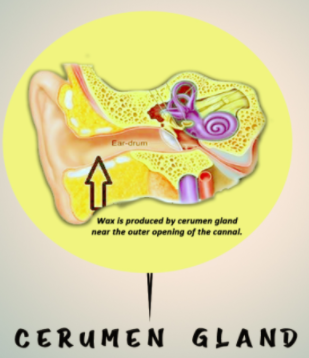
The waxy substance which coats the surface of the auditory canal is produced by Ceruminous glands. Ceruminous glands are simple, tubular glands that are coiled and made up of an inner secretory layer of cells and an outer myoepithelial layer of cells. They are classed as apocrine glands.
Additional Information: Ceruminous glands produce cerumen, or earwax, by mixing their secretion with sebum and dead epidermal cells. Cerumen helps in keeping the eardrum pliable, lubricates and cleans the external auditory canal, waterproofs the canal, kills bacteria, and serves as a barrier to trap foreign particles like dust, fungal spores, etc.by coating the guard hairs of the ear, making them sticky. Ceruminous glands are capable of developing both benign and malignant tumors. The examples of benign tumors include ceruminous adenoma, ceruminous pleomorphic adenoma, and ceruminous
Syringocystadenoma papilliferum. The examples of malignant tumors include ceruminous adenocarcinoma, adenoid cystic carcinoma, and mucoepidermoid carcinoma. It is seen that too much earwax might cause a temporary hearing loss.
So, the correct answer is ‘Ceruminous glands’.
Note: Ear wax is called wax, but it’s not a wax at all. The name comes from the waxy texture. Earwax is made partially of skin cells from the ear canal. This area always renews itself and contains skin. As dead cells drop off in some time, they are pulled in to produce earwax. Ear wax is made up of dead cells and Fatty acids, Squalene, Alcohol, and Cholesterol.
Complete answer:
The waxy substance which coats the surface of the auditory canal is produced by Ceruminous glands. Ceruminous glands are simple, tubular glands that are coiled and made up of an inner secretory layer of cells and an outer myoepithelial layer of cells. They are classed as apocrine glands.
Additional Information: Ceruminous glands produce cerumen, or earwax, by mixing their secretion with sebum and dead epidermal cells. Cerumen helps in keeping the eardrum pliable, lubricates and cleans the external auditory canal, waterproofs the canal, kills bacteria, and serves as a barrier to trap foreign particles like dust, fungal spores, etc.by coating the guard hairs of the ear, making them sticky. Ceruminous glands are capable of developing both benign and malignant tumors. The examples of benign tumors include ceruminous adenoma, ceruminous pleomorphic adenoma, and ceruminous
Syringocystadenoma papilliferum. The examples of malignant tumors include ceruminous adenocarcinoma, adenoid cystic carcinoma, and mucoepidermoid carcinoma. It is seen that too much earwax might cause a temporary hearing loss.
So, the correct answer is ‘Ceruminous glands’.
Note: Ear wax is called wax, but it’s not a wax at all. The name comes from the waxy texture. Earwax is made partially of skin cells from the ear canal. This area always renews itself and contains skin. As dead cells drop off in some time, they are pulled in to produce earwax. Ear wax is made up of dead cells and Fatty acids, Squalene, Alcohol, and Cholesterol.
Recently Updated Pages
Master Class 11 Social Science: Engaging Questions & Answers for Success

Master Class 11 English: Engaging Questions & Answers for Success
Master Class 11 Maths: Engaging Questions & Answers for Success
Master Class 11 Chemistry: Engaging Questions & Answers for Success
Master Class 11 Biology: Engaging Questions & Answers for Success
Master Class 11 Physics: Engaging Questions & Answers for Success
Trending doubts
Differentiate between an exothermic and an endothermic class 11 chemistry CBSE
There are 720 permutations of the digits 1 2 3 4 5 class 11 maths CBSE
Draw a diagram of a plant cell and label at least eight class 11 biology CBSE
Which chemical is known as king of chemicals A H 2 class 11 chemistry CBSE
Which gas is abundant in air class 11 chemistry CBSE
Draw a diagram of nephron and explain its structur class 11 biology CBSE