




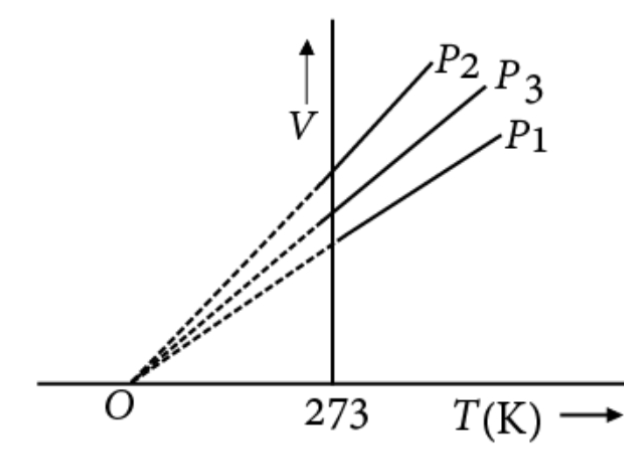
The volume-temperature graphs of a given mass of an ideal gas at constant pressure are shown below:
What is the correct order of pressures?
(A) $ {P_1} > {P_3} > {P_2} $
(B) $ {P_1} > {P_2} > {P_3} $
(C) $ {P_2} > {P_3} > {P_1} $
(D) $ {P_2} > {P_1} > {P_3} $
Answer
 Verified
575.1k+ views
Hint :Volume is the area occupied by gas, temperature is the measurement degree of the heat whereas the pressure is the force of particular gas when put inside a container. It was sir, Emile Clapeyron who connects all the gas laws proposed by Boyle, Charles, Gay Lussac, and Avogadro and framed the equation $ PV = nRT $ . For all, P is pressure, V is volume, n is number of gases molecules, R is universal gas constant and T is temperature.
Complete Step By Step Answer:
Gaseous state of matter is one of the five other states of matter namely solids, liquids, plasma and bosons. Among solids, liquids and gases, the gaseous state of matter had attracted the scientist the most because of its ability to have minimum forces of attraction and still having such importance for the existence of life. From oxygen important for combustion to the carbon dioxide required by plants for the photo-chemical process also called photosynthesis. They all are gas. Several laws were proposed to understand the nature and behaviour of the gases like, Boyle’s law, Charles’s law, Gay Lussac law, and the Avogadro law. These were this gaseous state which failed the great kinetic theory of gases developed by Maxwell and Boltzmann.
Emile Clapeyron when connecting all the gas laws gave the ideal gas equation which is $ PV = nRT $ .
If we take pressure to be constant in the ideal gas equation, then we can write volume as $ V = \dfrac{{nRT}}{P} $ . And if we replace all the constants by one constant, let say ‘ $ K $ ’ then the equation becomes $ V = KT $ . Now according to the equation of a straight line the constant is slope, that means $ K $ is slope of the line. And $ K = \dfrac{{nR}}{P} $ that is slope is inversely proportional to the pressure. Thus, the correct order of the pressure is $ {P_1} > {P_3} > {P_2} $ .
Note :
The equation of a straight line is $ y = mx + c $ where $ x $ and $ y $ are the axises and the $ m $ and $ c $ are the constants. The constant $ c $ is the intercept that means it determines the variation of a line from being linear to being a line with a particular slope. It is to remember, that slope is always inversely proportional to the volume and pressure which is in accordance with Boyle's law as well.
Complete Step By Step Answer:
Gaseous state of matter is one of the five other states of matter namely solids, liquids, plasma and bosons. Among solids, liquids and gases, the gaseous state of matter had attracted the scientist the most because of its ability to have minimum forces of attraction and still having such importance for the existence of life. From oxygen important for combustion to the carbon dioxide required by plants for the photo-chemical process also called photosynthesis. They all are gas. Several laws were proposed to understand the nature and behaviour of the gases like, Boyle’s law, Charles’s law, Gay Lussac law, and the Avogadro law. These were this gaseous state which failed the great kinetic theory of gases developed by Maxwell and Boltzmann.
Emile Clapeyron when connecting all the gas laws gave the ideal gas equation which is $ PV = nRT $ .
If we take pressure to be constant in the ideal gas equation, then we can write volume as $ V = \dfrac{{nRT}}{P} $ . And if we replace all the constants by one constant, let say ‘ $ K $ ’ then the equation becomes $ V = KT $ . Now according to the equation of a straight line the constant is slope, that means $ K $ is slope of the line. And $ K = \dfrac{{nR}}{P} $ that is slope is inversely proportional to the pressure. Thus, the correct order of the pressure is $ {P_1} > {P_3} > {P_2} $ .
Note :
The equation of a straight line is $ y = mx + c $ where $ x $ and $ y $ are the axises and the $ m $ and $ c $ are the constants. The constant $ c $ is the intercept that means it determines the variation of a line from being linear to being a line with a particular slope. It is to remember, that slope is always inversely proportional to the volume and pressure which is in accordance with Boyle's law as well.
Recently Updated Pages
If x a + bt + ct2 where x is in meters and t is in class 11 physics CBSE

A car covers the first half distance between two places class 11 physics CBSE
The resultant of two vectors overrightarrow P and overrightarrow class 11 physics CBSE
Find the value of cos 135 class 11 maths CBSE
A mass M is held in place by an applied force F and class 11 physics CBSE
A solution of glucose in water is labelled as 10 dfracwv class 11 chemistry CBSE
Trending doubts
One Metric ton is equal to kg A 10000 B 1000 C 100 class 11 physics CBSE
Find the value of the expression given below sin 30circ class 11 maths CBSE
Draw a diagram of nephron and explain its structur class 11 biology CBSE
10 examples of friction in our daily life
Proton was discovered by A Thomson B Rutherford C Chadwick class 11 chemistry CBSE
Bond order ofO2 O2+ O2 and O22 is in order A O2 langle class 11 chemistry CBSE