




The volume of a particular cube is numerically equal to its total surface area. Calculate the length of one edge of the cube.
(a) 6 units
(b) 8 units
(c) 10 units
(d) 12 units
Answer
 Verified
633.3k+ views
Hint: Here, first of all we will assume that the length of one side of the cube is ‘a’ units. We will use the formula that the volume of a cube is equal to the cube of its side length, that is, $Vol={{\left( side \right)}^{3}}$ and its total surface area is equal to 6 times the area of one of its face, that is, $TSA=6\times {{\left( side \right)}^{2}}$. Thereafter, on equating the volume to the total surface area, we can easily get the value of ‘a’ which is equal to the side length or edge length of the cube.
Complete step-by-step answer:
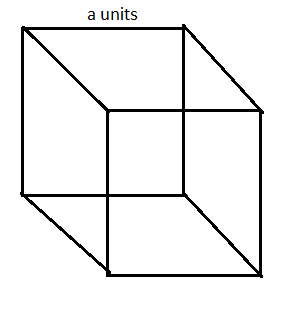
Let the length of the side of the cube be = ‘a’ units.
So, the volume of the cube = ${{a}^{3}}$ cubic units
And, the total surface area of the cube = $6\times {{a}^{2}}$ square units.
Since, it is given that the volume of the cube is equal to its surface area. Therefore, we can write:
${{a}^{3}}=6{{a}^{2}}$
$\Rightarrow {{a}^{3}}-6{{a}^{2}}=0$
Here, we may take ${{a}^{2}}$ common. So, we get:
${{a}^{2}}\left( a-6 \right)=0$
So, we have two cases, that is, either ${{a}^{2}}=0$ or $a-6=0$.
When we take the case of ${{a}^{2}}=0$, it implies that a = 0.
When we take the case $a-6=0$, it implies that a = 6.
Since, the length of the side of the cube can’t be 0, so the value a = 6 is only acceptable. This means that one edge of the cube is of length 6 units.
Hence, option (a) is the correct answer.
Note: Here, a confusion may arise that even if we are getting a cubic equation in terms of ‘a’, we are getting only one value of a. This is because upon equating ${{a}^{2}}$ to 0, we get a = 0, but length cannot be 0 as it is practically impossible. Hence, we take only one value of ‘a’ which is 6 and ignore the other two values, both of which are 0.
Complete step-by-step answer:
Let the length of the side of the cube be = ‘a’ units.
So, the volume of the cube = ${{a}^{3}}$ cubic units
And, the total surface area of the cube = $6\times {{a}^{2}}$ square units.
Since, it is given that the volume of the cube is equal to its surface area. Therefore, we can write:
${{a}^{3}}=6{{a}^{2}}$
$\Rightarrow {{a}^{3}}-6{{a}^{2}}=0$
Here, we may take ${{a}^{2}}$ common. So, we get:
${{a}^{2}}\left( a-6 \right)=0$
So, we have two cases, that is, either ${{a}^{2}}=0$ or $a-6=0$.
When we take the case of ${{a}^{2}}=0$, it implies that a = 0.
When we take the case $a-6=0$, it implies that a = 6.
Since, the length of the side of the cube can’t be 0, so the value a = 6 is only acceptable. This means that one edge of the cube is of length 6 units.
Hence, option (a) is the correct answer.
Note: Here, a confusion may arise that even if we are getting a cubic equation in terms of ‘a’, we are getting only one value of a. This is because upon equating ${{a}^{2}}$ to 0, we get a = 0, but length cannot be 0 as it is practically impossible. Hence, we take only one value of ‘a’ which is 6 and ignore the other two values, both of which are 0.
Recently Updated Pages
Master Class 12 Economics: Engaging Questions & Answers for Success

Master Class 12 English: Engaging Questions & Answers for Success
Master Class 12 Social Science: Engaging Questions & Answers for Success
Master Class 12 Maths: Engaging Questions & Answers for Success
Master Class 12 Physics: Engaging Questions & Answers for Success
Master Class 10 English: Engaging Questions & Answers for Success
Trending doubts
Explain the Treaty of Vienna of 1815 class 10 social science CBSE
Why is it 530 pm in india when it is 1200 afternoon class 10 social science CBSE
What is the full form of POSCO class 10 social science CBSE
Define Potential, Developed, Stock and Reserved resources
Which Country Has the Largest Border with India?
Complete the sentence with the most appropriate word class 10 english CBSE