




The vertices of the triangle are P(2,1), Q(4,-1) and R(3,2). If through P and R lines parallel to opposite sides are drawn to intersect in S, then what is the area of PQRS?
(a) 6
(b) 4
(c) 8
(d) 12
Answer
 Verified
623.7k+ views
- Hint: First of all we will construct the triangle as told in the question. Then we will find the point of intersection of the newly drawn line. Then we use the midpoint formula to get the final answer.
Complete step-by-step solution -
The formula needed for this question is the area of the triangle given three points. I am going to explain a concept here, which is true about any triangle, and this concept is used here.
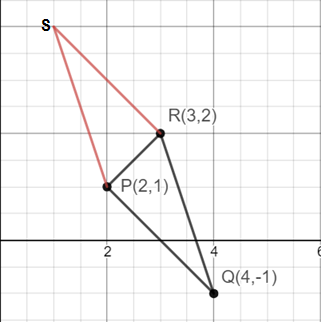
You can see the triangle in black lines, already given in the question. Now when we draw lines through P and R lines parallel to opposite sides they intersect at one point which we named S according to the question.
Now in any triangle PQR if this procedure is done, we always get a parallelogram PQRS no matter what we do and how we do.
Also, as you can see in the figure, the triangle is always the half of parallelogram in terms of area.
So, to calculate the area of the parallelogram we can calculate the area of the triangle and then multiply it by 2.
Let us do this.
Area of parallelogram = 2$\times$ area of triangle
We will find the area of triangle using matrix, so we get
\[ar(PQRS)=2\times \dfrac{1}{2}\left( \begin{matrix}
{{x}_{1}} & {{y}_{1}} & 1 \\
{{x}_{2}} & {{y}_{2}} & 1 \\
{{x}_{3}} & {{y}_{3}} & 1 \\
\end{matrix} \right)\]
Here \[\left( {{x}_{1}},\text{ }{{y}_{1}} \right)=\left( 2,\text{ }1 \right),\text{ }\left( {{x}_{2}},\text{ }{{y}_{2}} \right)=\left( 4,\text{ }-1 \right),\left( {{x}_{3}},\text{ }{{y}_{3}} \right)=\left( 3,2 \right)\], so we get
\[ar(PQRS)=\left( \begin{matrix}
2 & 1 & 1 \\
4 & -1 & 1 \\
3 & 2 & 1 \\
\end{matrix} \right)\]
\[\begin{align}
& ar(PQRS)=\left( \begin{matrix}
2 & 1 & 1 \\
4 & -1 & 1 \\
3 & 2 & 1 \\
\end{matrix} \right) \\
& ar(PQRS)=2((-1)(1)-(2)(1))-1((4)(1)-(3)(1))+1((4)(2)-(3)(-1)) \\
& ar(PQRS)=2(-1-2)-(4-3)+(8+3) \\
& ar(PQRS)=2(-3)-1+11 \\
& ar(PQRS)=-6-1+11=4 \\
\end{align}\]
Thus, the area of the quadrilateral PQRS is 4 sq. units.
Therefore, option(b) is correct.
Note: While in exam, drawing rough figures is very important. However, be sure that you draw them as neat and correct as possible. If you draw the diagram haphazardly, you might not notice that the triangle after some construction looks like a parallelogram and you might take up some other method to find out the area and waste a lot of time.
Complete step-by-step solution -
The formula needed for this question is the area of the triangle given three points. I am going to explain a concept here, which is true about any triangle, and this concept is used here.
You can see the triangle in black lines, already given in the question. Now when we draw lines through P and R lines parallel to opposite sides they intersect at one point which we named S according to the question.
Now in any triangle PQR if this procedure is done, we always get a parallelogram PQRS no matter what we do and how we do.
Also, as you can see in the figure, the triangle is always the half of parallelogram in terms of area.
So, to calculate the area of the parallelogram we can calculate the area of the triangle and then multiply it by 2.
Let us do this.
Area of parallelogram = 2$\times$ area of triangle
We will find the area of triangle using matrix, so we get
\[ar(PQRS)=2\times \dfrac{1}{2}\left( \begin{matrix}
{{x}_{1}} & {{y}_{1}} & 1 \\
{{x}_{2}} & {{y}_{2}} & 1 \\
{{x}_{3}} & {{y}_{3}} & 1 \\
\end{matrix} \right)\]
Here \[\left( {{x}_{1}},\text{ }{{y}_{1}} \right)=\left( 2,\text{ }1 \right),\text{ }\left( {{x}_{2}},\text{ }{{y}_{2}} \right)=\left( 4,\text{ }-1 \right),\left( {{x}_{3}},\text{ }{{y}_{3}} \right)=\left( 3,2 \right)\], so we get
\[ar(PQRS)=\left( \begin{matrix}
2 & 1 & 1 \\
4 & -1 & 1 \\
3 & 2 & 1 \\
\end{matrix} \right)\]
\[\begin{align}
& ar(PQRS)=\left( \begin{matrix}
2 & 1 & 1 \\
4 & -1 & 1 \\
3 & 2 & 1 \\
\end{matrix} \right) \\
& ar(PQRS)=2((-1)(1)-(2)(1))-1((4)(1)-(3)(1))+1((4)(2)-(3)(-1)) \\
& ar(PQRS)=2(-1-2)-(4-3)+(8+3) \\
& ar(PQRS)=2(-3)-1+11 \\
& ar(PQRS)=-6-1+11=4 \\
\end{align}\]
Thus, the area of the quadrilateral PQRS is 4 sq. units.
Therefore, option(b) is correct.
Note: While in exam, drawing rough figures is very important. However, be sure that you draw them as neat and correct as possible. If you draw the diagram haphazardly, you might not notice that the triangle after some construction looks like a parallelogram and you might take up some other method to find out the area and waste a lot of time.
Recently Updated Pages
Master Class 11 Social Science: Engaging Questions & Answers for Success

Master Class 11 Physics: Engaging Questions & Answers for Success
Master Class 11 Maths: Engaging Questions & Answers for Success
Master Class 11 Economics: Engaging Questions & Answers for Success
Master Class 11 Computer Science: Engaging Questions & Answers for Success
Master Class 11 Chemistry: Engaging Questions & Answers for Success
Trending doubts
One Metric ton is equal to kg A 10000 B 1000 C 100 class 11 physics CBSE
There are 720 permutations of the digits 1 2 3 4 5 class 11 maths CBSE
1 Quintal is equal to a 110 kg b 10 kg c 100kg d 1000 class 11 physics CBSE
State and prove Bernoullis theorem class 11 physics CBSE
Difference Between Prokaryotic Cells and Eukaryotic Cells
Which among the following are examples of coming together class 11 social science CBSE