




The vertices of a parallelogram are (3, – 2), (4, 0), (6, – 3), and (5, – 5). The diagonal intersect at a point M. The coordinates of the point M are
Answer
 Verified
626.4k+ views
Hint: We are given the vertex of the parallelogram. Firstly, we will understand how a diagonal and point of intersection of diagonal related to each other. Then we use the mid – point formula which is given as \[x=\dfrac{{{x}_{1}}+{{x}_{2}}}{2}\] and \[y=\dfrac{{{y}_{1}}+{{y}_{2}}}{2},\] where (x, y) is coordinate of the midpoint while \[\left( {{x}_{1}},{{y}_{1}} \right)\] and \[\left( {{x}_{2}},{{y}_{2}} \right)\] are the coordinates of the corner points.
Complete step by step answer:
We are given that we have a parallelogram whose coordinates of the vertices are as (3, – 2), (4, 0), (6, – 3), and (5, – 5). We are mentioned that the diagonal of the parallelogram intersect each other at M, we are asked to find the coordinate of M. To find the coordinate of the point M, we must have the information of the parallelogram and its diagonal.
So, we have that parallelogram is a special type of quadrilateral in which the opposite is equal and parallel. The diagonal of the parallelogram are not equal in the length because at the vertex, the angle is not \[{{90}^{\circ }}.\]
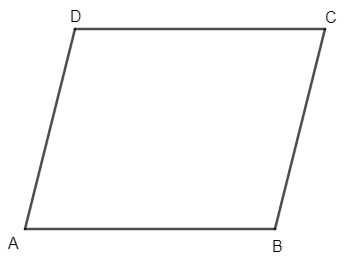
In the above parallelogram ABCD, AC and BD are diagonal. We know that when the diagonal meet each other, they do not just intersect basically they bisect each other. So, the diagonals bisect each other. So, the point where the diagonal of the parallelogram intersect is nothing but the midpoint of the diagonal.
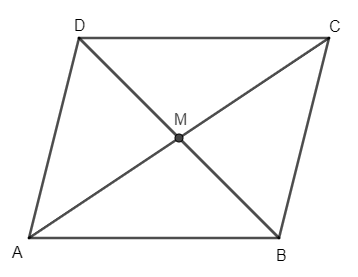
Here, M is the midpoint of AC and BD.
Now, let ABCD be our parallelogram with A(3, – 2), B(4, 0), C(6, – 3), and D(5, – 5).
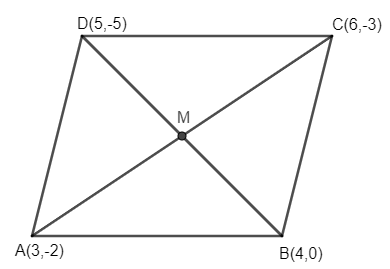
Now, we know that the point of intersection of the diagonal (M) is the midpoint of the diagonal. So, we apply midpoint formula on the diagonal AC, A(3, – 2) and C(6, – 3). The midpoint formula is as follows
\[x=\dfrac{{{x}_{1}}+{{x}_{2}}}{2}\]
\[y=\dfrac{{{y}_{1}}+{{y}_{2}}}{2}\]
So, consider \[\left( {{x}_{1}},{{y}_{1}} \right)=\left( 3,-2 \right)\] and \[\left( {{x}_{2}},{{y}_{2}} \right)=\left( 6,-3 \right)\] and consider the point of M as M(x, y). So, using the above formula, we get,
\[\Rightarrow x=\dfrac{3+6}{2}\]
\[\Rightarrow x=\dfrac{9}{2}\]
And similarly,
\[\Rightarrow y=\dfrac{-2+\left( -3 \right)}{2}\]
On simplifying, we get,
\[\Rightarrow y=\dfrac{-2-3}{2}\]
\[\Rightarrow y=\dfrac{-5}{2}\]
So, we get, coordinate of M as \[M\left( x,y \right)=M\left( \dfrac{9}{2},\dfrac{-5}{2} \right).\]
Note:
Remember that we do not have to solve for both the diagonal, we can just find the midpoint of any one diagonal and we can choose AC or BD. Using any one of the two we can be easily to find the coordinate of M and to be sure about the answer one can recheck by finding the midpoint of the other diagonal.
Complete step by step answer:
We are given that we have a parallelogram whose coordinates of the vertices are as (3, – 2), (4, 0), (6, – 3), and (5, – 5). We are mentioned that the diagonal of the parallelogram intersect each other at M, we are asked to find the coordinate of M. To find the coordinate of the point M, we must have the information of the parallelogram and its diagonal.
So, we have that parallelogram is a special type of quadrilateral in which the opposite is equal and parallel. The diagonal of the parallelogram are not equal in the length because at the vertex, the angle is not \[{{90}^{\circ }}.\]
In the above parallelogram ABCD, AC and BD are diagonal. We know that when the diagonal meet each other, they do not just intersect basically they bisect each other. So, the diagonals bisect each other. So, the point where the diagonal of the parallelogram intersect is nothing but the midpoint of the diagonal.
Here, M is the midpoint of AC and BD.
Now, let ABCD be our parallelogram with A(3, – 2), B(4, 0), C(6, – 3), and D(5, – 5).
Now, we know that the point of intersection of the diagonal (M) is the midpoint of the diagonal. So, we apply midpoint formula on the diagonal AC, A(3, – 2) and C(6, – 3). The midpoint formula is as follows
\[x=\dfrac{{{x}_{1}}+{{x}_{2}}}{2}\]
\[y=\dfrac{{{y}_{1}}+{{y}_{2}}}{2}\]
So, consider \[\left( {{x}_{1}},{{y}_{1}} \right)=\left( 3,-2 \right)\] and \[\left( {{x}_{2}},{{y}_{2}} \right)=\left( 6,-3 \right)\] and consider the point of M as M(x, y). So, using the above formula, we get,
\[\Rightarrow x=\dfrac{3+6}{2}\]
\[\Rightarrow x=\dfrac{9}{2}\]
And similarly,
\[\Rightarrow y=\dfrac{-2+\left( -3 \right)}{2}\]
On simplifying, we get,
\[\Rightarrow y=\dfrac{-2-3}{2}\]
\[\Rightarrow y=\dfrac{-5}{2}\]
So, we get, coordinate of M as \[M\left( x,y \right)=M\left( \dfrac{9}{2},\dfrac{-5}{2} \right).\]
Note:
Remember that we do not have to solve for both the diagonal, we can just find the midpoint of any one diagonal and we can choose AC or BD. Using any one of the two we can be easily to find the coordinate of M and to be sure about the answer one can recheck by finding the midpoint of the other diagonal.
Recently Updated Pages
Class 10 Question and Answer - Your Ultimate Solutions Guide

Master Class 12 Economics: Engaging Questions & Answers for Success
Master Class 12 Social Science: Engaging Questions & Answers for Success
Master Class 12 English: Engaging Questions & Answers for Success
Master Class 12 Maths: Engaging Questions & Answers for Success
Master Class 12 Physics: Engaging Questions & Answers for Success
Trending doubts
The slogan Jai Hind was given by A Lal Bahadur Shastri class 10 social science CBSE
Identify the feminine form of noun nephew a shenephew class 10 english CBSE
CSIR full form?
Distinguish between coming together federations and class 10 social science CBSE
Draw a diagram of the human eye as seen in a vertical class 10 biology CBSE
Identify the plural form of the word child from the class 10 english CBSE