




The velocity-time graph for a body with non-uniform motion is a :
$A.\quad straight\quad line$
$B.\quad straight\quad line\quad parallel\quad to\quad the\quad X-axis$
$C.\quad straight\quad line\quad parallel\quad to\quad the\quad Y-axis$
$D.\quad curved\quad line$
Answer
 Verified
621.6k+ views
Hint: Use relation between acceleration, velocity and time to find the nature of the graph.The Velocity-time graph gives acceleration as slope. In non-uniform motion acceleration changes, eventually slope changes. The slope is either increasing or decreasing.
Formula used:
$a\quad =\dfrac {v}{ t }$
Complete answer:
We know formula for acceleration is given by,
$a\quad =\dfrac {v}{ t }$
where, a: Acceleration
v: Velocity
t: Time
From the above equation, it can be understood that the slope calculated from the velocity-time graph gives acceleration. It is given that the body is in non-uniform motion which implies acceleration of the body changes at every instant. This means there is a variation in slope too. Slope remains constant for a straight line which leads to the conclusion that a curved line has varying slope i.e. the slope is either increasing or decreasing. Therefore, the velocity-time graph for a body in non-uniform motion is a curved line.
So, the correct answer is “Option D”.
Additional Information:
The figures given below show a velocity-time graph for a body in motion.
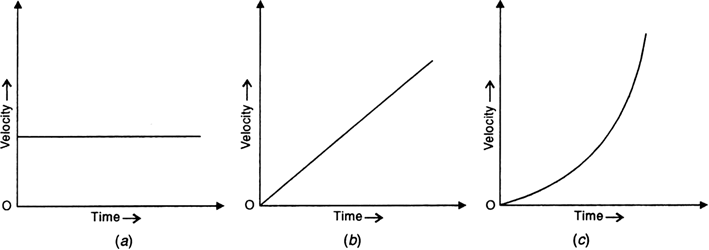
Figure.(a) represents Uniform motion or Zero Acceleration. It means the body moves with constant velocity in the same line. In this case, the acceleration is zero.
Figure.(b) represents Uniform Acceleration. It means the body travels equal with equal velocity in an equal interval of time.
Figure.(c) represents Non-uniform Acceleration. It means the body travels unequal distances in equal intervals of time causing inconsistent velocity.
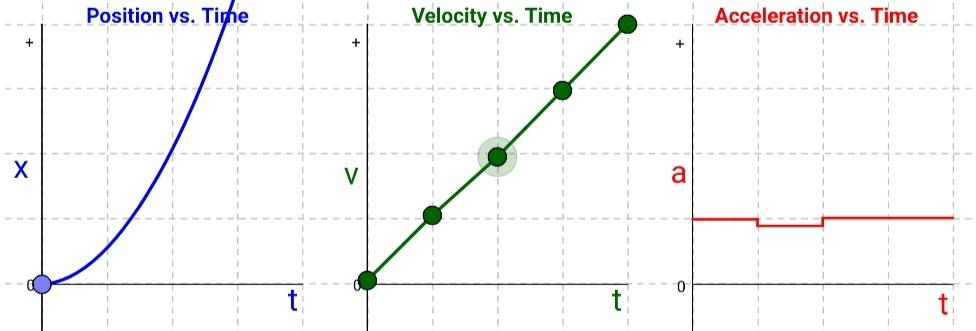
The above figures show how there is variation in position vs time graph and acceleration vs time graph as there is change in velocity vs time graph.
Note:
As the body is in non-uniform motion, the nature of the graph is a curved line. But if the body was in uniform motion, the nature of the graph would be a straight line. This straight line can be either passing from the center or a line intersecting both the axes or a line parallel to X-axis or Y-axis. Distance-time graph shows the same nature.
Formula used:
$a\quad =\dfrac {v}{ t }$
Complete answer:
We know formula for acceleration is given by,
$a\quad =\dfrac {v}{ t }$
where, a: Acceleration
v: Velocity
t: Time
From the above equation, it can be understood that the slope calculated from the velocity-time graph gives acceleration. It is given that the body is in non-uniform motion which implies acceleration of the body changes at every instant. This means there is a variation in slope too. Slope remains constant for a straight line which leads to the conclusion that a curved line has varying slope i.e. the slope is either increasing or decreasing. Therefore, the velocity-time graph for a body in non-uniform motion is a curved line.
So, the correct answer is “Option D”.
Additional Information:
The figures given below show a velocity-time graph for a body in motion.
Figure.(a) represents Uniform motion or Zero Acceleration. It means the body moves with constant velocity in the same line. In this case, the acceleration is zero.
Figure.(b) represents Uniform Acceleration. It means the body travels equal with equal velocity in an equal interval of time.
Figure.(c) represents Non-uniform Acceleration. It means the body travels unequal distances in equal intervals of time causing inconsistent velocity.
The above figures show how there is variation in position vs time graph and acceleration vs time graph as there is change in velocity vs time graph.
Note:
As the body is in non-uniform motion, the nature of the graph is a curved line. But if the body was in uniform motion, the nature of the graph would be a straight line. This straight line can be either passing from the center or a line intersecting both the axes or a line parallel to X-axis or Y-axis. Distance-time graph shows the same nature.
Recently Updated Pages
Master Class 11 Social Science: Engaging Questions & Answers for Success

Master Class 11 English: Engaging Questions & Answers for Success
Master Class 11 Maths: Engaging Questions & Answers for Success
Master Class 11 Chemistry: Engaging Questions & Answers for Success
Master Class 11 Biology: Engaging Questions & Answers for Success
Class 11 Question and Answer - Your Ultimate Solutions Guide
Trending doubts
One Metric ton is equal to kg A 10000 B 1000 C 100 class 11 physics CBSE
Difference Between Prokaryotic Cells and Eukaryotic Cells
Find the value of the expression given below sin 30circ class 11 maths CBSE
1 ton equals to A 100 kg B 1000 kg C 10 kg D 10000 class 11 physics CBSE
Two of the body parts which do not appear in MRI are class 11 biology CBSE
Draw a diagram of nephron and explain its structur class 11 biology CBSE