




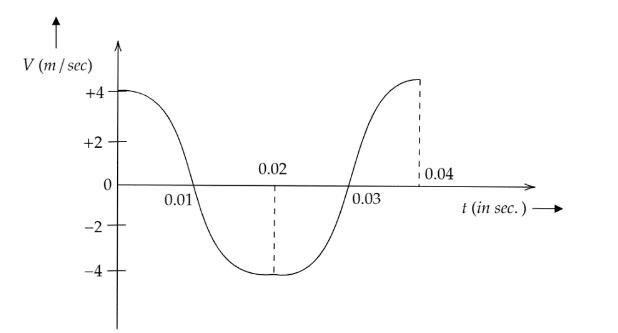
The velocity-time diagram of a harmonic oscillator is shown in the adjoining figure.The frequency of oscillation is:
A. $25{\text{ }}Hz$
B. $50{\text{ }}Hz$
C. $12.25{\text{ }}Hz$
D. ${\text{33}}{\text{.3 }}Hz$
Answer
 Verified
553.8k+ views
Hint:The figure consists of a velocity graph which is in the Y-axis and time graph which is in the X-axis of the harmonic oscillator. We have to find the frequency of the oscillator which we will find from the total time period from the graph. The inverse of the total time period is the frequency.
Complete step by step answer:
The velocity of a particle is defined as the displacement it covers in that period of time.
The curve in the figure is a sinusoidal curve. It is not a continuous curve as it gets stopped at $0.04{\text{ }}\sec $. Hence, it confirms that the harmonic oscillator operates till $0.04{\text{ }}\sec $.So, the total time period of the harmonic oscillator is $0.04{\text{ }}\sec $.
The formula to find the frequency of a particle from total time period is given by,
$f = \dfrac{1}{T}$
Where, $f$ is the frequency of the harmonic oscillator and $T$ is the total time period till which the harmonic oscillator operates.
From the given graph we get the total time period $T = 0.04{\text{ }}\sec $
So, the frequency is,
$f = \dfrac{1}{T} \\
\Rightarrow f= \dfrac{1}{{0.04}} \\
\therefore f= 25\,Hz$
So, the frequency of the harmonic oscillator is $25{\text{ }}Hz$.
Therefore, the correct option is A.
Note:It must be noted that the frequency of a particle is defined as the number of waves that passes a fixed point in unit time or may be also considered as the number of cycles of vibration by a particle undergone in unit time. The SI unit of frequency is Hertz.
Complete step by step answer:
The velocity of a particle is defined as the displacement it covers in that period of time.
The curve in the figure is a sinusoidal curve. It is not a continuous curve as it gets stopped at $0.04{\text{ }}\sec $. Hence, it confirms that the harmonic oscillator operates till $0.04{\text{ }}\sec $.So, the total time period of the harmonic oscillator is $0.04{\text{ }}\sec $.
The formula to find the frequency of a particle from total time period is given by,
$f = \dfrac{1}{T}$
Where, $f$ is the frequency of the harmonic oscillator and $T$ is the total time period till which the harmonic oscillator operates.
From the given graph we get the total time period $T = 0.04{\text{ }}\sec $
So, the frequency is,
$f = \dfrac{1}{T} \\
\Rightarrow f= \dfrac{1}{{0.04}} \\
\therefore f= 25\,Hz$
So, the frequency of the harmonic oscillator is $25{\text{ }}Hz$.
Therefore, the correct option is A.
Note:It must be noted that the frequency of a particle is defined as the number of waves that passes a fixed point in unit time or may be also considered as the number of cycles of vibration by a particle undergone in unit time. The SI unit of frequency is Hertz.
Recently Updated Pages
Which will be the least stable resonating structure class 11 chemistry CBSE

How many 5 digit telephone numbers can be construc-class-11-maths-CBSE
How do you find the angle of the resultant vector class 11 physics CBSE
Draw labelled diagram of the following i Gram seed class 11 biology CBSE
What is the need and importance of classification class 11 biology CBSE
The way in which the sparrows expressed their sorrow class 11 english CBSE
Trending doubts
One Metric ton is equal to kg A 10000 B 1000 C 100 class 11 physics CBSE
Find the value of the expression given below sin 30circ class 11 maths CBSE
1 Quintal is equal to a 110 kg b 10 kg c 100kg d 1000 class 11 physics CBSE
Draw a diagram of nephron and explain its structur class 11 biology CBSE
10 examples of friction in our daily life
Proton was discovered by A Thomson B Rutherford C Chadwick class 11 chemistry CBSE