




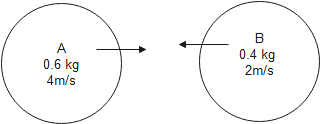
The velocities of two steel balls before impact are shown. If after head on impact the velocity of ball B is observed to be $3m/s$ to the right, the coefficient of restitution is:
Answer
 Verified
508.5k+ views
Hint: We know that coefficient of restitution is the ratio between the velocities after collision to that of the velocity before collision. Thus, to find the coefficient of restitution, we need to find the velocities and then use it to find the required answer.
Formula used:
$e=\dfrac{vel\; after\; collision}{vel\; before\;collision}$
Complete step-by-step answer:
We know that the coefficient of restitution is defined as the ratio between the velocity after collision to that of the velocity before collision. It is given as $e=\dfrac{vel\; after\; collision}{vel\; before\;collision}$
Here let us consider that the momentum of the balls is conserved, i.e. the momentum before and after collision are equal.
We know that the initial momentum is the sum of the momentum of A and B due to initial velocities.
Let $P_i=m_au_a+m_bu_b$, and $P_f=m_av_a+m_bv_b$where, are the masses , is the initial velocities and is the final velocities of of the balls A and B respectively.
We are given the mass and the initial velocity of the balls A and B, then we can say that
$P_i=0.6\times 4 + 0.4\times 2$
$\implies P_i=2.4 +0.8$
$\implies P_i=3.2$
Similarly, the final momentum is given as $P_f=m_av_a+m_bv_b$, then we have
$P_f=0.4\times 3+0.6\times v_b$,
$\implies P_f=1.2+0.6\times v_b$,
If $P_i=P_f$, we have
$\implies 3.2=1.2+0.6\times v_b$,
$\implies 2.0=0.6\times v_b$
$\therefore v_b=\dfrac{20}{6}$
We know that $e=\dfrac{vel\; after\; collision}{vel\; before\;collision}$
$e=\dfrac{V}{U}$
Clearly after collision, A and B will move away from each other, thus we have
$e=\dfrac{v_a-v_b}{u_a+u_b}$
$\implies e=\dfrac{2-\dfrac{20}{6}}{2+4}$
$\implies e=\dfrac{12-20}{6\times 6}$
$\implies e=\dfrac{-8}{36}$
$\therefore e=\dfrac{-2}{9}$
Thus the coefficient of restitution of the given problem is $\therefore e=\dfrac{-2}{9}$
Note: Here, since we have to find both the final velocity and the coefficient of restitution, we can use the principle of conservation of momentum. Since all the bodies on earth, irrespective of the shape, size or the speed in which they interact, we know that their momentum is conserved.
Formula used:
$e=\dfrac{vel\; after\; collision}{vel\; before\;collision}$
Complete step-by-step answer:
We know that the coefficient of restitution is defined as the ratio between the velocity after collision to that of the velocity before collision. It is given as $e=\dfrac{vel\; after\; collision}{vel\; before\;collision}$
Here let us consider that the momentum of the balls is conserved, i.e. the momentum before and after collision are equal.
We know that the initial momentum is the sum of the momentum of A and B due to initial velocities.
Let $P_i=m_au_a+m_bu_b$, and $P_f=m_av_a+m_bv_b$where, are the masses , is the initial velocities and is the final velocities of of the balls A and B respectively.
We are given the mass and the initial velocity of the balls A and B, then we can say that
$P_i=0.6\times 4 + 0.4\times 2$
$\implies P_i=2.4 +0.8$
$\implies P_i=3.2$
Similarly, the final momentum is given as $P_f=m_av_a+m_bv_b$, then we have
$P_f=0.4\times 3+0.6\times v_b$,
$\implies P_f=1.2+0.6\times v_b$,
If $P_i=P_f$, we have
$\implies 3.2=1.2+0.6\times v_b$,
$\implies 2.0=0.6\times v_b$
$\therefore v_b=\dfrac{20}{6}$
We know that $e=\dfrac{vel\; after\; collision}{vel\; before\;collision}$
$e=\dfrac{V}{U}$
Clearly after collision, A and B will move away from each other, thus we have
$e=\dfrac{v_a-v_b}{u_a+u_b}$
$\implies e=\dfrac{2-\dfrac{20}{6}}{2+4}$
$\implies e=\dfrac{12-20}{6\times 6}$
$\implies e=\dfrac{-8}{36}$
$\therefore e=\dfrac{-2}{9}$
Thus the coefficient of restitution of the given problem is $\therefore e=\dfrac{-2}{9}$
Note: Here, since we have to find both the final velocity and the coefficient of restitution, we can use the principle of conservation of momentum. Since all the bodies on earth, irrespective of the shape, size or the speed in which they interact, we know that their momentum is conserved.
Recently Updated Pages
Master Class 11 Computer Science: Engaging Questions & Answers for Success

Master Class 11 Business Studies: Engaging Questions & Answers for Success
Master Class 11 Economics: Engaging Questions & Answers for Success
Master Class 11 English: Engaging Questions & Answers for Success
Master Class 11 Maths: Engaging Questions & Answers for Success
Master Class 11 Biology: Engaging Questions & Answers for Success
Trending doubts
One Metric ton is equal to kg A 10000 B 1000 C 100 class 11 physics CBSE
There are 720 permutations of the digits 1 2 3 4 5 class 11 maths CBSE
Discuss the various forms of bacteria class 11 biology CBSE
Draw a diagram of a plant cell and label at least eight class 11 biology CBSE
State the laws of reflection of light
Explain zero factorial class 11 maths CBSE