




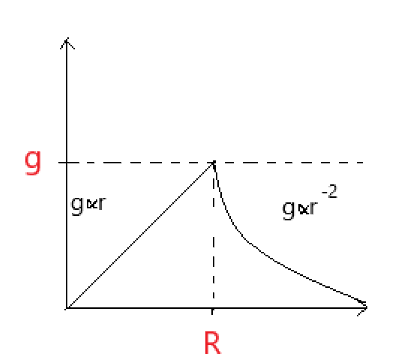
The variation of g with height or depth (r) is shown correctly by the graph in figure (where R is the radius of the earth).
A.
B.
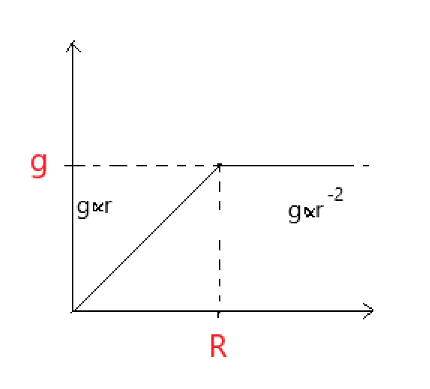
C.
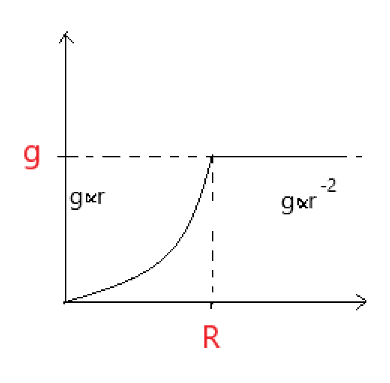
D.
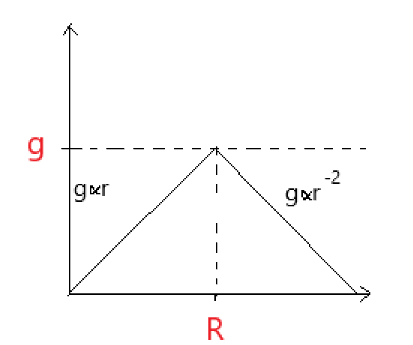
Answer
 Verified
644.1k+ views
Hint: For this question we start with the equation for g with respect to distance r from the center of the earth with mass M and radius R that is $g = \dfrac{{GM}}{{{r^2}}}$ . Then we find the expression of g when r< R that is ${g^1} = g\left( {1 - \dfrac{{2r}}{R}} \right)$ and when r>R that is ${g^1} = g{\left( {1 + \dfrac{r}{R}} \right)^{ - 2}}$ from these we get the relation of g with respect to r as $ \Rightarrow {g^1} \propto \left( {R - 2r} \right)$ and $ \Rightarrow {g^1} \propto \dfrac{1}{{{r^2}}}$ respectively.
Complete Step-by-Step solution:
We know that the acceleration due to gravity is denoted by the symbol g and is defined as the acceleration of an object because of the force acting on that object by the gravitational field of Earth. This force is written as
$F = mg$
Here m is the mass of the object. If $m = 1$, we get
$F = g$
This also says that g is the force on the unit mass. The g is independent of the mass of the body and can be accurately calculated in various ways.
Now we will try to see the variation of g with respect to height h. So let us assume an object of mass m, then the measure of the gravitational field strength $g$, at a distance r from the center of the earth with mass $M$ is given by:
$g = \dfrac{{GM}}{{{r^2}}}$
Now take the object at the surface of the earth that is r=R as shown in figure 1.
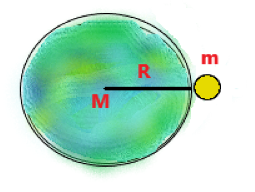
Here R is the radius of the earth. We get
$g = \dfrac{{GM}}{{{R^2}}}$-------------------------------- (1)
Now we assume that the object is at a height H from the surface of the earth as shown in figure 2.
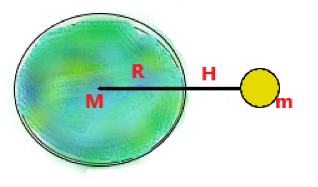
${g^1} = \dfrac{{GM}}{{{{\left( {R + H} \right)}^2}}}$--------------------------- (2)
Now dividing equation (2) by (1) we get
${g^1} = \dfrac{{g{R^2}}}{{{{\left( {R + H} \right)}^2}}}$
$ \Rightarrow {g^1} = \dfrac{g}{{{{\left( {1 + \dfrac{H}{R}} \right)}^2}}}$
$ \Rightarrow {g^1} = g{\left( {1 + \dfrac{H}{R}} \right)^{ - 2}}$-------------------------(3)
This expression is used when $\dfrac{H}{R} \geqslant 1$ that is when the object is at a distance greater than the earth radius.
But when $\dfrac{H}{R} < 1$ we can Apply the binomial expansion and we will get
$ \Rightarrow {g^1} = g\left( {1 - \dfrac{{2H}}{R}} \right)$--------------------------- (4)
From these we can conclude that
Region 1: When $r \leqslant R$ we can write
$ \Rightarrow {g^1} = g\left( {1 - \dfrac{{2r}}{R}} \right)$
$ \Rightarrow {g^1} \propto \left( {R - 2r} \right)$
Region 2: When $r \geqslant R$ we can write
$ \Rightarrow {g^1} = g{\left( {1 + \dfrac{r}{R}} \right)^{ - 2}}$
$ \Rightarrow {g^1} \propto \dfrac{1}{{{r^2}}}$
So the graph we get is shown in figure 3
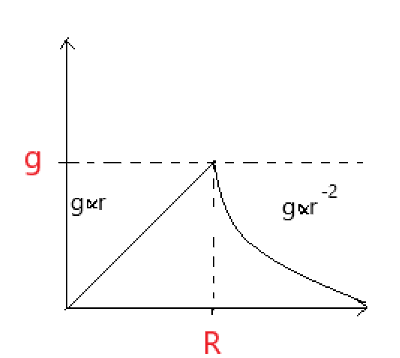
Figure 3
Hence option A is correct.
Note: We can also solve this question in a different way that is we get the expression of g with respect to r when $r < R$ as $g = \dfrac{{GM}}{{{R^3}}}r$ and when $r > R$ we get $g = \dfrac{{GM}}{{{r^2}}}$. By using these also we can plot the required graph.
Complete Step-by-Step solution:
We know that the acceleration due to gravity is denoted by the symbol g and is defined as the acceleration of an object because of the force acting on that object by the gravitational field of Earth. This force is written as
$F = mg$
Here m is the mass of the object. If $m = 1$, we get
$F = g$
This also says that g is the force on the unit mass. The g is independent of the mass of the body and can be accurately calculated in various ways.
Now we will try to see the variation of g with respect to height h. So let us assume an object of mass m, then the measure of the gravitational field strength $g$, at a distance r from the center of the earth with mass $M$ is given by:
$g = \dfrac{{GM}}{{{r^2}}}$
Now take the object at the surface of the earth that is r=R as shown in figure 1.
Figure 1
Here R is the radius of the earth. We get
$g = \dfrac{{GM}}{{{R^2}}}$-------------------------------- (1)
Now we assume that the object is at a height H from the surface of the earth as shown in figure 2.
Figure 2
${g^1} = \dfrac{{GM}}{{{{\left( {R + H} \right)}^2}}}$--------------------------- (2)
Now dividing equation (2) by (1) we get
${g^1} = \dfrac{{g{R^2}}}{{{{\left( {R + H} \right)}^2}}}$
$ \Rightarrow {g^1} = \dfrac{g}{{{{\left( {1 + \dfrac{H}{R}} \right)}^2}}}$
$ \Rightarrow {g^1} = g{\left( {1 + \dfrac{H}{R}} \right)^{ - 2}}$-------------------------(3)
This expression is used when $\dfrac{H}{R} \geqslant 1$ that is when the object is at a distance greater than the earth radius.
But when $\dfrac{H}{R} < 1$ we can Apply the binomial expansion and we will get
$ \Rightarrow {g^1} = g\left( {1 - \dfrac{{2H}}{R}} \right)$--------------------------- (4)
From these we can conclude that
Region 1: When $r \leqslant R$ we can write
$ \Rightarrow {g^1} = g\left( {1 - \dfrac{{2r}}{R}} \right)$
$ \Rightarrow {g^1} \propto \left( {R - 2r} \right)$
Region 2: When $r \geqslant R$ we can write
$ \Rightarrow {g^1} = g{\left( {1 + \dfrac{r}{R}} \right)^{ - 2}}$
$ \Rightarrow {g^1} \propto \dfrac{1}{{{r^2}}}$
So the graph we get is shown in figure 3
Figure 3
Hence option A is correct.
Note: We can also solve this question in a different way that is we get the expression of g with respect to r when $r < R$ as $g = \dfrac{{GM}}{{{R^3}}}r$ and when $r > R$ we get $g = \dfrac{{GM}}{{{r^2}}}$. By using these also we can plot the required graph.
Recently Updated Pages
Master Class 11 English: Engaging Questions & Answers for Success

Master Class 11 Social Science: Engaging Questions & Answers for Success
Master Class 11 Maths: Engaging Questions & Answers for Success
Master Class 11 Biology: Engaging Questions & Answers for Success
Master Class 11 Physics: Engaging Questions & Answers for Success
Master Class 11 Chemistry: Engaging Questions & Answers for Success
Trending doubts
Explain the Treaty of Vienna of 1815 class 10 social science CBSE
What is the full form of POSCO class 10 social science CBSE
Define Potential, Developed, Stock and Reserved resources
The diagonals of a rhombus are 10cm and 24cm Find the class 10 maths CBSE
Fill the blanks with proper collective nouns 1 A of class 10 english CBSE
What planets have no moons Which one has only one moon class 10 physics CBSE