




The value of g at a certain height h above the free surface of the earth is $\dfrac{x}{4}$ where $x$ is the value of g at the surface of the earth is. The height h is
A. R
B. 2R
C. 3R
D. 4R
Answer
 Verified
634.5k+ views
Hint: In this question, we first start by writing the general expression of g that is $g = \dfrac{{GM}}{{{r^2}}}$ then using this we write the expression of $x$ which is g when $r = R$ that is $x = \dfrac{{GM}}{{{R^2}}}$. Similarly we write the expression of $\dfrac{x}{4}$ which is g when $r = R + h$ that is $\dfrac{x}{4} = \dfrac{{GM}}{{{{\left( {R + h} \right)}^2}}}$ now equating the $x$ in both the equation we will get height \[h = R\].
Complete Step-by-Step solution:
We all know that the acceleration due to gravity is denoted by the symbol g and is defined as the acceleration of an object because of the force acting on that object by the gravitational field of Earth.
So we start by writing the expression for acceleration due to gravity g when an object of mass m is placed at a distance r from the center of the earth with mass M and radius R is given as:
$g = \dfrac{{GM}}{{{r^2}}}$
Now in this question, it is given that the acceleration due to gravity g when the object is on the surface of the earth that is when $r = R$ is equal to $x$ as can be seen from figure 1.

So we can write the expression for $x$ as:
$x = \dfrac{{GM}}{{{R^2}}}$-------------------------------(1)
Also, it is given that the acceleration due to gravity g when the object is placed at a height h above the surface of the earth that is when $r = R + h$ is equal to $\dfrac{x}{4}$ as can be seen from the figure 2.
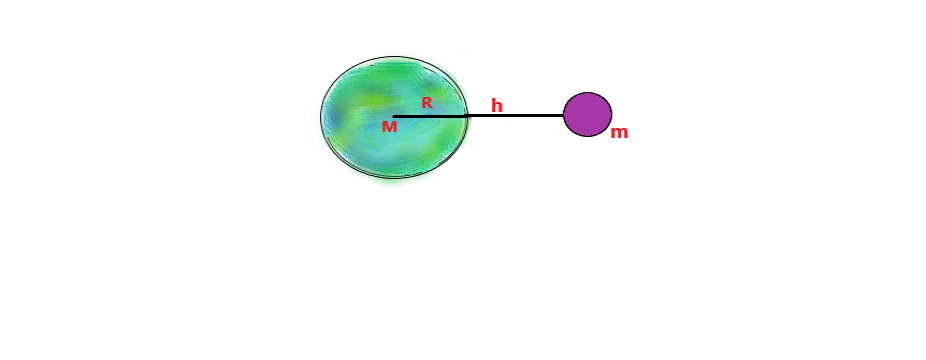
Similarly we can write the expression for $\dfrac{x}{4}$ as:
$\dfrac{x}{4} = \dfrac{{GM}}{{{{\left( {R + h} \right)}^2}}}$----------------------------- (2)
Now we take ${R^2}$ common from the denomination and get
$ \Rightarrow \dfrac{x}{4} = \dfrac{{GM}}{{{R^2}{{\left( {1 + \dfrac{h}{R}} \right)}^2}}}$
$ \Rightarrow \dfrac{x}{4} = \dfrac{{GM}}{{{R^2}}} \times \dfrac{1}{{{{\left( {1 + \dfrac{h}{R}} \right)}^2}}}$---------------------- (3)
Now using equation (1) we can replace $\dfrac{{GM}}{{{R^2}}} = x$ in equation number (3)
$ \Rightarrow \dfrac{{{x}}}{4} =l{x} \times \dfrac{1}{{{{\left( {1 + \dfrac{h}{R}} \right)}^2}}}$
$ \Rightarrow \dfrac{1}{4} = \dfrac{1}{{{{\left( {1 + \dfrac{h}{R}} \right)}^2}}}$
$ \Rightarrow 4 = {\left( {1 + \dfrac{h}{R}} \right)^2}$
Taking square root on both sides we will get
$ \Rightarrow 2 = \pm \left( {1 + \dfrac{h}{R}} \right)$
Taking $2 = + \left( {1 + \dfrac{h}{R}} \right)$ we will get
\[ \Rightarrow 2 - 1 = \dfrac{h}{R}\]
\[ \Rightarrow 1 = \dfrac{h}{R}\]
\[ \Rightarrow h = R\]
Hence the height h is equal to R that is the radius of the earth. So option A is correct.
Note: For these types of questions we need to have a clear understanding of how the acceleration due to gravity varies with the position of the object from the center of the earth that is $g = \dfrac{{GM}}{{{r^2}}}$. We also need to remember the different forms of this equation that are when the object is at distance r < R, r = R, and r > R.
Complete Step-by-Step solution:
We all know that the acceleration due to gravity is denoted by the symbol g and is defined as the acceleration of an object because of the force acting on that object by the gravitational field of Earth.
So we start by writing the expression for acceleration due to gravity g when an object of mass m is placed at a distance r from the center of the earth with mass M and radius R is given as:
$g = \dfrac{{GM}}{{{r^2}}}$
Now in this question, it is given that the acceleration due to gravity g when the object is on the surface of the earth that is when $r = R$ is equal to $x$ as can be seen from figure 1.
Figure 1
So we can write the expression for $x$ as:
$x = \dfrac{{GM}}{{{R^2}}}$-------------------------------(1)
Also, it is given that the acceleration due to gravity g when the object is placed at a height h above the surface of the earth that is when $r = R + h$ is equal to $\dfrac{x}{4}$ as can be seen from the figure 2.
Figure 2
Similarly we can write the expression for $\dfrac{x}{4}$ as:
$\dfrac{x}{4} = \dfrac{{GM}}{{{{\left( {R + h} \right)}^2}}}$----------------------------- (2)
Now we take ${R^2}$ common from the denomination and get
$ \Rightarrow \dfrac{x}{4} = \dfrac{{GM}}{{{R^2}{{\left( {1 + \dfrac{h}{R}} \right)}^2}}}$
$ \Rightarrow \dfrac{x}{4} = \dfrac{{GM}}{{{R^2}}} \times \dfrac{1}{{{{\left( {1 + \dfrac{h}{R}} \right)}^2}}}$---------------------- (3)
Now using equation (1) we can replace $\dfrac{{GM}}{{{R^2}}} = x$ in equation number (3)
$ \Rightarrow \dfrac{{{x}}}{4} =l{x} \times \dfrac{1}{{{{\left( {1 + \dfrac{h}{R}} \right)}^2}}}$
$ \Rightarrow \dfrac{1}{4} = \dfrac{1}{{{{\left( {1 + \dfrac{h}{R}} \right)}^2}}}$
$ \Rightarrow 4 = {\left( {1 + \dfrac{h}{R}} \right)^2}$
Taking square root on both sides we will get
$ \Rightarrow 2 = \pm \left( {1 + \dfrac{h}{R}} \right)$
Taking $2 = + \left( {1 + \dfrac{h}{R}} \right)$ we will get
\[ \Rightarrow 2 - 1 = \dfrac{h}{R}\]
\[ \Rightarrow 1 = \dfrac{h}{R}\]
\[ \Rightarrow h = R\]
Hence the height h is equal to R that is the radius of the earth. So option A is correct.
Note: For these types of questions we need to have a clear understanding of how the acceleration due to gravity varies with the position of the object from the center of the earth that is $g = \dfrac{{GM}}{{{r^2}}}$. We also need to remember the different forms of this equation that are when the object is at distance r < R, r = R, and r > R.
Recently Updated Pages
Master Class 10 English: Engaging Questions & Answers for Success

Master Class 10 Social Science: Engaging Questions & Answers for Success
Master Class 10 Computer Science: Engaging Questions & Answers for Success
Class 10 Question and Answer - Your Ultimate Solutions Guide
Master Class 10 General Knowledge: Engaging Questions & Answers for Success
Master Class 10 Maths: Engaging Questions & Answers for Success
Trending doubts
Explain the Treaty of Vienna of 1815 class 10 social science CBSE
Who Won 36 Oscar Awards? Record Holder Revealed
What is the median of the first 10 natural numbers class 10 maths CBSE
Why is it 530 pm in india when it is 1200 afternoon class 10 social science CBSE
Define Potential, Developed, Stock and Reserved resources
Fill the blanks with proper collective nouns 1 A of class 10 english CBSE