




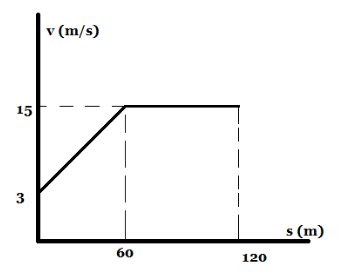
The $ v - s $ graph describing the motion of a motorcycle is shown in the figure. The time needed for the motorcycle to reach the position $ s = 120\;m $ [Given that $ \ln \;5 = 1.6 $ ] is $ 2\;x\;\sec $ , find $ x $ ?
Answer
 Verified
569.7k+ views
Hint: Here we find the relation between the velocity $ v $ and the displacement $ s $ for the two curves separately. For the first half of the journey till $ s = 60\;m $ we will formulate the equation of the curve as $ v = \dfrac{s}{5} + 3 $ . For the second half of the journey from $ s = 60\;m $ to $ s = 120{\mkern 1mu} m $ , we see that $ v = 15\;m/s $ . In both these equations, we will substitute $ v = \dfrac{{ds}}{{dt}} $ and solve the integrations with appropriate limits.
Formula used:
$ v = \dfrac{{ds}}{{dt}} $
Complete Step by step solution:
From the graph, we form the relationship between the velocity $ v $ and the displacement $ s $ for the first half of the journey, i.e. from $ s = 0\;m $ to $ s = 60\;m $ .
The slope of the graph can be determined by dividing the $ Y $ axis coordinates with the $ X $ axis coordinates. Thus we get the slope as
$ \dfrac{{15 - 3}}{{60 - 0}} = \dfrac{1}{5} $
Now considering the general $ Y $ axis coordinate as $ v $ and the $ X $ axis coordinate as $ s $ the equation of the line in slope point form will be
$ \dfrac{{v - 3}}{{s - 0}} = \dfrac{1}{5} $
$ \Rightarrow v = \dfrac{{s + 15}}{5} $
We know that
$ v = \dfrac{{ds}}{{dt}} $
Substituting the value of $ v $ from the above equation, we get
$ \dfrac{{ds}}{{dt}} = \dfrac{{s + 15}}{5} $
$ \Rightarrow \dfrac{{ds}}{{s + 15}} = \dfrac{{dt}}{5} $
Now integrating both sides of the equation, we get,
$ \Rightarrow \int {\dfrac{{ds}}{{s + 15}}} = \int {\dfrac{{dt}}{5}} $
Putting the limits of integration from $ s = 0\;m $ to $ s = 60\;m $ , we get,
$ \Rightarrow \int\limits_{s = 0}^{s = 60} {\dfrac{{ds}}{{s + 15}}} = \int\limits_{t = 0}^{t = t} {\dfrac{{dt}}{5}} $
$ \Rightarrow \left[ {\ln \;(s + 15)} \right]_0^{60} = \left[ {\dfrac{t}{5}} \right]_0^t $
Putting the values of the limits of the integration, we get,
$ \Rightarrow \left[ {\ln \;(60 + 15) - \ln \;(0 + 15)} \right] = \left[ {\dfrac{t}{5} - \dfrac{0}{5}} \right] $
$ \Rightarrow \left[ {\ln \;(75) - \ln \;(15)} \right] = \dfrac{t}{5} $
On further simplifying, we get,
$ \Rightarrow \dfrac{t}{5} = \ln \left( {\dfrac{{75}}{{15}}} \right) $
$ \Rightarrow \dfrac{t}{5} = \ln \left( 5 \right) $
$ \Rightarrow t = 5 \times \ln \left( 5 \right) $
It is given in the question that $ \ln \;5 = 1.6 $ . Substituting this value in the above equation, we get,
$ \Rightarrow t = 5 \times 1.6 $
$ \Rightarrow t = 8\;\sec $
This is the time taken for the motorcycle to reach $ s = 60\;m $ .
Now for the next half of the journey, i.e. from $ s = 60\;m $ to $ s = 120\;m $ , we can repeat the above process.
We see that the velocity for this half of the journey is constant, i.e. $ v = 15\;m/s $ .
Using this uniform velocity, and the relation $ v = \dfrac{{ds}}{{dt}} $ , we get,
$ v = 15\;m/s = \dfrac{{ds}}{{dt}} $
$ \Rightarrow \dfrac{{ds}}{{dt}} = 15 $
$ \Rightarrow ds = 15dt $
Integrating both sides, we get,
$ \Rightarrow \int {ds} = \int {15dt} $
We now have to substitute the limits carefully. The displacement $ s $ will vary from $ s = 60\;m $ to $ s = 120\;m $ . The time taken $ t $ will vary from $ t = 8\;\sec $ to $ t = t $ , such that the value of the time $ t $ will give the actual time taken by the motorcycle to travel the entire distance of $ 120\;m $ .
$ \Rightarrow \int\limits_{s = 60}^{s = 120} {ds} = \int\limits_{t = 8}^{t = t} {15dt} $
$ \Rightarrow \left[ s \right]_{60}^{120} = \left[ {15t} \right]_8^t $
Now calculating the limits properly, we obtain,
$ \Rightarrow \left[ {15{\mkern 1mu} (t - 8)} \right] = \left[ {120 - 60} \right] $
$ \Rightarrow t - 8 = \dfrac{{60}}{{15}} $
Upon rearranging the equation we get,
$ \Rightarrow t = 8 + 4 $
$ \Rightarrow t = 12\;\sec $
It is given that this time is equal to $ 2\;x $ .
Therefore $ 2x = 12\;\sec $ .
$ \Rightarrow x = 6 $
Thus the total time taken by the motorcycle to travel the entire distance of $ 120\;m $ is $ 12\;\sec $ with the value of $ x $ being $ 6 $ .
Note:
The motorcycle moves with some acceleration in the first half of the motion. In the second half of the motion, the acceleration of the motorcycle is $ 0 $ . Since the two graphs are two separate straight lines, we have analyzed them differently and have used the major relation $ v = \dfrac{{ds}}{{dt}} $ to simplify and integrate to get the solution.
Formula used:
$ v = \dfrac{{ds}}{{dt}} $
Complete Step by step solution:
From the graph, we form the relationship between the velocity $ v $ and the displacement $ s $ for the first half of the journey, i.e. from $ s = 0\;m $ to $ s = 60\;m $ .
The slope of the graph can be determined by dividing the $ Y $ axis coordinates with the $ X $ axis coordinates. Thus we get the slope as
$ \dfrac{{15 - 3}}{{60 - 0}} = \dfrac{1}{5} $
Now considering the general $ Y $ axis coordinate as $ v $ and the $ X $ axis coordinate as $ s $ the equation of the line in slope point form will be
$ \dfrac{{v - 3}}{{s - 0}} = \dfrac{1}{5} $
$ \Rightarrow v = \dfrac{{s + 15}}{5} $
We know that
$ v = \dfrac{{ds}}{{dt}} $
Substituting the value of $ v $ from the above equation, we get
$ \dfrac{{ds}}{{dt}} = \dfrac{{s + 15}}{5} $
$ \Rightarrow \dfrac{{ds}}{{s + 15}} = \dfrac{{dt}}{5} $
Now integrating both sides of the equation, we get,
$ \Rightarrow \int {\dfrac{{ds}}{{s + 15}}} = \int {\dfrac{{dt}}{5}} $
Putting the limits of integration from $ s = 0\;m $ to $ s = 60\;m $ , we get,
$ \Rightarrow \int\limits_{s = 0}^{s = 60} {\dfrac{{ds}}{{s + 15}}} = \int\limits_{t = 0}^{t = t} {\dfrac{{dt}}{5}} $
$ \Rightarrow \left[ {\ln \;(s + 15)} \right]_0^{60} = \left[ {\dfrac{t}{5}} \right]_0^t $
Putting the values of the limits of the integration, we get,
$ \Rightarrow \left[ {\ln \;(60 + 15) - \ln \;(0 + 15)} \right] = \left[ {\dfrac{t}{5} - \dfrac{0}{5}} \right] $
$ \Rightarrow \left[ {\ln \;(75) - \ln \;(15)} \right] = \dfrac{t}{5} $
On further simplifying, we get,
$ \Rightarrow \dfrac{t}{5} = \ln \left( {\dfrac{{75}}{{15}}} \right) $
$ \Rightarrow \dfrac{t}{5} = \ln \left( 5 \right) $
$ \Rightarrow t = 5 \times \ln \left( 5 \right) $
It is given in the question that $ \ln \;5 = 1.6 $ . Substituting this value in the above equation, we get,
$ \Rightarrow t = 5 \times 1.6 $
$ \Rightarrow t = 8\;\sec $
This is the time taken for the motorcycle to reach $ s = 60\;m $ .
Now for the next half of the journey, i.e. from $ s = 60\;m $ to $ s = 120\;m $ , we can repeat the above process.
We see that the velocity for this half of the journey is constant, i.e. $ v = 15\;m/s $ .
Using this uniform velocity, and the relation $ v = \dfrac{{ds}}{{dt}} $ , we get,
$ v = 15\;m/s = \dfrac{{ds}}{{dt}} $
$ \Rightarrow \dfrac{{ds}}{{dt}} = 15 $
$ \Rightarrow ds = 15dt $
Integrating both sides, we get,
$ \Rightarrow \int {ds} = \int {15dt} $
We now have to substitute the limits carefully. The displacement $ s $ will vary from $ s = 60\;m $ to $ s = 120\;m $ . The time taken $ t $ will vary from $ t = 8\;\sec $ to $ t = t $ , such that the value of the time $ t $ will give the actual time taken by the motorcycle to travel the entire distance of $ 120\;m $ .
$ \Rightarrow \int\limits_{s = 60}^{s = 120} {ds} = \int\limits_{t = 8}^{t = t} {15dt} $
$ \Rightarrow \left[ s \right]_{60}^{120} = \left[ {15t} \right]_8^t $
Now calculating the limits properly, we obtain,
$ \Rightarrow \left[ {15{\mkern 1mu} (t - 8)} \right] = \left[ {120 - 60} \right] $
$ \Rightarrow t - 8 = \dfrac{{60}}{{15}} $
Upon rearranging the equation we get,
$ \Rightarrow t = 8 + 4 $
$ \Rightarrow t = 12\;\sec $
It is given that this time is equal to $ 2\;x $ .
Therefore $ 2x = 12\;\sec $ .
$ \Rightarrow x = 6 $
Thus the total time taken by the motorcycle to travel the entire distance of $ 120\;m $ is $ 12\;\sec $ with the value of $ x $ being $ 6 $ .
Note:
The motorcycle moves with some acceleration in the first half of the motion. In the second half of the motion, the acceleration of the motorcycle is $ 0 $ . Since the two graphs are two separate straight lines, we have analyzed them differently and have used the major relation $ v = \dfrac{{ds}}{{dt}} $ to simplify and integrate to get the solution.
Recently Updated Pages
Master Class 11 Business Studies: Engaging Questions & Answers for Success

Master Class 11 Computer Science: Engaging Questions & Answers for Success
Master Class 11 Economics: Engaging Questions & Answers for Success
Master Class 11 Social Science: Engaging Questions & Answers for Success
Master Class 11 English: Engaging Questions & Answers for Success
Master Class 11 Chemistry: Engaging Questions & Answers for Success
Trending doubts
Draw a diagram of nephron and explain its structur class 11 biology CBSE
Explain zero factorial class 11 maths CBSE
Chemical formula of Bleaching powder is A Ca2OCl2 B class 11 chemistry CBSE
Name the part of the brain responsible for the precision class 11 biology CBSE
The growth of tendril in pea plants is due to AEffect class 11 biology CBSE
One Metric ton is equal to kg A 10000 B 1000 C 100 class 11 physics CBSE