




The typical Lubb-Dupp sounds heard in the heartbeat of a healthy person are due to
A. Closing of the tricuspid and bicuspid valve
B. Blood flow through the aorta
C. Closing of the tricuspid and semilunar valves
D. Closing of the semilunar valves
Answer
 Verified
648k+ views
Hint: Lubb is the first sound and dupp is the second sound produced by a normal heart. Human heart has a well developed network of valves in order to carry out blood flow efficiently in the right direction.
Complete answer:
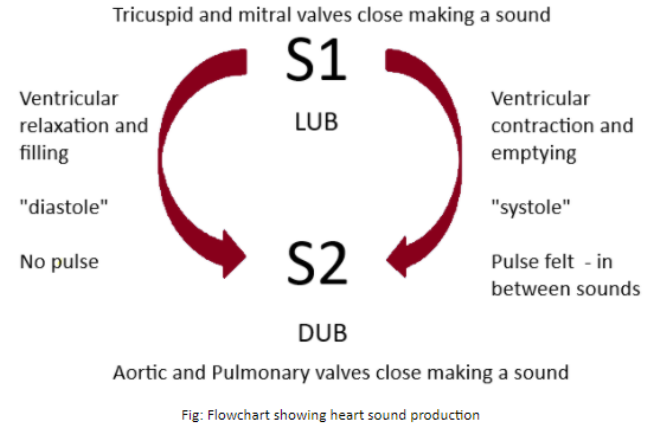
Physiologically, four heart sounds are produced per cardiac cycle, but in a normal heart, only the first and second heart sounds because these are loud enough to be heard through a stethoscope. The first heart sound is significantly low-pitched, soft, and relatively long, sounding like lubb. The second heart sound has a higher pitch and is shorter and sharper, sounding like dupp. Thus one normally hears “lubb-dupp-lubb-dupp…..”. The first sound is associated with the closure of the tricuspid valve, whereas the second sound is associated with the closure of the semilunar valves (the pulmonary valve and the aortic valve). Thus, the first prominent sound is heard when the ventricles contract at systole, and the second sound is heard when the ventricles relax at the beginning of diastole. No sound is produced by the opening of valves.
So, the correct answer is ‘closing of the tricuspid and semilunar valves’.
Note: - The tricuspid valve is present between the right atrium from the right ventricle. It is called tricuspid due to the presence of three cusps.
- Semilunar valves are located between the ventricles and the outflow vessels. They prevent the backflow of the blood.
Complete answer:
Physiologically, four heart sounds are produced per cardiac cycle, but in a normal heart, only the first and second heart sounds because these are loud enough to be heard through a stethoscope. The first heart sound is significantly low-pitched, soft, and relatively long, sounding like lubb. The second heart sound has a higher pitch and is shorter and sharper, sounding like dupp. Thus one normally hears “lubb-dupp-lubb-dupp…..”. The first sound is associated with the closure of the tricuspid valve, whereas the second sound is associated with the closure of the semilunar valves (the pulmonary valve and the aortic valve). Thus, the first prominent sound is heard when the ventricles contract at systole, and the second sound is heard when the ventricles relax at the beginning of diastole. No sound is produced by the opening of valves.
So, the correct answer is ‘closing of the tricuspid and semilunar valves’.
Note: - The tricuspid valve is present between the right atrium from the right ventricle. It is called tricuspid due to the presence of three cusps.
- Semilunar valves are located between the ventricles and the outflow vessels. They prevent the backflow of the blood.
Recently Updated Pages
Master Class 11 Social Science: Engaging Questions & Answers for Success

Master Class 11 English: Engaging Questions & Answers for Success
Master Class 11 Accountancy: Engaging Questions & Answers for Success
Master Class 11 Physics: Engaging Questions & Answers for Success
Master Class 11 Computer Science: Engaging Questions & Answers for Success
Master Class 11 Business Studies: Engaging Questions & Answers for Success
Trending doubts
One Metric ton is equal to kg A 10000 B 1000 C 100 class 11 physics CBSE
Find the value of the expression given below sin 30circ class 11 maths CBSE
Draw a diagram of nephron and explain its structur class 11 biology CBSE
10 examples of friction in our daily life
Proton was discovered by A Thomson B Rutherford C Chadwick class 11 chemistry CBSE
The teeth used for biting and cutting food are called class 11 biology CBSE