




The type of epithelial cells which line in the inner surface of the fallopian tubes, bronchioles, and small bronchi are known as
(a)Squamous epithelium
(b)Columnar epithelium
(c)Ciliated epithelium
(d)Cuboidal epithelium
Answer
 Verified
654.6k+ views
Hint: They are the simple thin tissues having hair-like structures on their outer surface that helps in the movement of certain substances or particles. They are present mostly in the lining of the various organs.
Complete answer:
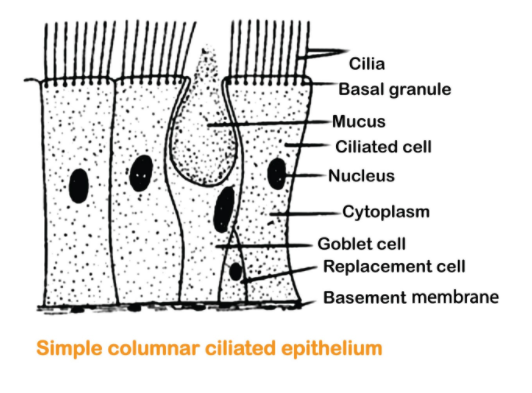
The ciliated epithelium is found in the lining of the fallopian tubes, bronchioles, and small bronchi. The cilia are the hair-like structures that are present on the cell and help in the movement of various particles.
Additional Information: -The epithelium is a layer of cells closely bound to each other resulting in the formation of a continuous sheet. In animals’ modification of these cells with outgrowth and ingrowth is commonly seen.
-According to the surrounding the epithelium can be protective (may produce outgrowth like nails, horns on animals), absorptive, or secretory (sebaceous gland and mammary glands).
-When the cells of an epithelial surface are several layers deep, they can be distinguished into: stratified (mouth, esophagus, rectum), stratified ciliated (a respiratory passage, the vas deferens, and the epididymis), and transitional epithelium (urinary bladder).
-Ciliated epithelium is also known as the respiratory epithelium as it is generally found in the lining of the respiratory tract.
-It prevents infection and other diseases by preventing the pathogens from entering by preventing foreign particles or other substances from entering the body.
-The cells are attached to the basement membrane, single-layered with a nucleus in each cell.
-The outer surface of the cell has cilia that act in the movement of the various substances.
So, the correct answer is ‘Ciliated epithelium’.
Note: The cells of the epithelial can be of various types like columnar, simple, squamous, irregular, or ciliated. The columnar epithelium covers the intestinal tract from the end of the esophagus to the rectum. The cubical epithelium is found in many glands and ducts like in the kidney. Ciliated epithelium lines the trachea, bronchi of the lungs, nasal cavities, uterus, and oviducts of female and in male epididymis and vasa deferens.
Complete answer:
The ciliated epithelium is found in the lining of the fallopian tubes, bronchioles, and small bronchi. The cilia are the hair-like structures that are present on the cell and help in the movement of various particles.
Additional Information: -The epithelium is a layer of cells closely bound to each other resulting in the formation of a continuous sheet. In animals’ modification of these cells with outgrowth and ingrowth is commonly seen.
-According to the surrounding the epithelium can be protective (may produce outgrowth like nails, horns on animals), absorptive, or secretory (sebaceous gland and mammary glands).
-When the cells of an epithelial surface are several layers deep, they can be distinguished into: stratified (mouth, esophagus, rectum), stratified ciliated (a respiratory passage, the vas deferens, and the epididymis), and transitional epithelium (urinary bladder).
-Ciliated epithelium is also known as the respiratory epithelium as it is generally found in the lining of the respiratory tract.
-It prevents infection and other diseases by preventing the pathogens from entering by preventing foreign particles or other substances from entering the body.
-The cells are attached to the basement membrane, single-layered with a nucleus in each cell.
-The outer surface of the cell has cilia that act in the movement of the various substances.
So, the correct answer is ‘Ciliated epithelium’.
Note: The cells of the epithelial can be of various types like columnar, simple, squamous, irregular, or ciliated. The columnar epithelium covers the intestinal tract from the end of the esophagus to the rectum. The cubical epithelium is found in many glands and ducts like in the kidney. Ciliated epithelium lines the trachea, bronchi of the lungs, nasal cavities, uterus, and oviducts of female and in male epididymis and vasa deferens.
Recently Updated Pages
If x a + bt + ct2 where x is in meters and t is in class 11 physics CBSE

A car covers the first half distance between two places class 11 physics CBSE
The resultant of two vectors overrightarrow P and overrightarrow class 11 physics CBSE
Find the value of cos 135 class 11 maths CBSE
A mass M is held in place by an applied force F and class 11 physics CBSE
A solution of glucose in water is labelled as 10 dfracwv class 11 chemistry CBSE
Trending doubts
One Metric ton is equal to kg A 10000 B 1000 C 100 class 11 physics CBSE
Find the value of the expression given below sin 30circ class 11 maths CBSE
What do you mean by retardation What is its SI uni class 11 physics CBSE
Draw a diagram of nephron and explain its structur class 11 biology CBSE
10 examples of friction in our daily life
Difference between physical and chemical change class 11 chemistry CBSE