




The total surface area of a right circular cone of slant height 20cm is \[384\pi c{{m}^{2}}\].
Calculate (i) the radius in cm.
(ii) its volume in \[c{{m}^{3}}\], in terms of \[\pi \].
Answer
 Verified
646.2k+ views
Hint: Use the formula for total surface area of the cone and substitute the value given to get the radius of one. Then find height with known values of radius of slant height. Substitute these values in thevoulme formula to get volume of the cone.
Complete step-by-step answer:
Consider the figure drawn below.
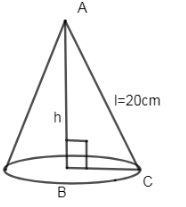
Let l be the slant height of the cone, h be the height of the cone and r be the radius of base of the cone.
We have been given the slant height, l = 20cm.
The total surface area of the right circular cone is \[384\pi c{{m}^{2}}\].
The total surface area of a cone is the sum of the area of its base and the lateral (side) surface. The lateral surface of a cone is the area of the lateral or side surface only which is given as \[\pi rl\].
Total surface area (TSA) = lateral surface area (LSA) + area of the base.
The base of the cone is in the form of a circle, thus the area will be \[\pi {{r}^{2}}\].
\[\therefore \] TSA = LSA + area of the base \[=\pi rl+\pi {{r}^{2}}\]
TSA \[=\pi r\left( l+r \right)-(1)\]
We have been given the value of TSA as \[384\pi c{{m}^{2}}\]. Let us substitute this value in equation (1) and get the radius r and l = 20.
\[\begin{align}
& 384\pi =\pi r\left( l+r \right) \\
& 384\pi =\pi r\left( 20+r \right) \\
\end{align}\]
Cancel \[\pi \] on LHS and RHS.
\[384=20r+{{r}^{2}}\]
\[\Rightarrow {{r}^{2}}+20r-384=0\]
The above expression is similar to the quadratic formula \[a{{x}^{2}}+bx+c=0\]. Compare both equations and we get the value as,
a = 1, b = 20, c = -384.
Substitute these values in the quadratic formula.
\[\begin{align}
& r=\dfrac{-b\pm \sqrt{{{b}^{2}}-4ac}}{2a}=\dfrac{-20\pm \sqrt{{{\left( 20 \right)}^{2}}-4\times 1\times \left( -384 \right)}}{2\times 1} \\
& r=\dfrac{-20\pm \sqrt{400+1536}}{2}=\dfrac{-20\pm \sqrt{1936}}{2}=\dfrac{-201\pm 44}{2} \\
\end{align}\]
\[\therefore r=\dfrac{-20+44}{2}\] and \[r=\dfrac{-20-44}{2}=\dfrac{-64}{2}=-32\].
\[r=\dfrac{24}{2}=12\]
Thus take radius, r = 12cm.
Thus we got the radius of the right circular cone as 12cm.
Now let us find the volume of cone.
We know the formula for getting the volume of cone \[=\dfrac{1}{3}\pi {{r}^{2}}h\].
By looking in the figure, ABC is the right angled triangle. So by using Pythagoras theorem, we can say that
\[A{{B}^{2}}+B{{C}^{2}}=A{{C}^{2}}\]
\[{{h}^{2}}+{{r}^{2}}={{l}^{2}}\]
\[\Rightarrow {{h}^{2}}={{l}^{2}}-{{r}^{2}}\] , where l = 20cm, r = 12cm
\[\therefore h=\sqrt{{{l}^{2}}-{{r}^{2}}}=\sqrt{{{20}^{2}}-{{12}^{2}}}=\sqrt{400-144}\]
\[h=\sqrt{256}=16\]cm.
\[\therefore \] Volume of cone \[=\dfrac{1}{3}\pi {{r}^{2}}h\]
\[\begin{align}
& =\dfrac{1}{3}\pi {{\left( 12 \right)}^{2}}\times 16 \\
& =\dfrac{1}{3}\pi \times 12\times 12\times 16 \\
& =768\pi c{{m}^{3}} \\
\end{align}\]
\[\therefore \] Radius of the right circular cone, r = 12cm.
\[\therefore \] Volume of the right circular cone = V \[=768\pi c{{m}^{3}}\].
Note: We have neglected, r = -32 cm as radius can never be negative. Thus take the value of radius, r = 12cm. If we get the value of radius, then from the figure you can get the height of the cone, as it is right angled by the base.
Complete step-by-step answer:
Consider the figure drawn below.
Let l be the slant height of the cone, h be the height of the cone and r be the radius of base of the cone.
We have been given the slant height, l = 20cm.
The total surface area of the right circular cone is \[384\pi c{{m}^{2}}\].
The total surface area of a cone is the sum of the area of its base and the lateral (side) surface. The lateral surface of a cone is the area of the lateral or side surface only which is given as \[\pi rl\].
Total surface area (TSA) = lateral surface area (LSA) + area of the base.
The base of the cone is in the form of a circle, thus the area will be \[\pi {{r}^{2}}\].
\[\therefore \] TSA = LSA + area of the base \[=\pi rl+\pi {{r}^{2}}\]
TSA \[=\pi r\left( l+r \right)-(1)\]
We have been given the value of TSA as \[384\pi c{{m}^{2}}\]. Let us substitute this value in equation (1) and get the radius r and l = 20.
\[\begin{align}
& 384\pi =\pi r\left( l+r \right) \\
& 384\pi =\pi r\left( 20+r \right) \\
\end{align}\]
Cancel \[\pi \] on LHS and RHS.
\[384=20r+{{r}^{2}}\]
\[\Rightarrow {{r}^{2}}+20r-384=0\]
The above expression is similar to the quadratic formula \[a{{x}^{2}}+bx+c=0\]. Compare both equations and we get the value as,
a = 1, b = 20, c = -384.
Substitute these values in the quadratic formula.
\[\begin{align}
& r=\dfrac{-b\pm \sqrt{{{b}^{2}}-4ac}}{2a}=\dfrac{-20\pm \sqrt{{{\left( 20 \right)}^{2}}-4\times 1\times \left( -384 \right)}}{2\times 1} \\
& r=\dfrac{-20\pm \sqrt{400+1536}}{2}=\dfrac{-20\pm \sqrt{1936}}{2}=\dfrac{-201\pm 44}{2} \\
\end{align}\]
\[\therefore r=\dfrac{-20+44}{2}\] and \[r=\dfrac{-20-44}{2}=\dfrac{-64}{2}=-32\].
\[r=\dfrac{24}{2}=12\]
Thus take radius, r = 12cm.
Thus we got the radius of the right circular cone as 12cm.
Now let us find the volume of cone.
We know the formula for getting the volume of cone \[=\dfrac{1}{3}\pi {{r}^{2}}h\].
By looking in the figure, ABC is the right angled triangle. So by using Pythagoras theorem, we can say that
\[A{{B}^{2}}+B{{C}^{2}}=A{{C}^{2}}\]
\[{{h}^{2}}+{{r}^{2}}={{l}^{2}}\]
\[\Rightarrow {{h}^{2}}={{l}^{2}}-{{r}^{2}}\] , where l = 20cm, r = 12cm
\[\therefore h=\sqrt{{{l}^{2}}-{{r}^{2}}}=\sqrt{{{20}^{2}}-{{12}^{2}}}=\sqrt{400-144}\]
\[h=\sqrt{256}=16\]cm.
\[\therefore \] Volume of cone \[=\dfrac{1}{3}\pi {{r}^{2}}h\]
\[\begin{align}
& =\dfrac{1}{3}\pi {{\left( 12 \right)}^{2}}\times 16 \\
& =\dfrac{1}{3}\pi \times 12\times 12\times 16 \\
& =768\pi c{{m}^{3}} \\
\end{align}\]
\[\therefore \] Radius of the right circular cone, r = 12cm.
\[\therefore \] Volume of the right circular cone = V \[=768\pi c{{m}^{3}}\].
Note: We have neglected, r = -32 cm as radius can never be negative. Thus take the value of radius, r = 12cm. If we get the value of radius, then from the figure you can get the height of the cone, as it is right angled by the base.
Recently Updated Pages
Master Class 12 Economics: Engaging Questions & Answers for Success

Master Class 12 English: Engaging Questions & Answers for Success
Master Class 12 Social Science: Engaging Questions & Answers for Success
Master Class 12 Maths: Engaging Questions & Answers for Success
Master Class 12 Physics: Engaging Questions & Answers for Success
Master Class 9 General Knowledge: Engaging Questions & Answers for Success
Trending doubts
Explain the Treaty of Vienna of 1815 class 10 social science CBSE
Who Won 36 Oscar Awards? Record Holder Revealed
Why is it 530 pm in india when it is 1200 afternoon class 10 social science CBSE
Make a sketch of the human nerve cell What function class 10 biology CBSE
What is the full form of POSCO class 10 social science CBSE
Define Potential, Developed, Stock and Reserved resources