




The switch in figure is open for t < 0 then closed at time t = 0. Find the current in the inductor.
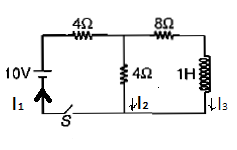
A) i=7.5−0.25${e^{ - 7t}}$
B) i=1.5−0.25${e^{ - 10t}}$
C) i=1.5−0.25${e^{ - 9t}}$
D) i=1.5−0.25 ${e^{ - 12t}}$
Answer
 Verified
588.9k+ views
Hint:We are going to find out the value of current at time zero and at time infinity. At the time of zero there will be infinite resistance and at time infinity the inductor will be charged. Through net R(resistance) we will get the inductor current and after simplifying it we get our solution.
Complete step by step answer:
Step 1:
An inductor is a passive electronic component that stores energy in the form of a magnetic field. In its simplest form, an inductor consists of a wire loop or coil. The inductance is directly proportional to the number of turns in the coil. Inductance also depends on the radius of the coil and on the type of material around which the coil is wound.
At (t=0), we can see that no charge is going through the inductor so it will offer infinite resistance.
Then initially our current ${i_1}$ =$\dfrac{{10}}{8}$ which is equal to 1.25A $\left( {\therefore V = iR} \right)$ V is volt, I is current and R is resistance along inductor
Then at t=$\infty$ (for a long time) inductor will be charged fully
Net resistance R equal to $4 + \dfrac{{8 \times 4}}{{8 + 4}}$ which is equal to $\dfrac{{20}}{3}$
${i_2}$ Will be equal to $\dfrac{{10}}{{\dfrac{{20}}{3}}}$ and this will give ${i_2}$ equal to 1.5A
So along 8$\Omega $ there will be 0.5A current and along 4$\Omega $ there is 1.0A of current
Step 2:
Now we know that in the branch of inductor in saturation there is a 0.5A of current and it can be calculated as ${i_L}$ =0.5$\left( {1 - {e^{\dfrac{t}{\tau }}}} \right)$ ……. (1) and here ${\tau _L}$ =$\dfrac{L}{{{R_{NET}}}}$ (${R_{NET}}$ is calculated across the branches of inductor)
${R_{NET}}$ =10$\Omega $ and from here we will get value of ${\tau _L}$=0.1sec
Now, equation (1) will have a form of ${i_L}$ =0.5$\left( {1 - {e^{\dfrac{t}{{0.1}}}}} \right)$ which is equal to ${i_L}$ =0.5$\left( {1 - {e^{ - 10t}}} \right)$
Then i=1.25+0.25$\left( {1 - {e^{\dfrac{t}{{0.1}}}}} \right)$ or it is equal to 1.5−0.25$\left( {1 - {e^{ - 10t}}} \right)$
Hence option B is correct
Note:In simple words we can say- use Ohm's Law and find the value of the total current: I = $\dfrac{V}{R}$ amp. Calculate the voltages across resistor R and inductor L by using Ohm's Law. If series inductors: Just add up the value of each individual inductor. Two or more identical parallel inductors: Add them up and divide by the number of inductors.
Complete step by step answer:
Step 1:
An inductor is a passive electronic component that stores energy in the form of a magnetic field. In its simplest form, an inductor consists of a wire loop or coil. The inductance is directly proportional to the number of turns in the coil. Inductance also depends on the radius of the coil and on the type of material around which the coil is wound.
At (t=0), we can see that no charge is going through the inductor so it will offer infinite resistance.
Then initially our current ${i_1}$ =$\dfrac{{10}}{8}$ which is equal to 1.25A $\left( {\therefore V = iR} \right)$ V is volt, I is current and R is resistance along inductor
Then at t=$\infty$ (for a long time) inductor will be charged fully
Net resistance R equal to $4 + \dfrac{{8 \times 4}}{{8 + 4}}$ which is equal to $\dfrac{{20}}{3}$
${i_2}$ Will be equal to $\dfrac{{10}}{{\dfrac{{20}}{3}}}$ and this will give ${i_2}$ equal to 1.5A
So along 8$\Omega $ there will be 0.5A current and along 4$\Omega $ there is 1.0A of current
Step 2:
Now we know that in the branch of inductor in saturation there is a 0.5A of current and it can be calculated as ${i_L}$ =0.5$\left( {1 - {e^{\dfrac{t}{\tau }}}} \right)$ ……. (1) and here ${\tau _L}$ =$\dfrac{L}{{{R_{NET}}}}$ (${R_{NET}}$ is calculated across the branches of inductor)
${R_{NET}}$ =10$\Omega $ and from here we will get value of ${\tau _L}$=0.1sec
Now, equation (1) will have a form of ${i_L}$ =0.5$\left( {1 - {e^{\dfrac{t}{{0.1}}}}} \right)$ which is equal to ${i_L}$ =0.5$\left( {1 - {e^{ - 10t}}} \right)$
Then i=1.25+0.25$\left( {1 - {e^{\dfrac{t}{{0.1}}}}} \right)$ or it is equal to 1.5−0.25$\left( {1 - {e^{ - 10t}}} \right)$
Hence option B is correct
Note:In simple words we can say- use Ohm's Law and find the value of the total current: I = $\dfrac{V}{R}$ amp. Calculate the voltages across resistor R and inductor L by using Ohm's Law. If series inductors: Just add up the value of each individual inductor. Two or more identical parallel inductors: Add them up and divide by the number of inductors.
Recently Updated Pages
Basicity of sulphurous acid and sulphuric acid are

Master Class 12 English: Engaging Questions & Answers for Success
Master Class 12 Social Science: Engaging Questions & Answers for Success
Master Class 12 Maths: Engaging Questions & Answers for Success
Master Class 12 Economics: Engaging Questions & Answers for Success
Master Class 12 Physics: Engaging Questions & Answers for Success
Trending doubts
Which are the Top 10 Largest Countries of the World?
Draw a labelled sketch of the human eye class 12 physics CBSE
Draw ray diagrams each showing i myopic eye and ii class 12 physics CBSE
Give 10 examples of unisexual and bisexual flowers
Coming together federation is practiced in A India class 12 social science CBSE
How was the Civil Disobedience Movement different from class 12 social science CBSE