




The structure of ${\text{I}}{{\text{F}}_{\text{5}}}$ can be best demonstrated as:
(A)-
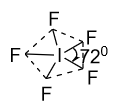
(B)-
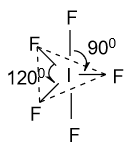
(C)-
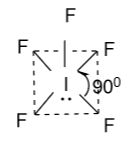
(D)- None of these
Answer
 Verified
584.7k+ views
Hint: For the estimation of exact structure of any compound we have to know about the atomic number electronic configuration of all the atoms present in that compound, so that we will assure the bonding between them and will predict the geometry and structure.
Complete answer:
For the structural demonstration of ${\text{I}}{{\text{F}}_{\text{5}}}$, we have to consider following points:
-In ${\text{I}}{{\text{F}}_{\text{5}}}$ iodine is the central atom as it is electropositive or less electronegative as compare to the fluorine atom.
-Atomic number of fluorine is 9 and its electronic configuration is written as ${\text{1}}{{\text{s}}^{\text{2}}}{\text{,2}}{{\text{s}}^{\text{2}}}{\text{2}}{{\text{p}}^{\text{5}}}$, from this it is clear that in the outermost shell of fluorine seven valence electrons are present.
-Atomic number of iodine is 53 and its electronic configuration is written as $\left[ {{\text{Kr}}} \right]{\text{4}}{{\text{d}}^{{\text{10}}}}{\text{5}}{{\text{s}}^{\text{2}}}{\text{5}}{{\text{p}}^{\text{5}}}$, from this it is clear that in the outermost shell of iodine also seven valence electrons are present.
-Out of these seven valence electrons of iodine five makes bonds with five fluorine atoms in the excited state and remaining two electrons are present in the form of lone pair in the following manner:
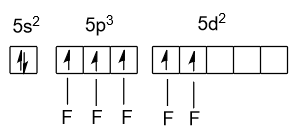
-Five bond pairs and one electron lone pair of iodine produces ${\text{s}}{{\text{p}}^{\text{3}}}{{\text{d}}^{\text{2}}}$ which demonstrate the structure of square pyramidal.
Hence, option (C) is correct.
Note:
Here some of you may think that the term geometry and structure convey the same meaning but it is not true. The geometry of any compound shows the diagram of the compound when all bond pairs are present, but if some deflection arises in the compound due to the presence of lone pair or any other species then the obtained diagram will show the structure of that compound.
Complete answer:
For the structural demonstration of ${\text{I}}{{\text{F}}_{\text{5}}}$, we have to consider following points:
-In ${\text{I}}{{\text{F}}_{\text{5}}}$ iodine is the central atom as it is electropositive or less electronegative as compare to the fluorine atom.
-Atomic number of fluorine is 9 and its electronic configuration is written as ${\text{1}}{{\text{s}}^{\text{2}}}{\text{,2}}{{\text{s}}^{\text{2}}}{\text{2}}{{\text{p}}^{\text{5}}}$, from this it is clear that in the outermost shell of fluorine seven valence electrons are present.
-Atomic number of iodine is 53 and its electronic configuration is written as $\left[ {{\text{Kr}}} \right]{\text{4}}{{\text{d}}^{{\text{10}}}}{\text{5}}{{\text{s}}^{\text{2}}}{\text{5}}{{\text{p}}^{\text{5}}}$, from this it is clear that in the outermost shell of iodine also seven valence electrons are present.
-Out of these seven valence electrons of iodine five makes bonds with five fluorine atoms in the excited state and remaining two electrons are present in the form of lone pair in the following manner:
-Five bond pairs and one electron lone pair of iodine produces ${\text{s}}{{\text{p}}^{\text{3}}}{{\text{d}}^{\text{2}}}$ which demonstrate the structure of square pyramidal.
Hence, option (C) is correct.
Note:
Here some of you may think that the term geometry and structure convey the same meaning but it is not true. The geometry of any compound shows the diagram of the compound when all bond pairs are present, but if some deflection arises in the compound due to the presence of lone pair or any other species then the obtained diagram will show the structure of that compound.
Recently Updated Pages
Master Class 11 English: Engaging Questions & Answers for Success

Master Class 11 Social Science: Engaging Questions & Answers for Success
Master Class 11 Maths: Engaging Questions & Answers for Success
Master Class 11 Biology: Engaging Questions & Answers for Success
Master Class 11 Physics: Engaging Questions & Answers for Success
Master Class 11 Chemistry: Engaging Questions & Answers for Success
Trending doubts
One Metric ton is equal to kg A 10000 B 1000 C 100 class 11 physics CBSE
Difference Between Prokaryotic Cells and Eukaryotic Cells
1 ton equals to A 100 kg B 1000 kg C 10 kg D 10000 class 11 physics CBSE
Find the value of the expression given below sin 30circ class 11 maths CBSE
Two of the body parts which do not appear in MRI are class 11 biology CBSE
What are hard magnetic materials class 11 physics CBSE