




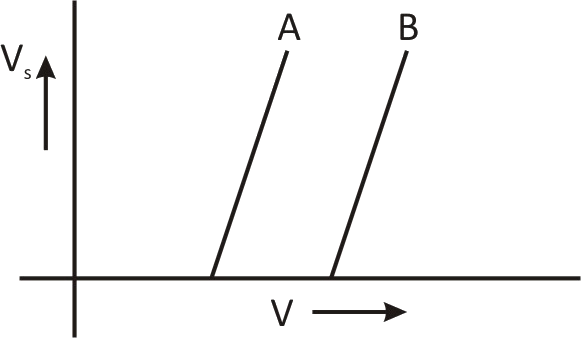
The stopping potential as a function of frequency of the incident radiation is plotted for two different photo electric surfaces A and B. The graphs show the work function of A is:
A. Greater than B
B. Smaller than B
C. Same as that of B
D. No comparison can be done from the given graphs
Answer
 Verified
626.7k+ views
Hint: First of all, we will observe the graph as given in the question. The horizontal axis represents the frequency of the incident radiation. Frequency is directly proportional to the work function.
Complete step by step answer:
In the given question, we are supplied with the following data:
The graph plot shows the stopping potential versus threshold frequency.
The graph is plotted for two electric surfaces A and B.
We are asked to find out which one of the following conditions is true for the two electric surfaces.
To begin with, we will first go for the Einstein’s equation of photoelectric effect, which is given by:
\[e{V_0} = h\nu - h{\nu _0}\] …… (1)
Where,
\[e\] indicates the charge of the outgoing electron.
\[{V_0}\] indicates the potential of the surface.
\[h\nu \] indicates the energy of the incoming photon particle.
\[h{\nu _0}\] indicates the work function.
We can modify the equation (1) as follows:
$\Rightarrow e{V_0} = h\nu - h{\nu _0}$
$\Rightarrow {V_0} = \dfrac{{h\nu }}{e} - \dfrac{{h{\nu _0}}}{e} \\$
As we can see from the graph is that the threshold frequency for the electric surface A is less than that of electric surface B. It is obvious from the given graph that if we expand the given graph to A and B, the intercept of line A on the \[V - \] axis would be smaller compared to line B, meaning that A's work function is smaller than B's.
So, the correct answer is “Option B”.
Note:
It is important to remember that according to Plank’s quantum theory, light is always emitted from the respective source in the form of discrete packets and these packets of energies are called photons. When the photons hit a surface, the energy of photons is transmitted into the metal surface which excites the electrons present in there. The electrons after gaining the energy move out of the surface.
Complete step by step answer:
In the given question, we are supplied with the following data:
The graph plot shows the stopping potential versus threshold frequency.
The graph is plotted for two electric surfaces A and B.
We are asked to find out which one of the following conditions is true for the two electric surfaces.
To begin with, we will first go for the Einstein’s equation of photoelectric effect, which is given by:
\[e{V_0} = h\nu - h{\nu _0}\] …… (1)
Where,
\[e\] indicates the charge of the outgoing electron.
\[{V_0}\] indicates the potential of the surface.
\[h\nu \] indicates the energy of the incoming photon particle.
\[h{\nu _0}\] indicates the work function.
We can modify the equation (1) as follows:
$\Rightarrow e{V_0} = h\nu - h{\nu _0}$
$\Rightarrow {V_0} = \dfrac{{h\nu }}{e} - \dfrac{{h{\nu _0}}}{e} \\$
As we can see from the graph is that the threshold frequency for the electric surface A is less than that of electric surface B. It is obvious from the given graph that if we expand the given graph to A and B, the intercept of line A on the \[V - \] axis would be smaller compared to line B, meaning that A's work function is smaller than B's.
So, the correct answer is “Option B”.
Note:
It is important to remember that according to Plank’s quantum theory, light is always emitted from the respective source in the form of discrete packets and these packets of energies are called photons. When the photons hit a surface, the energy of photons is transmitted into the metal surface which excites the electrons present in there. The electrons after gaining the energy move out of the surface.
Recently Updated Pages
Master Class 12 Economics: Engaging Questions & Answers for Success

Master Class 12 Social Science: Engaging Questions & Answers for Success
Master Class 12 English: Engaging Questions & Answers for Success
Master Class 12 Maths: Engaging Questions & Answers for Success
Master Class 12 Physics: Engaging Questions & Answers for Success
Master Class 12 Biology: Engaging Questions & Answers for Success
Trending doubts
Draw a labelled sketch of the human eye class 12 physics CBSE
Which are the Top 10 Largest Countries of the World?
Draw ray diagrams each showing i myopic eye and ii class 12 physics CBSE
Which is the correct genotypic ratio of mendel dihybrid class 12 biology CBSE
Differentiate between homogeneous and heterogeneous class 12 chemistry CBSE
Which animal never drinks water in its entire life class 12 biology CBSE