




The stability of benzene diazonium salts is because of:
(A) Inductive Effect.
(B) Resonance.
(C) Hyperconjugation.
(D) Mesomeric Effect.
Answer
 Verified
592.8k+ views
Hint: We know that In order to answer the question, first we have to check whether the given salt is more stable than others. Then after we will discuss the most stable diazonium salts. This is not found in aliphatic diazonium salts.
Complete answer:
Aromatic diazonium salts such as Benzene Diazonium Halide are more stable than aliphatic diazonium salts due to dispersion of positive charge over the benzene ring caused by resonance. Dispersion of positive charge over the benzene ring caused by resonance. Diazonium salts are the organic compounds consisting of triple bonds in between Nitrogen atoms as well as having either an alkyl or aryl (benzene ring) on the other side.
The diazonium salts are the moderate stage between the azo colors (or mixes are known to be mainstream shading specialists). Diazonium salt containing aryl bunch straightforwardly connected to the nitrogen iota is generally steady because of reverberation adjustment between the benzene cores and N-molecule. And the Benzene Diazonium Halide has a N,N triple bond and containing an aryl group directly linked to the Nitrogen atom makes it more stable than other given Diazonium Salts.
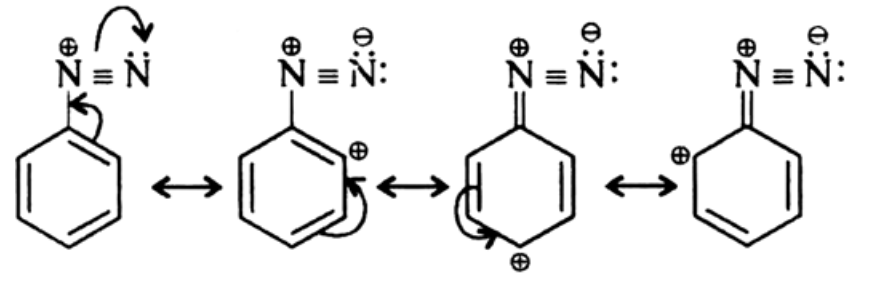
Due to resonance there is a dispersal of positive charge on the benzene ring. This resonance accounts for the stability of the diazonium ion. Hence, diazonium salts of aromatic amines are more stable than those of aliphatic amines.
Therefore, the correct answer is option B.
Note:
Remember that one of the most widely recognized strategies for arrangement of diazonium salt is by the response of nitrous corrosive with fragrant amines. The response of aniline (sweet-smelling amine) with nitrous corrosive outcomes in the arrangement of the diazonium salt. This salt is the benzene diazonium chloride. Nitrous corrosive is a profoundly poisonous gas.
Complete answer:
Aromatic diazonium salts such as Benzene Diazonium Halide are more stable than aliphatic diazonium salts due to dispersion of positive charge over the benzene ring caused by resonance. Dispersion of positive charge over the benzene ring caused by resonance. Diazonium salts are the organic compounds consisting of triple bonds in between Nitrogen atoms as well as having either an alkyl or aryl (benzene ring) on the other side.
The diazonium salts are the moderate stage between the azo colors (or mixes are known to be mainstream shading specialists). Diazonium salt containing aryl bunch straightforwardly connected to the nitrogen iota is generally steady because of reverberation adjustment between the benzene cores and N-molecule. And the Benzene Diazonium Halide has a N,N triple bond and containing an aryl group directly linked to the Nitrogen atom makes it more stable than other given Diazonium Salts.
Due to resonance there is a dispersal of positive charge on the benzene ring. This resonance accounts for the stability of the diazonium ion. Hence, diazonium salts of aromatic amines are more stable than those of aliphatic amines.
Therefore, the correct answer is option B.
Note:
Remember that one of the most widely recognized strategies for arrangement of diazonium salt is by the response of nitrous corrosive with fragrant amines. The response of aniline (sweet-smelling amine) with nitrous corrosive outcomes in the arrangement of the diazonium salt. This salt is the benzene diazonium chloride. Nitrous corrosive is a profoundly poisonous gas.
Recently Updated Pages
If x a + bt + ct2 where x is in meters and t is in class 11 physics CBSE

A car covers the first half distance between two places class 11 physics CBSE
The resultant of two vectors overrightarrow P and overrightarrow class 11 physics CBSE
Find the value of cos 135 class 11 maths CBSE
A mass M is held in place by an applied force F and class 11 physics CBSE
A solution of glucose in water is labelled as 10 dfracwv class 11 chemistry CBSE
Trending doubts
One Metric ton is equal to kg A 10000 B 1000 C 100 class 11 physics CBSE
Find the value of the expression given below sin 30circ class 11 maths CBSE
Draw a diagram of nephron and explain its structur class 11 biology CBSE
10 examples of friction in our daily life
Proton was discovered by A Thomson B Rutherford C Chadwick class 11 chemistry CBSE
Bond order ofO2 O2+ O2 and O22 is in order A O2 langle class 11 chemistry CBSE