




The spring extends by x on loading, then energy stored by the spring is (if T is the tension in spring and k spring constant).
A. $\dfrac{{{\text{T}}^{\text{2}}}}{2\text{k}}$
B. $\dfrac{{{\text{T}}^{\text{2}}}}{2{{\text{k}}^{2}}}$
C. $\dfrac{\text{2k}}{{{\text{T}}^{\text{2}}}}$
D. $\dfrac{\text{2}{{\text{T}}^{\text{2}}}}{\text{k}}$
Answer
 Verified
638.4k+ views
Hint: The answer to this question lies in the knowledge of the energy stored in a string. The formula to find the potential energy stored in the string is very important.
Complete step by step answer:
According to the given question, we can draw the following diagram for demonstration.
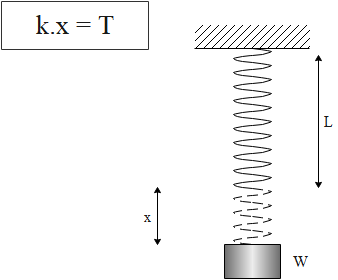
As per the given diagram, we can assume the actual length of the spring as L which is extended by a length of x when a weight of W is added to one end. The equation in the diagram is for the readers to remember this formula in a diagrammatic form. In the given equation, k is the spring constant and x is the increment in the length of the spring. T refers to the tension force created in the spring due to the weight. With the equation,
$\text{k}\cdot \text{x = T}$(given in the diagram)
We can easily calculate the energy stored in the spring.
We know,
Energy in the spring $=\text{ }\dfrac{1}{2}\text{k}{{\text{x}}^{2}}$
$\therefore \text{ E = }\dfrac{1}{2}\cdot \text{k}\cdot {{\left( \dfrac{\text{T}}{\text{k}} \right)}^{2}}\text{ }\left[ \because \,{{\left( \text{k}\cdot \text{x} \right)}^{2}}\text{ = }{{\text{T}}^{2}} \right]$
$\begin{align}
& =\text{ }\dfrac{1}{2}\cdot \dfrac{{{\text{T}}^{2}}}{\text{k}} \\
& =\text{ }\dfrac{{{\text{T}}^{2}}}{\text{2k}} \\
\end{align}$
Note: Elastic energy or the potential energy that is stored as a result of the deformation of any elastic object, should always be taken into consideration. By elastic object we mean a string and the phenomenon that we are considering is stretching of a string.
We should know that the spring constant is the measure of the stiffness of the string. From Hooke’s law, we can get an idea about the force that is $\dfrac{{{\text{T}}^{\text{2}}}}{2\text{k}}$ required to find the elastic potential energy.
Complete step by step answer:
According to the given question, we can draw the following diagram for demonstration.
As per the given diagram, we can assume the actual length of the spring as L which is extended by a length of x when a weight of W is added to one end. The equation in the diagram is for the readers to remember this formula in a diagrammatic form. In the given equation, k is the spring constant and x is the increment in the length of the spring. T refers to the tension force created in the spring due to the weight. With the equation,
$\text{k}\cdot \text{x = T}$(given in the diagram)
We can easily calculate the energy stored in the spring.
We know,
Energy in the spring $=\text{ }\dfrac{1}{2}\text{k}{{\text{x}}^{2}}$
$\therefore \text{ E = }\dfrac{1}{2}\cdot \text{k}\cdot {{\left( \dfrac{\text{T}}{\text{k}} \right)}^{2}}\text{ }\left[ \because \,{{\left( \text{k}\cdot \text{x} \right)}^{2}}\text{ = }{{\text{T}}^{2}} \right]$
$\begin{align}
& =\text{ }\dfrac{1}{2}\cdot \dfrac{{{\text{T}}^{2}}}{\text{k}} \\
& =\text{ }\dfrac{{{\text{T}}^{2}}}{\text{2k}} \\
\end{align}$
Note: Elastic energy or the potential energy that is stored as a result of the deformation of any elastic object, should always be taken into consideration. By elastic object we mean a string and the phenomenon that we are considering is stretching of a string.
We should know that the spring constant is the measure of the stiffness of the string. From Hooke’s law, we can get an idea about the force that is $\dfrac{{{\text{T}}^{\text{2}}}}{2\text{k}}$ required to find the elastic potential energy.
Recently Updated Pages
Master Class 11 English: Engaging Questions & Answers for Success

Master Class 11 Social Science: Engaging Questions & Answers for Success
Master Class 11 Maths: Engaging Questions & Answers for Success
Master Class 11 Chemistry: Engaging Questions & Answers for Success
Master Class 11 Biology: Engaging Questions & Answers for Success
Master Class 11 Physics: Engaging Questions & Answers for Success
Trending doubts
Explain the Treaty of Vienna of 1815 class 10 social science CBSE
Why is it 530 pm in india when it is 1200 afternoon class 10 social science CBSE
What is the full form of CNG A Complete Natural Gas class 10 social science CBSE
In cricket, what is a "Yorker" designed to do?
What is the full form of POSCO class 10 social science CBSE
Define Potential, Developed, Stock and Reserved resources