




The source of nitrogen in Gabriel synthesis of amines is:
A. Sodium azide $Na{N_3}$
B. Sodium nitrite $NaN{O_2}$
C. Potassium cyanide $ KCN $
D. Potassium phthalimide ${C_6}{H_4}(C{O_2}){N^ - }{K^ + }$
Answer
 Verified
643.5k+ views
Hint: the Gabriel synthesis is a method used to prepare primary amines.
Complete step by step solution: while preparing amines when ammonia is reacted with alkyl halides it results in multiple alkylations which can be reduced by using a large excess of ammonia. Hence phthalimide can be used. It is quite acidic in nature so it is converted to potassium phthalide by reacting it with potassium hydroxide.
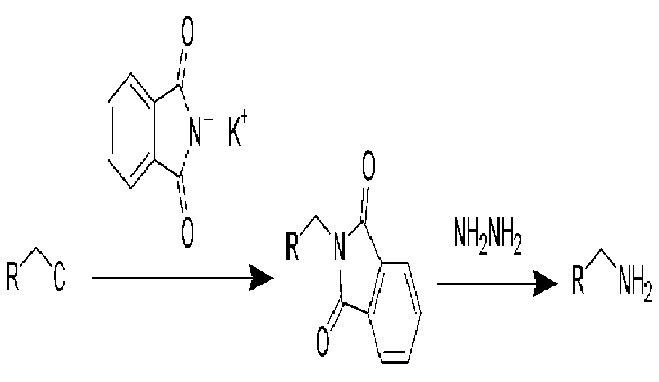
The phthalimide anion is a strong nucleophile and it reacts with an alkyl halide by a nucleophilic reaction of SN2 to give N-alkyl phthalimide. At this point the N-alkyl phthalimide can be hydrolyzed by with aqueous acid or base but the hydrolysis is often difficult it is often more convenient to treat the N-alkyl phthalimide with hydrazine () in refluxing ethanol to give a primary amine and phthalazine-1, 4-dione. Synthesis of amines using the Gabriel synthesis is, as we might expect restricted to the use of methyl, primary and secondary alkyl halides. The use of tertiary halides leads almost exclusively to eliminations.
Hence the correct option is option D as potassium phthalimide is used in Gabriel synthesis.
Additional information: Multiple alkylations are not a problem when tertiary amines are alkylated with methyl or primary amines. Such reactions take place in good yield
Note: This method is used to avoid multiple alkylations that occur while treating amines with alkyl halides.
Complete step by step solution: while preparing amines when ammonia is reacted with alkyl halides it results in multiple alkylations which can be reduced by using a large excess of ammonia. Hence phthalimide can be used. It is quite acidic in nature so it is converted to potassium phthalide by reacting it with potassium hydroxide.
The phthalimide anion is a strong nucleophile and it reacts with an alkyl halide by a nucleophilic reaction of SN2 to give N-alkyl phthalimide. At this point the N-alkyl phthalimide can be hydrolyzed by with aqueous acid or base but the hydrolysis is often difficult it is often more convenient to treat the N-alkyl phthalimide with hydrazine () in refluxing ethanol to give a primary amine and phthalazine-1, 4-dione. Synthesis of amines using the Gabriel synthesis is, as we might expect restricted to the use of methyl, primary and secondary alkyl halides. The use of tertiary halides leads almost exclusively to eliminations.
Hence the correct option is option D as potassium phthalimide is used in Gabriel synthesis.
Additional information: Multiple alkylations are not a problem when tertiary amines are alkylated with methyl or primary amines. Such reactions take place in good yield
Note: This method is used to avoid multiple alkylations that occur while treating amines with alkyl halides.
Recently Updated Pages
Master Class 12 Business Studies: Engaging Questions & Answers for Success

Master Class 12 Biology: Engaging Questions & Answers for Success
Master Class 12 Chemistry: Engaging Questions & Answers for Success
Class 12 Question and Answer - Your Ultimate Solutions Guide
Master Class 12 Economics: Engaging Questions & Answers for Success
Basicity of sulphurous acid and sulphuric acid are
Trending doubts
Draw a labelled sketch of the human eye class 12 physics CBSE
Which are the Top 10 Largest Countries of the World?
Draw ray diagrams each showing i myopic eye and ii class 12 physics CBSE
Which is the correct genotypic ratio of mendel dihybrid class 12 biology CBSE
Differentiate between homogeneous and heterogeneous class 12 chemistry CBSE
Give 10 examples of unisexual and bisexual flowers