




The site of EMP pathway in cell is
(A) Peroxisome
(B) Cytoplasm
(C) Matrix of mitochondria
(D) Inner membrane of mitochondria
Answer
 Verified
613.5k+ views
Hint: EMP pathway is the most commonly used type of glycolysis. The full form of EMP pathway is Gustav Embden, Otto Meyerhof and J. Parnas pathway since they gave the scheme for glycolysis. It is the first process that takes place in the respiration.
Complete step by step answer:
Glycolysis takes place aerobically or anaerobically but it doesn’t involve molecular oxygen. It is the sequence of catalytic reactions that are irreversible in nature. In this process the complex molecules like glucose, fructose etc. break down into the simpler compounds like pyruvate, pyruvic acid and hydrogens with the certain amount of energy released. Hence it is known as glycolysis. It is a common pathway that occurs in both aerobic and anaerobic respiration. The energy released from the glycolysis process is in the form of ATP (Adenosine triphosphate) and NADH.
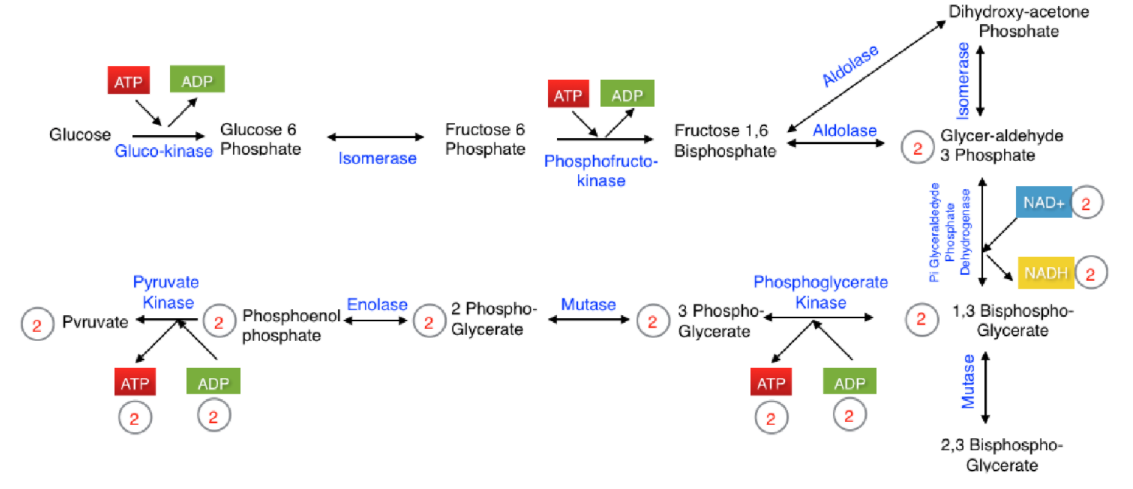
The pyruvate that is produced as the result of glycolysis enters into the citric acid cycle where it diffuses in the mitochondria. Glycolysis takes place in the cytosol of the cells of both prokaryotic and eukaryotic cells of the living organisms. Cytosol is the liquid component of the cytoplasm. Hence the site of the EMP pathway in the cell is cytoplasm.
Thus, the option (B) is correct.
Note: Glycolysis or EMP pathway takes place in two phases. They are preparatory phase and pay off phase. The preparatory phase deals with the first five of ten catalytic reactions. And the payoff phase deals with the last five reactions.
Complete step by step answer:
Glycolysis takes place aerobically or anaerobically but it doesn’t involve molecular oxygen. It is the sequence of catalytic reactions that are irreversible in nature. In this process the complex molecules like glucose, fructose etc. break down into the simpler compounds like pyruvate, pyruvic acid and hydrogens with the certain amount of energy released. Hence it is known as glycolysis. It is a common pathway that occurs in both aerobic and anaerobic respiration. The energy released from the glycolysis process is in the form of ATP (Adenosine triphosphate) and NADH.
The pyruvate that is produced as the result of glycolysis enters into the citric acid cycle where it diffuses in the mitochondria. Glycolysis takes place in the cytosol of the cells of both prokaryotic and eukaryotic cells of the living organisms. Cytosol is the liquid component of the cytoplasm. Hence the site of the EMP pathway in the cell is cytoplasm.
Thus, the option (B) is correct.
Note: Glycolysis or EMP pathway takes place in two phases. They are preparatory phase and pay off phase. The preparatory phase deals with the first five of ten catalytic reactions. And the payoff phase deals with the last five reactions.
Recently Updated Pages
Master Class 12 Economics: Engaging Questions & Answers for Success

Master Class 12 English: Engaging Questions & Answers for Success
Master Class 12 Social Science: Engaging Questions & Answers for Success
Master Class 12 Maths: Engaging Questions & Answers for Success
Master Class 12 Physics: Engaging Questions & Answers for Success
Master Class 11 Social Science: Engaging Questions & Answers for Success
Trending doubts
One Metric ton is equal to kg A 10000 B 1000 C 100 class 11 physics CBSE
Difference Between Prokaryotic Cells and Eukaryotic Cells
Find the value of the expression given below sin 30circ class 11 maths CBSE
Two of the body parts which do not appear in MRI are class 11 biology CBSE
Draw a diagram of nephron and explain its structur class 11 biology CBSE
10 examples of friction in our daily life