




The SI unit of wavelength is _________
(A). cm
(B). dm
(C). m
(D). km
Answer
 Verified
631.2k+ views
- Hint: While considering wavelength, we have to consider for what purpose the term wavelength is used for and also which quantity is being measured in the case of wavelength.
Complete step-by-step solution -
Usually, in wave mechanics, wavelength is the distance between two consecutive crests or two consecutive troughs. In simple words we can say that it is the distance at which the shape of the wave repeats itself. Usually, wavelength is denoted by a Greek letter called Lambda $\left( \lambda \right)$.
Given below is the graph of a sine wave, which is a periodic wave by nature. The distance between two consecutive crests is denoted by an orange line which is the wavelength.
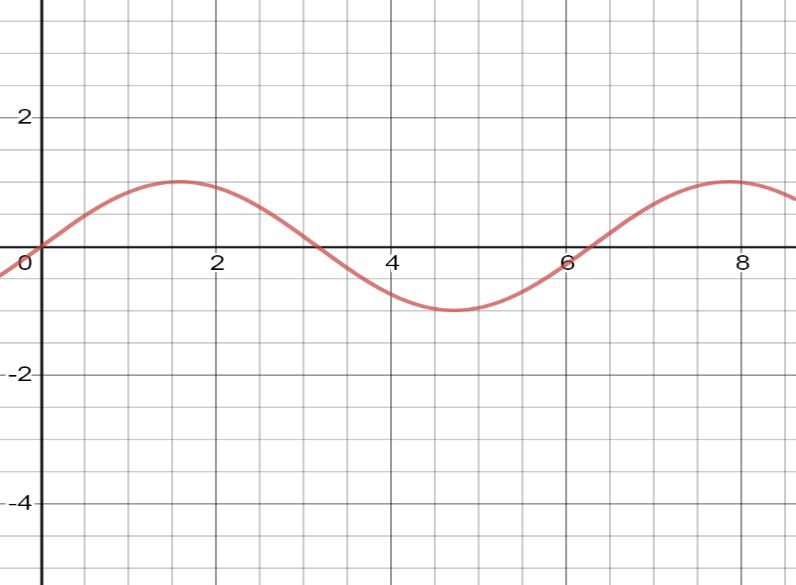
So we are measuring the distance in this case. The SI unit of distance as we all know is metre (m).
So the answer to the question is option (C) – m
Additional Information:
Waves are of two types, 1) Transverse waves and 2) Longitudinal Waves
There are crests and troughs present in transverse waves while compressions and rarefactions are present in longitudinal waves.
While the wavelength in a transverse wave is the distance between two consecutive troughs or crests, the wavelength in longitudinal waves is defined as the distance between two consecutive compressions or rarefactions.
Note: Wavelength plays a huge role in physics. In quantum mechanics, if you know the wavelength of a matter-wave we can find the momentum associated with the wave.
Complete step-by-step solution -
Usually, in wave mechanics, wavelength is the distance between two consecutive crests or two consecutive troughs. In simple words we can say that it is the distance at which the shape of the wave repeats itself. Usually, wavelength is denoted by a Greek letter called Lambda $\left( \lambda \right)$.
Given below is the graph of a sine wave, which is a periodic wave by nature. The distance between two consecutive crests is denoted by an orange line which is the wavelength.
So we are measuring the distance in this case. The SI unit of distance as we all know is metre (m).
So the answer to the question is option (C) – m
Additional Information:
Waves are of two types, 1) Transverse waves and 2) Longitudinal Waves
There are crests and troughs present in transverse waves while compressions and rarefactions are present in longitudinal waves.
While the wavelength in a transverse wave is the distance between two consecutive troughs or crests, the wavelength in longitudinal waves is defined as the distance between two consecutive compressions or rarefactions.
Note: Wavelength plays a huge role in physics. In quantum mechanics, if you know the wavelength of a matter-wave we can find the momentum associated with the wave.
Recently Updated Pages
Three beakers labelled as A B and C each containing 25 mL of water were taken A small amount of NaOH anhydrous CuSO4 and NaCl were added to the beakers A B and C respectively It was observed that there was an increase in the temperature of the solutions contained in beakers A and B whereas in case of beaker C the temperature of the solution falls Which one of the following statements isarecorrect i In beakers A and B exothermic process has occurred ii In beakers A and B endothermic process has occurred iii In beaker C exothermic process has occurred iv In beaker C endothermic process has occurred

Master Class 11 Social Science: Engaging Questions & Answers for Success
Master Class 11 Physics: Engaging Questions & Answers for Success
Master Class 11 Maths: Engaging Questions & Answers for Success
Master Class 11 Economics: Engaging Questions & Answers for Success
Master Class 11 Computer Science: Engaging Questions & Answers for Success
Three beakers labelled as A B and C each containing 25 mL of water were taken A small amount of NaOH anhydrous CuSO4 and NaCl were added to the beakers A B and C respectively It was observed that there was an increase in the temperature of the solutions contained in beakers A and B whereas in case of beaker C the temperature of the solution falls Which one of the following statements isarecorrect i In beakers A and B exothermic process has occurred ii In beakers A and B endothermic process has occurred iii In beaker C exothermic process has occurred iv In beaker C endothermic process has occurred
Master Class 11 Social Science: Engaging Questions & Answers for Success
Master Class 11 Physics: Engaging Questions & Answers for Success
Trending doubts
One Metric ton is equal to kg A 10000 B 1000 C 100 class 11 physics CBSE
There are 720 permutations of the digits 1 2 3 4 5 class 11 maths CBSE
State and prove Bernoullis theorem class 11 physics CBSE
Draw a diagram of a plant cell and label at least eight class 11 biology CBSE
Difference Between Prokaryotic Cells and Eukaryotic Cells
1 Quintal is equal to a 110 kg b 10 kg c 100kg d 1000 class 11 physics CBSE