




The SI unit of amplitude is…………..
(A). Hertz
(B). Metre
(C). Second
(D). None of these
Answer
 Verified
640.5k+ views
Hint: When a wave propagates, it moves up and down so the maximum distance of up and down is called amplitude. For amplitude, we will measure distance so we should know the unit of distance.
Complete step-by-step answer:
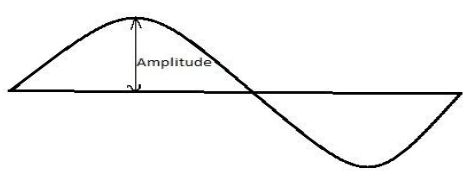
As we know that amplitude is the maximum distance of the wave moving up and down (as shown in fig.). In this definition, the amplitude is defined as the distance, and we better know that the distance measures in the meter so the SI unit of amplitude is meter.
Option(b) is correct.
Additional information:
In option (a) hertz is the unit of frequency and it is defined as the total cycle complete in one second.
In option (c) second is the unit of time, when a wave completes a full cycle the total time taken to by the wave to complete the cycle is called the period of the wave, and the unit of a period is also second. The period is inversely proportional to the frequency.
If we measure the horizontal distance of the one cycle of a wave this distance is called the wavelength of the wave and we know that it is also a distance so its unit will also be a meter.
Note: The students may be confused about the amplitude when they measure it in horizontal and vertical. If we measure the horizontal distance that will be called wavelength when we measure for a complete cycle and time taken to complete the full cycle is called the period of the wave. When we measure vertical distance as shown, the figure is called amplitude.
Complete step-by-step answer:
As we know that amplitude is the maximum distance of the wave moving up and down (as shown in fig.). In this definition, the amplitude is defined as the distance, and we better know that the distance measures in the meter so the SI unit of amplitude is meter.
Option(b) is correct.
Additional information:
In option (a) hertz is the unit of frequency and it is defined as the total cycle complete in one second.
In option (c) second is the unit of time, when a wave completes a full cycle the total time taken to by the wave to complete the cycle is called the period of the wave, and the unit of a period is also second. The period is inversely proportional to the frequency.
If we measure the horizontal distance of the one cycle of a wave this distance is called the wavelength of the wave and we know that it is also a distance so its unit will also be a meter.
Note: The students may be confused about the amplitude when they measure it in horizontal and vertical. If we measure the horizontal distance that will be called wavelength when we measure for a complete cycle and time taken to complete the full cycle is called the period of the wave. When we measure vertical distance as shown, the figure is called amplitude.
Recently Updated Pages
Master Class 11 English: Engaging Questions & Answers for Success

Master Class 11 Social Science: Engaging Questions & Answers for Success
Master Class 11 Maths: Engaging Questions & Answers for Success
Master Class 11 Biology: Engaging Questions & Answers for Success
Master Class 11 Physics: Engaging Questions & Answers for Success
Master Class 11 Chemistry: Engaging Questions & Answers for Success
Trending doubts
One Metric ton is equal to kg A 10000 B 1000 C 100 class 11 physics CBSE
Difference Between Prokaryotic Cells and Eukaryotic Cells
Two of the body parts which do not appear in MRI are class 11 biology CBSE
Find the value of the expression given below sin 30circ class 11 maths CBSE
Draw a diagram of a plant cell and label at least eight class 11 biology CBSE
10 examples of friction in our daily life