




The shrinking of protoplasm in plant cell, is called as
A) Plasmolysis
B) Deplasmolysis
C) Flaccidity
D) Turgidity
Answer
 Verified
584.1k+ views
Hint: Cytoplasm along with the nucleoplasm is known as the protoplasm. When the cell is placed in a hypertonic solution, the protoplasm of the cell shrinks due to outward movement of solvent from the cell to the surrounding. Due to the loss of turgor pressure, the protoplasmic membrane detaches from the cell wall.
Complete answer:
To solve this question, we must know the different types of movement of solvent molecules in the plant cell.
The plant cell comprises the outer layer of the cell wall and the protoplasm. When the plant cell is placed in a hypertonic solution, the exosmosis takes place that is the outward movement of the solvent molecules (region of higher concentration of solvent to the region of lower concentration). This shrinkage of the protoplasm is termed as plasmolysis. It is a very common phenomenon taking place at the guard cells in the leaf.
Deplasmolysis- It is opposite of plasmolysis. It means swelling of the protoplasm when the cell is placed in hypotonic solution.
Flaccidity- It is the condition of the cell that is placed in an isotonic solution. The cell does not have any turgor pressure and in this stake the cell shrinks but the plasma membrane is not pushed to the wall.
Turgidity- It is the condition of the cell when it contains a greater amount of fluid in the cell or the cell is in a swollen state.
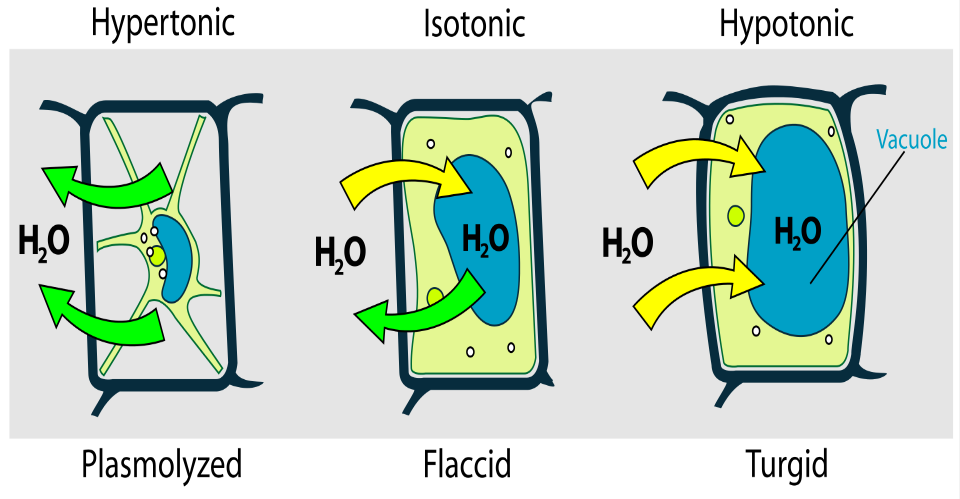
The correct answer is A.
Note:
The solutions are of three types-
1. Isotonic- In which the solute concentration is equal to that of the solvent.
2. Hypotonic-In this the solute concentration is less than that of solvent.
3. Hypertonic- In this the solute concentration is greater than that of solvent.
Complete answer:
To solve this question, we must know the different types of movement of solvent molecules in the plant cell.
The plant cell comprises the outer layer of the cell wall and the protoplasm. When the plant cell is placed in a hypertonic solution, the exosmosis takes place that is the outward movement of the solvent molecules (region of higher concentration of solvent to the region of lower concentration). This shrinkage of the protoplasm is termed as plasmolysis. It is a very common phenomenon taking place at the guard cells in the leaf.
Deplasmolysis- It is opposite of plasmolysis. It means swelling of the protoplasm when the cell is placed in hypotonic solution.
Flaccidity- It is the condition of the cell that is placed in an isotonic solution. The cell does not have any turgor pressure and in this stake the cell shrinks but the plasma membrane is not pushed to the wall.
Turgidity- It is the condition of the cell when it contains a greater amount of fluid in the cell or the cell is in a swollen state.
The correct answer is A.
Note:
The solutions are of three types-
1. Isotonic- In which the solute concentration is equal to that of the solvent.
2. Hypotonic-In this the solute concentration is less than that of solvent.
3. Hypertonic- In this the solute concentration is greater than that of solvent.
Recently Updated Pages
Master Class 11 Social Science: Engaging Questions & Answers for Success

Master Class 11 English: Engaging Questions & Answers for Success
Master Class 11 Accountancy: Engaging Questions & Answers for Success
Master Class 11 Physics: Engaging Questions & Answers for Success
Master Class 11 Computer Science: Engaging Questions & Answers for Success
Master Class 11 Business Studies: Engaging Questions & Answers for Success
Trending doubts
One Metric ton is equal to kg A 10000 B 1000 C 100 class 11 physics CBSE
Find the value of the expression given below sin 30circ class 11 maths CBSE
Draw a diagram of nephron and explain its structur class 11 biology CBSE
10 examples of friction in our daily life
Proton was discovered by A Thomson B Rutherford C Chadwick class 11 chemistry CBSE
The teeth used for biting and cutting food are called class 11 biology CBSE