




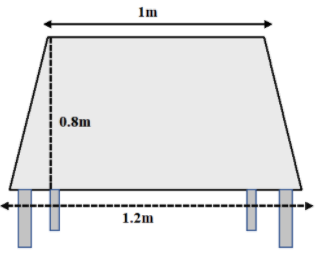
The shape of the top surface of a table is a trapezium. Find its area if it’s parallel sides are 1m and 1.2m and the perpendicular distance between them is 0.8m.
Answer
 Verified
667.5k+ views
Hint: We are given that the lengths of the parallel sides of a trapezium are 1m and 1.2m, and the distance between two parallel lines is 0.8m. Substitute the values in the formula of area of trapezium, $A = \dfrac{1}{2}\left( {a + b} \right)h$, where $a$ and $b$ are length of parallel lines and $h$ is the distance between parallel lines.
Complete step by step solution: We have to find the area of the top surface of the table.
The shape of the tabletop is a trapezium.
We are given that the lengths of the parallel sides of a trapezium are 1m and 1.2m, and the distance between two parallel lines is 0.8m
We know that the area of the trapezium is half the product of distance between parallel lines and the sum of the length of parallel lines.
That is, $A = \dfrac{1}{2}\left( {a + b} \right)h$, where $a$ and $b$ are length of parallel lines and $h$ is the distance between parallel lines.
On substituting $a = 1$, $b = 1.2$ and $h = 0.8$ in the above formula of area of the trapezium, we will get,
$A = \dfrac{1}{2}\left( {1 + 1.2} \right)\left( {0.8} \right)$
On solving the brackets, we will get,
$A = \dfrac{1}{2}\left( {2.2} \right)\left( {0.8} \right)$
Multiply the brackets,
$A = \dfrac{1}{2}\left( {1.76} \right)$
Now, on dividing by 2, we will get,
$A = 0.88{m^2}$
Hence, the area of the tabletop is $0.88\;{m^2}$
Note: A trapezium is a quadrilateral with a pair of parallel sides and a pair of non-parallel sides. Perimeter is the summation of lengths of all sides of the trapezium. And the area of the trapezium is the $\dfrac{1}{2}\left( {a + b} \right)h$, where $a$ and $b$ are length of parallel lines and $h$ is the distance between parallel lines. The area of any figure is always measured in square units.
Complete step by step solution: We have to find the area of the top surface of the table.
The shape of the tabletop is a trapezium.
We are given that the lengths of the parallel sides of a trapezium are 1m and 1.2m, and the distance between two parallel lines is 0.8m
We know that the area of the trapezium is half the product of distance between parallel lines and the sum of the length of parallel lines.
That is, $A = \dfrac{1}{2}\left( {a + b} \right)h$, where $a$ and $b$ are length of parallel lines and $h$ is the distance between parallel lines.
On substituting $a = 1$, $b = 1.2$ and $h = 0.8$ in the above formula of area of the trapezium, we will get,
$A = \dfrac{1}{2}\left( {1 + 1.2} \right)\left( {0.8} \right)$
On solving the brackets, we will get,
$A = \dfrac{1}{2}\left( {2.2} \right)\left( {0.8} \right)$
Multiply the brackets,
$A = \dfrac{1}{2}\left( {1.76} \right)$
Now, on dividing by 2, we will get,
$A = 0.88{m^2}$
Hence, the area of the tabletop is $0.88\;{m^2}$
Note: A trapezium is a quadrilateral with a pair of parallel sides and a pair of non-parallel sides. Perimeter is the summation of lengths of all sides of the trapezium. And the area of the trapezium is the $\dfrac{1}{2}\left( {a + b} \right)h$, where $a$ and $b$ are length of parallel lines and $h$ is the distance between parallel lines. The area of any figure is always measured in square units.
Recently Updated Pages
Master Class 10 Computer Science: Engaging Questions & Answers for Success

Differentiate between voluntary action and reflex class 10 biology CBSE
The uses of bleaching powder are A It is used bleaching class 10 chemistry CBSE
Fill in the blanks with abstract nouns of the words class 10 english CBSE
How many threedigit numbers are there class 10 maths CBSE
What is a reflex arc class 10 biology CBSE
Trending doubts
Explain the Treaty of Vienna of 1815 class 10 social science CBSE
10 examples of evaporation in daily life with explanations
Which country is known as "The land of Fire and Ice"?
What is the full form of POSCO class 10 social science CBSE
Make a sketch of the human nerve cell What function class 10 biology CBSE
In which year voting age was reduced from 21 to 18?