




The sensation of sight in human brain is perceived by
A. Optic lobes
B. Occipital lobes
C. Association area of frontal lobes
D. Somaesthetic area of parietal lobes
Answer
 Verified
613.2k+ views
Hint: The human brain has four lobes: frontal, parietal, temporal, and occipital. The main functions of each of them are control of movements, taste, and touch, sight, and memories respectively.
Step by step answer:Each side of the human brain has four lobes. The frontal lobe is responsible for cognitive functions and control of voluntary movements. The parietal lobe processes information about surroundings like temperature, taste, touch, and movement, and the occipital lobe is primarily responsible for vision. The temporal lobe is involved in the processing of memories and integrating them with sensations of taste, sound, sight, and touch. The occipital lobe derives its name from its location. It lies below the occipital bone of the skull. It is the smallest of all the four lobes present in the brain. There are different sections of the occipital lobe. They are as follows:
-Lingula
-The secondary visual cortex is also known as Brodmann areas 18 and 19 or V2, V3, V4, V5 which surrounds the primary visual cortex.
-Lateral geniculate bodies
-The primary visual cortex also called Brodmann area 17 or V1
-Dorsomedial stream
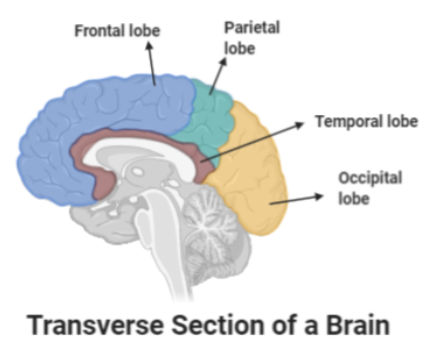
The functions of the occipital lobe are:
-Distance calculation
-Depth perception and calculation
-Determination of color
-Recognition of objects
-Movement recognition and direction
-Recognition of faces
-Relating vision and objects with memory
Note: The optic lobes are present in the brains of many animal species. The optic lobe of arthropods is a part of the protocerebrum that resides behind the arthropod eye and is responsible for the processing of visual information for the organism. The optic lobes of a bird or reptile are also part of the midbrain. The birds have the best vision as compared to any other vertebrate. The large optic lobes of a bird process the complex signals sent from the eye to the brain.
Step by step answer:Each side of the human brain has four lobes. The frontal lobe is responsible for cognitive functions and control of voluntary movements. The parietal lobe processes information about surroundings like temperature, taste, touch, and movement, and the occipital lobe is primarily responsible for vision. The temporal lobe is involved in the processing of memories and integrating them with sensations of taste, sound, sight, and touch. The occipital lobe derives its name from its location. It lies below the occipital bone of the skull. It is the smallest of all the four lobes present in the brain. There are different sections of the occipital lobe. They are as follows:
-Lingula
-The secondary visual cortex is also known as Brodmann areas 18 and 19 or V2, V3, V4, V5 which surrounds the primary visual cortex.
-Lateral geniculate bodies
-The primary visual cortex also called Brodmann area 17 or V1
-Dorsomedial stream
The functions of the occipital lobe are:
-Distance calculation
-Depth perception and calculation
-Determination of color
-Recognition of objects
-Movement recognition and direction
-Recognition of faces
-Relating vision and objects with memory
Note: The optic lobes are present in the brains of many animal species. The optic lobe of arthropods is a part of the protocerebrum that resides behind the arthropod eye and is responsible for the processing of visual information for the organism. The optic lobes of a bird or reptile are also part of the midbrain. The birds have the best vision as compared to any other vertebrate. The large optic lobes of a bird process the complex signals sent from the eye to the brain.
Recently Updated Pages
Master Class 11 Social Science: Engaging Questions & Answers for Success

Master Class 11 Chemistry: Engaging Questions & Answers for Success
Master Class 12 Business Studies: Engaging Questions & Answers for Success
Master Class 12 Chemistry: Engaging Questions & Answers for Success
Master Class 12 Biology: Engaging Questions & Answers for Success
Class 12 Question and Answer - Your Ultimate Solutions Guide
Trending doubts
One Metric ton is equal to kg A 10000 B 1000 C 100 class 11 physics CBSE
Difference Between Prokaryotic Cells and Eukaryotic Cells
How many of the following diseases can be studied with class 11 biology CBSE
Two of the body parts which do not appear in MRI are class 11 biology CBSE
Which of the following enzymes is used for carboxylation class 11 biology CBSE
Explain zero factorial class 11 maths CBSE