




The semi vertical angle of right circular cone of maximum volume of a given slant height is:
(a) \[{{\cos }^{-1}}\sqrt{2}\]
(b) \[{{\sin }^{-1}}\sqrt{2}\]
(c) \[{{\tan }^{-1}}\sqrt{3}\]
(d) \[{{\tan }^{-1}}\sqrt{2}\]
Answer
 Verified
544.5k+ views
Hint: First of all, write the volume of the cone as \[V=\dfrac{1}{3}\pi {{r}^{2}}h\]. Then write ‘r’ in terms of ‘h’ and ‘l’ by using Pythagoras Theorem. Differentiate V with respect to ‘h’ to maximize it and get the value of h in terms of ‘l’. Then find the semi-vertical angle by using \[\tan \alpha =\dfrac{r}{h}\].
Complete step-by-step answer:
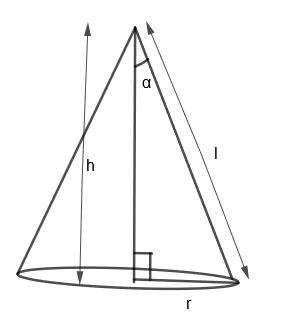
Here, we have to find the semi-vertical angle of the right circular cone of the maximum volume of a given slant height. Let us take the height of the cone as ‘h’, slant height of the cone as ‘l’, and radius of the base of the cone as ‘r’. Also, let ‘\[\alpha \]’ be the semi-vertical angle of the cone. So, we can show the cone diagrammatically as,
By Pythagoras Theorem, we know that:
\[{{\left( \text{Perpendicular} \right)}^{2}}+{{\left( \text{Base} \right)}^{2}}={{\left( \text{Hypotenuse} \right)}^{2}}\]
So, for the cone, we get,
\[\begin{align}
& {{h}^{2}}+{{r}^{2}}={{l}^{2}} \\
& \Rightarrow {{r}^{2}}={{l}^{2}}-{{h}^{2}}....\left( i \right) \\
\end{align}\]
Now, we know that the volume of the cone, \[V=\dfrac{1}{3}\pi {{r}^{2}}h\]
Now, by substituting \[{{r}^{2}}={{l}^{2}}-{{h}^{2}}\] from equation (i), we get,
\[\begin{align}
& V=\dfrac{1}{3}\pi \left( {{l}^{2}}-{{h}^{2}} \right)h \\
& \Rightarrow V=\dfrac{\pi }{3}\left( {{l}^{2}}h-{{h}^{3}} \right)....\left( ii \right) \\
\end{align}\]
Since we are given the cone of the particular slant height, we will now differentiate V with respect to h. We know that,
\[\dfrac{d}{dx}\left( {{x}^{n}} \right)=n{{x}^{n-1}}\].
So, by differentiating both sides of the equation (ii), with respect to h, we get,
\[\dfrac{dV}{dh}=\dfrac{\pi }{3}\left( {{l}^{2}}-3{{h}^{2}} \right)....\left( iii \right)\]
By further differentiating the above equation with respect to h, we get,
\[\dfrac{{{d}^{2}}V}{d{{h}^{2}}}=\dfrac{\pi }{3}\left( 0-6h \right)....\left( iv \right)\]
We know that for a critical point that is minima or maxima, \[\dfrac{dy}{dx}=0\]. So, here \[\dfrac{dV}{dh}=0\]
By substituting the value of \[\dfrac{dV}{dh}\] from equation (iii), we get,
\[\dfrac{\pi }{3}\left( {{l}^{2}}-3{{h}^{2}} \right)=0\]
\[{{l}^{2}}-3{{h}^{2}}=0\]
\[\Rightarrow {{l}^{2}}=3{{h}^{2}}\]
\[\dfrac{{{l}^{2}}}{3}={{h}^{2}}\]
So, we get, \[h=\dfrac{l}{\sqrt{3}}\]
By substituting \[h=\dfrac{l}{\sqrt{3}}\] in equation (iv), we get,
\[\dfrac{{{d}^{2}}V}{d{{h}^{2}}}=\dfrac{\pi }{3}\left( -6.\dfrac{l}{\sqrt{3}} \right)<0\]
We know that when at a certain point, \[\dfrac{dy}{dx}=0\] and \[\dfrac{{{d}^{2}}y}{d{{x}^{2}}}<0\], it is the point of maxima. Similarly, at \[h=\dfrac{l}{\sqrt{3}}\], \[\dfrac{dV}{dh}=0\] and \[\dfrac{{{d}^{2}}V}{d{{h}^{2}}}<0\]. So, we get that the cone has the maximum value at \[h=\dfrac{l}{\sqrt{3}}\].
By substituting the value of \[h=\dfrac{l}{\sqrt{3}}\] in equation (i), we get,
\[{{r}^{2}}={{l}^{2}}-{{\left( \dfrac{l}{\sqrt{3}} \right)}^{2}}\]
\[\Rightarrow {{r}^{2}}={{l}^{2}}-\dfrac{{{l}^{2}}}{3}\]
\[\Rightarrow {{r}^{2}}=\dfrac{2{{l}^{2}}}{3}\]
By taking square root on both the sides, we get,
\[r=\sqrt{\dfrac{2}{3}}l\]
We know that, \[\tan \alpha =\dfrac{r}{h}\].
By substituting the value of \[r=\sqrt{\dfrac{2}{3}}l\] and \[h=\dfrac{l}{\sqrt{3}}\], we get,
\[\tan \alpha =\dfrac{\sqrt{\dfrac{2}{3}}l}{\dfrac{l}{\sqrt{3}}}=\sqrt{2}\]
\[\Rightarrow \alpha ={{\tan }^{-1}}\left( \sqrt{2} \right)\]
So, we get the semi-vertical angle of the right circular cone of maximum value and the given slant height as
\[\alpha ={{\tan }^{-1}}\left( \sqrt{2} \right)\]
Hence, option (d) is the right answer.
Note: Students must note that in this question, slant height is given. So, we must take the slant height (l) as a constant and calculate other parameters like r, h, \[\alpha \] in terms of slant height only. Also, take special care while differentiating V with respect to h, taking l as constant. Also remember that, for maxima at any point on the curve, \[\dfrac{{{d}^{2}}y}{dx}=0\] and \[\dfrac{{{d}^{2}}y}{d{{x}^{2}}}<0\], both conditions must be satisfied.
Complete step-by-step answer:
Here, we have to find the semi-vertical angle of the right circular cone of the maximum volume of a given slant height. Let us take the height of the cone as ‘h’, slant height of the cone as ‘l’, and radius of the base of the cone as ‘r’. Also, let ‘\[\alpha \]’ be the semi-vertical angle of the cone. So, we can show the cone diagrammatically as,
By Pythagoras Theorem, we know that:
\[{{\left( \text{Perpendicular} \right)}^{2}}+{{\left( \text{Base} \right)}^{2}}={{\left( \text{Hypotenuse} \right)}^{2}}\]
So, for the cone, we get,
\[\begin{align}
& {{h}^{2}}+{{r}^{2}}={{l}^{2}} \\
& \Rightarrow {{r}^{2}}={{l}^{2}}-{{h}^{2}}....\left( i \right) \\
\end{align}\]
Now, we know that the volume of the cone, \[V=\dfrac{1}{3}\pi {{r}^{2}}h\]
Now, by substituting \[{{r}^{2}}={{l}^{2}}-{{h}^{2}}\] from equation (i), we get,
\[\begin{align}
& V=\dfrac{1}{3}\pi \left( {{l}^{2}}-{{h}^{2}} \right)h \\
& \Rightarrow V=\dfrac{\pi }{3}\left( {{l}^{2}}h-{{h}^{3}} \right)....\left( ii \right) \\
\end{align}\]
Since we are given the cone of the particular slant height, we will now differentiate V with respect to h. We know that,
\[\dfrac{d}{dx}\left( {{x}^{n}} \right)=n{{x}^{n-1}}\].
So, by differentiating both sides of the equation (ii), with respect to h, we get,
\[\dfrac{dV}{dh}=\dfrac{\pi }{3}\left( {{l}^{2}}-3{{h}^{2}} \right)....\left( iii \right)\]
By further differentiating the above equation with respect to h, we get,
\[\dfrac{{{d}^{2}}V}{d{{h}^{2}}}=\dfrac{\pi }{3}\left( 0-6h \right)....\left( iv \right)\]
We know that for a critical point that is minima or maxima, \[\dfrac{dy}{dx}=0\]. So, here \[\dfrac{dV}{dh}=0\]
By substituting the value of \[\dfrac{dV}{dh}\] from equation (iii), we get,
\[\dfrac{\pi }{3}\left( {{l}^{2}}-3{{h}^{2}} \right)=0\]
\[{{l}^{2}}-3{{h}^{2}}=0\]
\[\Rightarrow {{l}^{2}}=3{{h}^{2}}\]
\[\dfrac{{{l}^{2}}}{3}={{h}^{2}}\]
So, we get, \[h=\dfrac{l}{\sqrt{3}}\]
By substituting \[h=\dfrac{l}{\sqrt{3}}\] in equation (iv), we get,
\[\dfrac{{{d}^{2}}V}{d{{h}^{2}}}=\dfrac{\pi }{3}\left( -6.\dfrac{l}{\sqrt{3}} \right)<0\]
We know that when at a certain point, \[\dfrac{dy}{dx}=0\] and \[\dfrac{{{d}^{2}}y}{d{{x}^{2}}}<0\], it is the point of maxima. Similarly, at \[h=\dfrac{l}{\sqrt{3}}\], \[\dfrac{dV}{dh}=0\] and \[\dfrac{{{d}^{2}}V}{d{{h}^{2}}}<0\]. So, we get that the cone has the maximum value at \[h=\dfrac{l}{\sqrt{3}}\].
By substituting the value of \[h=\dfrac{l}{\sqrt{3}}\] in equation (i), we get,
\[{{r}^{2}}={{l}^{2}}-{{\left( \dfrac{l}{\sqrt{3}} \right)}^{2}}\]
\[\Rightarrow {{r}^{2}}={{l}^{2}}-\dfrac{{{l}^{2}}}{3}\]
\[\Rightarrow {{r}^{2}}=\dfrac{2{{l}^{2}}}{3}\]
By taking square root on both the sides, we get,
\[r=\sqrt{\dfrac{2}{3}}l\]
We know that, \[\tan \alpha =\dfrac{r}{h}\].
By substituting the value of \[r=\sqrt{\dfrac{2}{3}}l\] and \[h=\dfrac{l}{\sqrt{3}}\], we get,
\[\tan \alpha =\dfrac{\sqrt{\dfrac{2}{3}}l}{\dfrac{l}{\sqrt{3}}}=\sqrt{2}\]
\[\Rightarrow \alpha ={{\tan }^{-1}}\left( \sqrt{2} \right)\]
So, we get the semi-vertical angle of the right circular cone of maximum value and the given slant height as
\[\alpha ={{\tan }^{-1}}\left( \sqrt{2} \right)\]
Hence, option (d) is the right answer.
Note: Students must note that in this question, slant height is given. So, we must take the slant height (l) as a constant and calculate other parameters like r, h, \[\alpha \] in terms of slant height only. Also, take special care while differentiating V with respect to h, taking l as constant. Also remember that, for maxima at any point on the curve, \[\dfrac{{{d}^{2}}y}{dx}=0\] and \[\dfrac{{{d}^{2}}y}{d{{x}^{2}}}<0\], both conditions must be satisfied.
Recently Updated Pages
Master Class 10 Social Science: Engaging Questions & Answers for Success

Master Class 10 Science: Engaging Questions & Answers for Success
Master Class 10 Maths: Engaging Questions & Answers for Success
Master Class 10 General Knowledge: Engaging Questions & Answers for Success
Master Class 10 Computer Science: Engaging Questions & Answers for Success
Class 10 Question and Answer - Your Ultimate Solutions Guide
Trending doubts
What is the full form of PNG A Petrol Natural Gas B class 10 chemistry CBSE
Explain the Treaty of Vienna of 1815 class 10 social science CBSE
In cricket, how many legal balls are there in a standard over?
Why is there a time difference of about 5 hours between class 10 social science CBSE
Who Won 36 Oscar Awards? Record Holder Revealed
What is the median of the first 10 natural numbers class 10 maths CBSE