




The respiratory organs of insects are
(a) Gills or branchiae
(b) Tracheae and spiracle
(c) Respiratory trumpets
(d) All of the above
Answer
 Verified
644.1k+ views
Hint: They are the hexapod invertebrates and are the largest group within the arthropod phylum. They accomplished the respiration using a system of internal tubes and sacs.
Insects has a tracheal respiratory system in which the exchange of gases takes place at the tracheoles by the diffusion process. In this system, the tracheal carries oxygen directly to the body cells and does not require blood to transport it. In most of the insects, air is inhaled through openings on the sides of the abdomen and thorax called spiracles.
Complete answer:
Respiratory organs of insects:
Trachea: The respiratory system of arthropods consists of a network of the trachea. The trachea is an air tube lined with epithelial cells.
Taenidia: The cuticular lining of the trachea is spirally thickened that appears like ridges and form taenidia. It prevents the tracheal tubes from collapsing.
Spiracles: Trachea opens externally through ten pairs of small holes named spiracles present on the lateral side of the body. The opening of spiracles is regulated by sphincters.
Tracheoles: The tracheae further subdivided into finer branches called tracheoles which are air capillaries without inner taenidial ridges. Tracheoles are lined by a protein known as trachein and they are generally filled with a fluid in which oxygen dissolves and circulates to the tissues.
Tergo-sternal muscles: These paired muscles connect the dorsal side of the body to the ventral side and are responsible for breathing. On contraction, they compress the abdominal cavity forcing air to move out. During relaxed conditions, these muscles bring the abdominal cavity back into its original shape.
So, the correct answer is ‘Tracheae and spiracle ‘.
Note:
1. Each tracheal tube grows as an invagination of the ectoderm during embryonic development.
2. Some aquatic insects like mayfly and dragonfly larvae utilize tracheal gills for respiration in water.
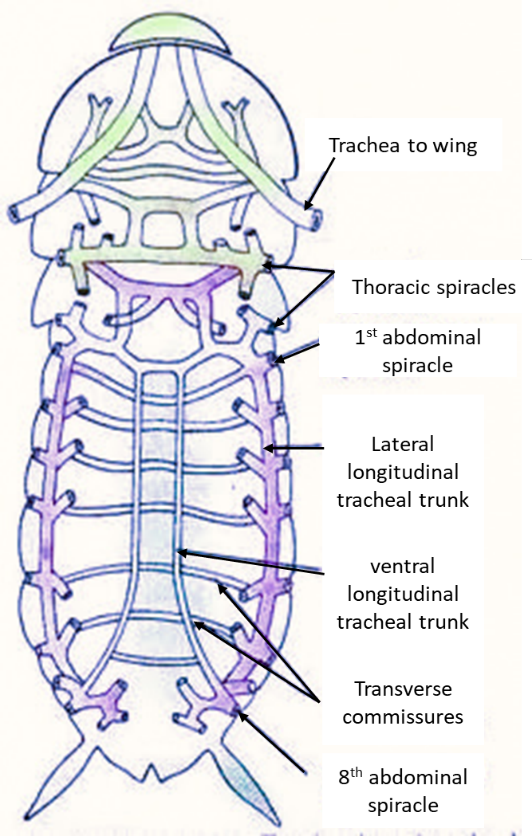
Figure: Structure of respiratory organs in insects
Insects has a tracheal respiratory system in which the exchange of gases takes place at the tracheoles by the diffusion process. In this system, the tracheal carries oxygen directly to the body cells and does not require blood to transport it. In most of the insects, air is inhaled through openings on the sides of the abdomen and thorax called spiracles.
Complete answer:
Respiratory organs of insects:
Trachea: The respiratory system of arthropods consists of a network of the trachea. The trachea is an air tube lined with epithelial cells.
Taenidia: The cuticular lining of the trachea is spirally thickened that appears like ridges and form taenidia. It prevents the tracheal tubes from collapsing.
Spiracles: Trachea opens externally through ten pairs of small holes named spiracles present on the lateral side of the body. The opening of spiracles is regulated by sphincters.
Tracheoles: The tracheae further subdivided into finer branches called tracheoles which are air capillaries without inner taenidial ridges. Tracheoles are lined by a protein known as trachein and they are generally filled with a fluid in which oxygen dissolves and circulates to the tissues.
Tergo-sternal muscles: These paired muscles connect the dorsal side of the body to the ventral side and are responsible for breathing. On contraction, they compress the abdominal cavity forcing air to move out. During relaxed conditions, these muscles bring the abdominal cavity back into its original shape.
So, the correct answer is ‘Tracheae and spiracle ‘.
Note:
1. Each tracheal tube grows as an invagination of the ectoderm during embryonic development.
2. Some aquatic insects like mayfly and dragonfly larvae utilize tracheal gills for respiration in water.
Figure: Structure of respiratory organs in insects
Recently Updated Pages
Master Class 11 English: Engaging Questions & Answers for Success

Master Class 11 Social Science: Engaging Questions & Answers for Success
Master Class 11 Maths: Engaging Questions & Answers for Success
Master Class 11 Biology: Engaging Questions & Answers for Success
Master Class 11 Physics: Engaging Questions & Answers for Success
Master Class 11 Chemistry: Engaging Questions & Answers for Success
Trending doubts
One Metric ton is equal to kg A 10000 B 1000 C 100 class 11 physics CBSE
What is cell theory Who formulated it class 11 biology CBSE
Phyllotaxy is the arrangement of ALeaflets BLeaves class 11 biology CBSE
Difference Between Prokaryotic Cells and Eukaryotic Cells
The symbiotic association of fungi and algae is called class 11 biology CBSE
Cell theory was formulated by A Schleiden and Schwann class 11 biology CBSE