




The resistance of the meter bridge AB is given in figure is $4\Omega $ with cell of emf E=0.5V and rheostat resistance $Rh=2\Omega $ the null point is obtained at some point J. When the cell is replaced by another one of emf $E={{E}_{2}}$ the same null point J is found for $Rh=6\Omega $. The emf E is:
a) 0.6V
b) 0.5V
c) 0.3V
d)0.4V
Answer
 Verified
564.3k+ views
Hint: The resistance of the meter bridge is given as $4\Omega $ hence we can obtain the resistance per unit length i.e. 1m of the meter bridge. First we need to determine the potential gradient when the rheostat in the circuit is varied. Hence comparing the two cases, the emf E of the cell can be determined
Formula used:
$\phi =\dfrac{{{V}_{l}}}{l}$
Complete answer:
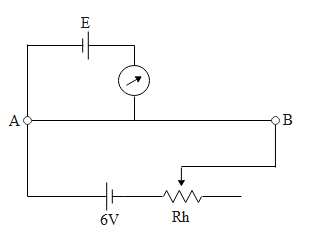
In the first case an emf of 0.5V is connected to the meter bridge such that the null point is obtained at J. In the above circuit diagram we can see a battery of 6V is connected to the meter bridge wire via rheostat. If V is the emf of the cell i.e. 6V, ${{V}_{Rh}}$ is the drop across the rheostat and ${{V}_{l}}$ is the potential drop across the wire AB of length ‘l’, then using Kirchhoff’s law we get,
$V={{V}_{Rh}}+{{V}_{l}}$
Since from ohm’s law, voltage across a resistor is equal to the product of current times the resistance, the current (i) in the above condition we get,
$\begin{align}
& V={{V}_{Rh}}+{{V}_{l}} \\
& \Rightarrow 6V=i2\Omega +i4\Omega \\
& \Rightarrow i=\dfrac{6V}{6\Omega } \\
& \therefore i=1A \\
\end{align}$
Since current is equal to 1 ampere, the potential drop across the wire AB is,
$\begin{align}
& {{V}_{l}}=i{{R}_{l}} \\
& \Rightarrow {{V}_{l}}=1A\times 4\Omega \\
& \therefore {{V}_{l}}=4V \\
\end{align}$
This 4V is dropped across a length of 1 m i.e. 100cm.Therefore potential gradient $\phi $ (potential drop per unit length of the wire) is,
$\begin{align}
& \phi =\dfrac{{{V}_{l}}}{l} \\
& \therefore \phi =\dfrac{4V}{100cm}=0.04Vc{{m}^{-1}} \\
\end{align}$
When an emf of 0.5V is connected, the length ${{L}_{J}}$ of the balancing point with respect to A is equal to,
$\begin{align}
& {{L}_{J}}=\dfrac{{{E}_{1}}}{\phi } \\
& \Rightarrow {{L}_{J}}=\dfrac{0.5V}{0.04Vc{{m}^{-1}}} \\
& \therefore {{L}_{J}}=12.5cm \\
\end{align}$
When another cell of emf ${{E}_{2}}$ is connected the balancing length is the same, but potential gradient varies as the resistance of the rheostat is changed to $Rh=6\Omega $ . hence the current across the wire AB is,
$\begin{align}
& V={{V}_{Rh}}+{{V}_{l}} \\
& \Rightarrow 6V=i6\Omega +i4\Omega \\
& \Rightarrow i=\dfrac{6V}{10\Omega } \\
& \therefore i=0.6A \\
\end{align}$
Hence the drop across the wire AB is,
$\begin{align}
& {{V}_{l}}=i{{R}_{l}} \\
& \Rightarrow {{V}_{l}}=0.6A\times 4\Omega \\
& \therefore {{V}_{l}}=2.4V \\
\end{align}$
Therefore the potential gradient across the wire would be,
$\begin{align}
& \phi =\dfrac{{{V}_{l}}}{l} \\
& \therefore \phi =\dfrac{2.4V}{100cm}=0.024Vc{{m}^{-1}} \\
\end{align}$
In the question it is given that the balancing length is the same. Hence the potential drop across the balancing length i.e. ${{E}_{2}}$ is,
$\begin{align}
& {{E}_{2}}={{L}_{J}}\phi \\
& \Rightarrow {{E}_{2}}=12.5cm\times 0.024Vc{{m}^{-1}} \\
& \therefore {{E}_{2}}=0.3V \\
\end{align}$
Hence the correct answer of the above question is option c.
Note:
It is to be noted that the wire in the meter bridge should have uniform resistance. If not then the principle of potential gradient will not be valid. The above is basically a set up of a potentiometer but it can be called as a meter bridge as the length of the wire is 1m.
Formula used:
$\phi =\dfrac{{{V}_{l}}}{l}$
Complete answer:
In the first case an emf of 0.5V is connected to the meter bridge such that the null point is obtained at J. In the above circuit diagram we can see a battery of 6V is connected to the meter bridge wire via rheostat. If V is the emf of the cell i.e. 6V, ${{V}_{Rh}}$ is the drop across the rheostat and ${{V}_{l}}$ is the potential drop across the wire AB of length ‘l’, then using Kirchhoff’s law we get,
$V={{V}_{Rh}}+{{V}_{l}}$
Since from ohm’s law, voltage across a resistor is equal to the product of current times the resistance, the current (i) in the above condition we get,
$\begin{align}
& V={{V}_{Rh}}+{{V}_{l}} \\
& \Rightarrow 6V=i2\Omega +i4\Omega \\
& \Rightarrow i=\dfrac{6V}{6\Omega } \\
& \therefore i=1A \\
\end{align}$
Since current is equal to 1 ampere, the potential drop across the wire AB is,
$\begin{align}
& {{V}_{l}}=i{{R}_{l}} \\
& \Rightarrow {{V}_{l}}=1A\times 4\Omega \\
& \therefore {{V}_{l}}=4V \\
\end{align}$
This 4V is dropped across a length of 1 m i.e. 100cm.Therefore potential gradient $\phi $ (potential drop per unit length of the wire) is,
$\begin{align}
& \phi =\dfrac{{{V}_{l}}}{l} \\
& \therefore \phi =\dfrac{4V}{100cm}=0.04Vc{{m}^{-1}} \\
\end{align}$
When an emf of 0.5V is connected, the length ${{L}_{J}}$ of the balancing point with respect to A is equal to,
$\begin{align}
& {{L}_{J}}=\dfrac{{{E}_{1}}}{\phi } \\
& \Rightarrow {{L}_{J}}=\dfrac{0.5V}{0.04Vc{{m}^{-1}}} \\
& \therefore {{L}_{J}}=12.5cm \\
\end{align}$
When another cell of emf ${{E}_{2}}$ is connected the balancing length is the same, but potential gradient varies as the resistance of the rheostat is changed to $Rh=6\Omega $ . hence the current across the wire AB is,
$\begin{align}
& V={{V}_{Rh}}+{{V}_{l}} \\
& \Rightarrow 6V=i6\Omega +i4\Omega \\
& \Rightarrow i=\dfrac{6V}{10\Omega } \\
& \therefore i=0.6A \\
\end{align}$
Hence the drop across the wire AB is,
$\begin{align}
& {{V}_{l}}=i{{R}_{l}} \\
& \Rightarrow {{V}_{l}}=0.6A\times 4\Omega \\
& \therefore {{V}_{l}}=2.4V \\
\end{align}$
Therefore the potential gradient across the wire would be,
$\begin{align}
& \phi =\dfrac{{{V}_{l}}}{l} \\
& \therefore \phi =\dfrac{2.4V}{100cm}=0.024Vc{{m}^{-1}} \\
\end{align}$
In the question it is given that the balancing length is the same. Hence the potential drop across the balancing length i.e. ${{E}_{2}}$ is,
$\begin{align}
& {{E}_{2}}={{L}_{J}}\phi \\
& \Rightarrow {{E}_{2}}=12.5cm\times 0.024Vc{{m}^{-1}} \\
& \therefore {{E}_{2}}=0.3V \\
\end{align}$
Hence the correct answer of the above question is option c.
Note:
It is to be noted that the wire in the meter bridge should have uniform resistance. If not then the principle of potential gradient will not be valid. The above is basically a set up of a potentiometer but it can be called as a meter bridge as the length of the wire is 1m.
Recently Updated Pages
Master Class 11 Social Science: Engaging Questions & Answers for Success

Master Class 11 Chemistry: Engaging Questions & Answers for Success
Master Class 12 Business Studies: Engaging Questions & Answers for Success
Master Class 12 Chemistry: Engaging Questions & Answers for Success
Master Class 12 Biology: Engaging Questions & Answers for Success
Class 12 Question and Answer - Your Ultimate Solutions Guide
Trending doubts
One Metric ton is equal to kg A 10000 B 1000 C 100 class 11 physics CBSE
Difference Between Prokaryotic Cells and Eukaryotic Cells
How many of the following diseases can be studied with class 11 biology CBSE
Two of the body parts which do not appear in MRI are class 11 biology CBSE
Which of the following enzymes is used for carboxylation class 11 biology CBSE
Explain zero factorial class 11 maths CBSE