




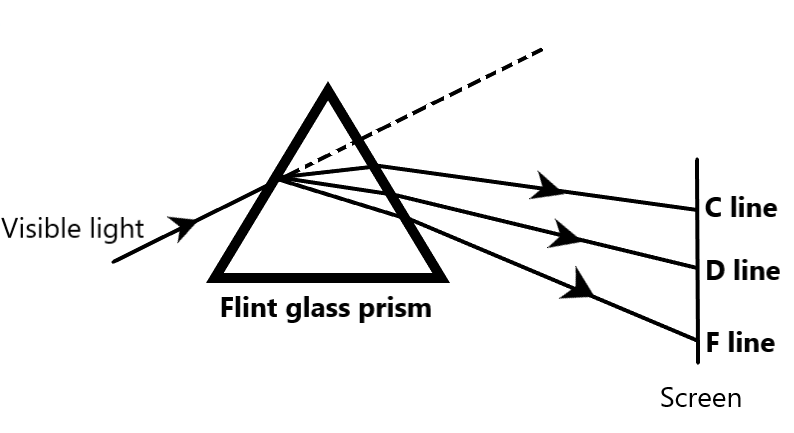
The refractive indices of flint glass prisms for $C,D$ and $F$ lines are $1.790,1.795$ and $1.805$ respectively. The dispersive power of the flint glass prism is
$\begin{align}
& A)0.141 \\
& B)0.125 \\
& C)0.018 \\
& D)0.929 \\
\end{align}$
Answer
 Verified
612k+ views
Hint: Dispersive power of a prism is defined as the ratio of angular dispersion to the angle of deviation for the mean wavelength. $C,D$ and $F$ lines of a prism correspond to red, yellow and violet lines of the prism. Angle of deviation of a particular color of light when passed through a prism is dependent on the refractive index of that particular color of light.
Formula used:
$\omega =\dfrac{{{\delta }_{v}}-{{\delta }_{r}}}{{{\delta }_{y}}}=\dfrac{{{\mu }_{v}}-{{\mu }_{r}}}{{{\mu }_{y}}-1}$
Complete step by step answer:
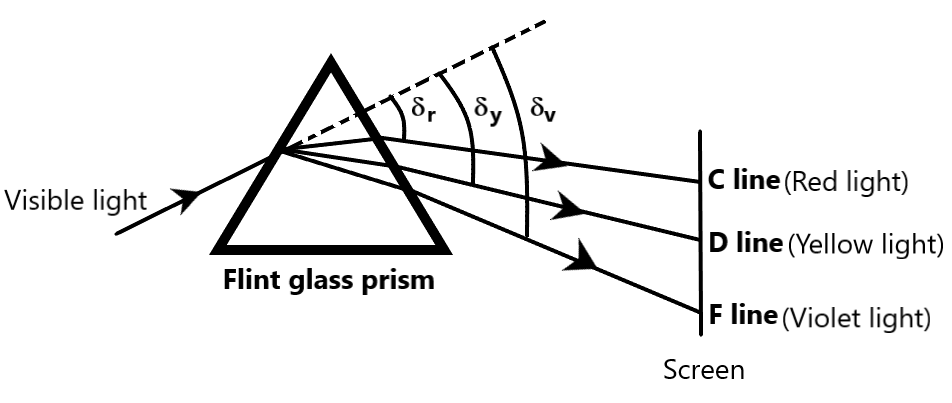
Dispersive power of the material of a prism refers to the ratio of angular dispersion to the angle of deviation for the mean wavelength. Here, angle of deviation for the mean wavelength corresponds to the yellow line of the prism. $C,D$ and $F$ lines of a prism correspond to red, yellow and violet lines of the prism. Mathematically, dispersive power of a prism is given by
$\omega =\dfrac{{{\delta }_{v}}-{{\delta }_{r}}}{{{\delta }_{y}}}$
where
$\omega $ is the dispersive power of a prism
${{\delta }_{v}}$ is the angle of deviation of violet light
${{\delta }_{r}}$ is the angle of deviation of red light
${{\delta }_{y}}$ is the angle of deviation of yellow light (mean wavelength)
${{\delta }_{v}}-{{\delta }_{r}}$ refers to the angular dispersion of the prism
Let this be equation 1.
The figure given below can be referred for clarity.
Since angular dispersion and angle of deviation for the mean wavelength are related to the respective refractive indices of red, yellow and violet lines of the prism, dispersive power of the prism is also related to the refractive indices of the mentioned. Therefore, equation 1 can be rewritten as
$\omega =\dfrac{{{\delta }_{v}}-{{\delta }_{r}}}{{{\delta }_{y}}}=\dfrac{{{\mu }_{v}}-{{\mu }_{r}}}{{{\mu }_{y}}-1}$
where
${{\mu }_{v}}$ is the refractive index corresponding to violet light or $F$ line
${{\mu }_{r}}$ is the refractive index corresponding to red light or $C$ line
${{\mu }_{y}}$ is the refractive index corresponding to yellow light or $D$ line
Let this be equation 2.
Coming to our question, we are provided with a flint glass prism. It is also given that
${{\mu }_{r}}=1.790$, is the refractive index corresponding to $C$ line of the flint glass prism
${{\mu }_{v}}=1.805$, is the refractive index corresponding to $F$ line of the prism
${{\mu }_{y}}=1.795$, is the refractive index corresponding to $D$ line of the prism
Substituting these values in equation 2, we have
$\omega =\dfrac{{{\mu }_{v}}-{{\mu }_{r}}}{{{\mu }_{y}}-1}=\dfrac{1.805-1.790}{1.795-1}=\dfrac{0.015}{0.795}=0.018{}^\circ $
Therefore, dispersive power of the given flint glass prism is equal to $0.018{}^\circ $. The correct answer is option $C$.
Note:
The question can also be approached in a different way, using the formula given below:
\[\omega =\dfrac{{{\mu }_{F}}-{{\mu }_{C}}}{{{\mu }_{D}}-1}\]
where
${{\mu }_{F}}$ is the refractive index corresponding to $F$ line
${{\mu }_{C}}$ is the refractive index corresponding to $C$ line
${{\mu }_{D}}$ is the refractive index corresponding to $D$ line
This can be considered as a direct approach to the question and students need not think about red, yellow and violet lines, here.
Formula used:
$\omega =\dfrac{{{\delta }_{v}}-{{\delta }_{r}}}{{{\delta }_{y}}}=\dfrac{{{\mu }_{v}}-{{\mu }_{r}}}{{{\mu }_{y}}-1}$
Complete step by step answer:
Dispersive power of the material of a prism refers to the ratio of angular dispersion to the angle of deviation for the mean wavelength. Here, angle of deviation for the mean wavelength corresponds to the yellow line of the prism. $C,D$ and $F$ lines of a prism correspond to red, yellow and violet lines of the prism. Mathematically, dispersive power of a prism is given by
$\omega =\dfrac{{{\delta }_{v}}-{{\delta }_{r}}}{{{\delta }_{y}}}$
where
$\omega $ is the dispersive power of a prism
${{\delta }_{v}}$ is the angle of deviation of violet light
${{\delta }_{r}}$ is the angle of deviation of red light
${{\delta }_{y}}$ is the angle of deviation of yellow light (mean wavelength)
${{\delta }_{v}}-{{\delta }_{r}}$ refers to the angular dispersion of the prism
Let this be equation 1.
The figure given below can be referred for clarity.
Since angular dispersion and angle of deviation for the mean wavelength are related to the respective refractive indices of red, yellow and violet lines of the prism, dispersive power of the prism is also related to the refractive indices of the mentioned. Therefore, equation 1 can be rewritten as
$\omega =\dfrac{{{\delta }_{v}}-{{\delta }_{r}}}{{{\delta }_{y}}}=\dfrac{{{\mu }_{v}}-{{\mu }_{r}}}{{{\mu }_{y}}-1}$
where
${{\mu }_{v}}$ is the refractive index corresponding to violet light or $F$ line
${{\mu }_{r}}$ is the refractive index corresponding to red light or $C$ line
${{\mu }_{y}}$ is the refractive index corresponding to yellow light or $D$ line
Let this be equation 2.
Coming to our question, we are provided with a flint glass prism. It is also given that
${{\mu }_{r}}=1.790$, is the refractive index corresponding to $C$ line of the flint glass prism
${{\mu }_{v}}=1.805$, is the refractive index corresponding to $F$ line of the prism
${{\mu }_{y}}=1.795$, is the refractive index corresponding to $D$ line of the prism
Substituting these values in equation 2, we have
$\omega =\dfrac{{{\mu }_{v}}-{{\mu }_{r}}}{{{\mu }_{y}}-1}=\dfrac{1.805-1.790}{1.795-1}=\dfrac{0.015}{0.795}=0.018{}^\circ $
Therefore, dispersive power of the given flint glass prism is equal to $0.018{}^\circ $. The correct answer is option $C$.
Note:
The question can also be approached in a different way, using the formula given below:
\[\omega =\dfrac{{{\mu }_{F}}-{{\mu }_{C}}}{{{\mu }_{D}}-1}\]
where
${{\mu }_{F}}$ is the refractive index corresponding to $F$ line
${{\mu }_{C}}$ is the refractive index corresponding to $C$ line
${{\mu }_{D}}$ is the refractive index corresponding to $D$ line
This can be considered as a direct approach to the question and students need not think about red, yellow and violet lines, here.
Recently Updated Pages
Master Class 12 Business Studies: Engaging Questions & Answers for Success

Master Class 12 Biology: Engaging Questions & Answers for Success
Master Class 12 Chemistry: Engaging Questions & Answers for Success
Class 12 Question and Answer - Your Ultimate Solutions Guide
Master Class 11 Social Science: Engaging Questions & Answers for Success
Master Class 11 English: Engaging Questions & Answers for Success
Trending doubts
Which are the Top 10 Largest Countries of the World?
Draw a labelled sketch of the human eye class 12 physics CBSE
Differentiate between homogeneous and heterogeneous class 12 chemistry CBSE
Sulphuric acid is known as the king of acids State class 12 chemistry CBSE
Why is the cell called the structural and functional class 12 biology CBSE
Which is the correct genotypic ratio of mendel dihybrid class 12 biology CBSE