




The reaction of methyl trichloroacetate $(C{l_3}CC{O_2}Me)$ with, sodium methoxide $\left( {NaOMe} \right)$ generates:
A.Carbocation
B.Carbene
C.Carbanion
D.Carbon radical
Answer
 Verified
635.7k+ views
Hint: In any chemical reaction 2 reactants react with each other to form product and formation of product depends upon the type of reactants that are reacting and presence of atoms or molecules in the reactants.
Step by step answer: When methyl trichloroacetate reacts with sodium methoxide then the formed product is carbine. And the mechanism of the reaction which takes place between these both reactants is shown as follow:
Firstly negatively charged oxygen of sodium methoxide $\left( {NaOMe} \right)$attack on the carbonyl carbon of methyl trichloroacetate $(C{l_3}CC{O_2}Me)$because it bears partial positive charge.
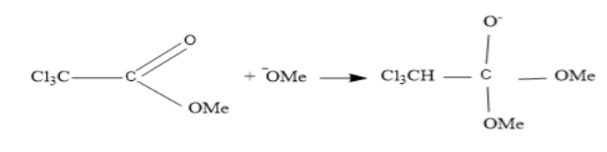
Now the formed product on the above step do rearrangement to form trichloromethane anion and by product.

Now trichloromethane anion changes to carbene and chloride ions.

Hence the correct option is B.
Additional information: Carbene is a neutral molecule in which carbon atoms form two bonds and two unshared electrons are also present, and these two electrons are not lone pairs of electrons. Cabinet is generally also known as methylene.
In the option carbocation name is also present, which is a species of carbon in which carbon carries position charge and it comes under the category of cation.
In the option carbanion name is also present, which is a species of carbon in which carbon carries negative charge and it comes under the category of anion.
Note: in the given question you may go wrong during the formation of bonds, so for neglecting this type of mistake always keep in mind that negatively charged part of one reactant attack on the positive part of the other reactant.
Step by step answer: When methyl trichloroacetate reacts with sodium methoxide then the formed product is carbine. And the mechanism of the reaction which takes place between these both reactants is shown as follow:
Firstly negatively charged oxygen of sodium methoxide $\left( {NaOMe} \right)$attack on the carbonyl carbon of methyl trichloroacetate $(C{l_3}CC{O_2}Me)$because it bears partial positive charge.
Now the formed product on the above step do rearrangement to form trichloromethane anion and by product.
Now trichloromethane anion changes to carbene and chloride ions.
Hence the correct option is B.
Additional information: Carbene is a neutral molecule in which carbon atoms form two bonds and two unshared electrons are also present, and these two electrons are not lone pairs of electrons. Cabinet is generally also known as methylene.
In the option carbocation name is also present, which is a species of carbon in which carbon carries position charge and it comes under the category of cation.
In the option carbanion name is also present, which is a species of carbon in which carbon carries negative charge and it comes under the category of anion.
Note: in the given question you may go wrong during the formation of bonds, so for neglecting this type of mistake always keep in mind that negatively charged part of one reactant attack on the positive part of the other reactant.
Recently Updated Pages
Basicity of sulphurous acid and sulphuric acid are

Master Class 12 Economics: Engaging Questions & Answers for Success
Master Class 12 Biology: Engaging Questions & Answers for Success
Master Class 11 English: Engaging Questions & Answers for Success
Master Class 11 Physics: Engaging Questions & Answers for Success
Master Class 11 Computer Science: Engaging Questions & Answers for Success
Trending doubts
Draw a labelled sketch of the human eye class 12 physics CBSE
Draw ray diagrams each showing i myopic eye and ii class 12 physics CBSE
Which are the Top 10 Largest Countries of the World?
Which is the correct genotypic ratio of mendel dihybrid class 12 biology CBSE
Draw a ray diagram of compound microscope when the class 12 physics CBSE
What is the Full Form of PVC, PET, HDPE, LDPE, PP and PS ?