




The ratio of the areas of the in-circle and circum-circle of square is: \[\]
A.$1:\sqrt{2}$\[\]
B.$1:\sqrt{3}$\[\]
C.$1:4$\[\]
D. $1:2$\[\]
Answer
 Verified
586.2k+ views
Hint: We draw the diagram of square ABCD whose in-circle touches the sides AB, BC, CD, DA at the points P, Q, R, S respectively. The circumcentre and in the center of the square is O. We use the fact that the point of contact of the circle and the sides of the square divides in half and conclude ${{r}_{1}}=\dfrac{a}{2}$ where ${{r}_{1}}$ the radius of in-circle is and $a$ is the length of the side. We use the Pythagoras theorem in triangle ODS find the radius of circum-circle as $OD={{r}_{2}}=\dfrac{a}{\sqrt{2}}$. We use the formula of area of any circle $A=\pi {{r}^{2}}$ to find the ratio of areas of in-circle and circum-circle of square ${{A}_{1}}:{{A}_{2}}$.\[\]
Complete step-by-step solution
We know that an in-circle of any polygon touches the sides of the polygon and a circum-circle of the polygon passes through vertices of the polygon. The center of the in-circle is called in-center and the center of the circum-circle is called circum-center. We also know that in-center and circum-center for a square coincide.\[\]
We show the circum-circle of the square ABCD and the in-circle of the square ABCD which touches the sides AB, BC, CD, DA at the points P, Q, R, S respectively. The circumcenter and in center of the square is O. \[\]
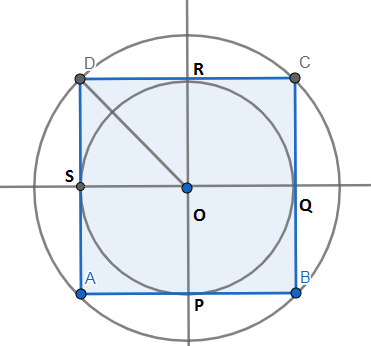
Let us denote the length of the square as $a$, the radius of the in-circle as ${{r}_{1}}$ and the radius of the circum-circle as ${{r}_{2}}$. So we have from the figure,
\[a=AB,BC,CD,DA\]
The point of contact of the circle and the sides of the square divides in half. So we have from the figure,
\[\begin{align}
& {{r}_{1}}=DS=AS=AP=BP=\dfrac{AD}{2}=\dfrac{a}{2} \\
& OS=AP=\dfrac{a}{2} \\
\end{align}\]
We have $OD={{r}_{2}}$ as the radius of the circle in the figure. We use the Pythagoras theorem in right angled triangle DOS where OD is hypotenuse and have,
\[\begin{align}
& O{{D}^{2}}=D{{S}^{2}}+O{{S}^{2}} \\
& \Rightarrow O{{D}^{2}}={{\left( \dfrac{a}{2} \right)}^{2}}+{{\left( \dfrac{a}{2} \right)}^{2}} \\
& \Rightarrow O{{D}^{2}}=2\times \dfrac{{{a}^{2}}}{2} \\
& \Rightarrow OD=\sqrt{\dfrac{{{a}^{2}}}{4}}=\dfrac{a}{\sqrt{2}} \\
& \therefore {{r}_{2}}=\dfrac{a}{\sqrt{2}} \\
\end{align}\]
Let us denote the area of in-circle as ${{A}_{1}}$ and area of circum-circle as ${{A}_{2}}$. We know that area of any circle with radius $r$ is given by $\pi {{r}^{2}}$. We use this formula and find ${{A}_{1}}.{{A}_{2}}$ as follows:
We are asked to find in the question the ratio of ${{A}_{1}}$ to ${{A}_{2}}$ which we find below.
\[{{A}_{1}}:{{A}_{2}}=\dfrac{{{A}_{1}}}{{{A}_{2}}}=\dfrac{\pi \dfrac{{{a}^{2}}}{4}}{\pi \dfrac{{{a}^{2}}}{2}}=\dfrac{1}{4}\times 2=\dfrac{2}{4}=\dfrac{1}{2}=1:2\]
So the correct choice is D.
Note: We note that the in-center and circum-center are the points of intersection of diagonals square. The Pythagoras theorem states that “in a right-angled triangle the square of the hypotenuse is the sum of squares of the other two sides”. We must not confuse by finding the ratio of radius ${{r}_{1}}:{{r}_{2}}$ instead of area ${{A}_{1}}:{{A}_{2}}$ where most mistakes happen.
Complete step-by-step solution
We know that an in-circle of any polygon touches the sides of the polygon and a circum-circle of the polygon passes through vertices of the polygon. The center of the in-circle is called in-center and the center of the circum-circle is called circum-center. We also know that in-center and circum-center for a square coincide.\[\]
We show the circum-circle of the square ABCD and the in-circle of the square ABCD which touches the sides AB, BC, CD, DA at the points P, Q, R, S respectively. The circumcenter and in center of the square is O. \[\]
Let us denote the length of the square as $a$, the radius of the in-circle as ${{r}_{1}}$ and the radius of the circum-circle as ${{r}_{2}}$. So we have from the figure,
\[a=AB,BC,CD,DA\]
The point of contact of the circle and the sides of the square divides in half. So we have from the figure,
\[\begin{align}
& {{r}_{1}}=DS=AS=AP=BP=\dfrac{AD}{2}=\dfrac{a}{2} \\
& OS=AP=\dfrac{a}{2} \\
\end{align}\]
We have $OD={{r}_{2}}$ as the radius of the circle in the figure. We use the Pythagoras theorem in right angled triangle DOS where OD is hypotenuse and have,
\[\begin{align}
& O{{D}^{2}}=D{{S}^{2}}+O{{S}^{2}} \\
& \Rightarrow O{{D}^{2}}={{\left( \dfrac{a}{2} \right)}^{2}}+{{\left( \dfrac{a}{2} \right)}^{2}} \\
& \Rightarrow O{{D}^{2}}=2\times \dfrac{{{a}^{2}}}{2} \\
& \Rightarrow OD=\sqrt{\dfrac{{{a}^{2}}}{4}}=\dfrac{a}{\sqrt{2}} \\
& \therefore {{r}_{2}}=\dfrac{a}{\sqrt{2}} \\
\end{align}\]
Let us denote the area of in-circle as ${{A}_{1}}$ and area of circum-circle as ${{A}_{2}}$. We know that area of any circle with radius $r$ is given by $\pi {{r}^{2}}$. We use this formula and find ${{A}_{1}}.{{A}_{2}}$ as follows:
We are asked to find in the question the ratio of ${{A}_{1}}$ to ${{A}_{2}}$ which we find below.
\[{{A}_{1}}:{{A}_{2}}=\dfrac{{{A}_{1}}}{{{A}_{2}}}=\dfrac{\pi \dfrac{{{a}^{2}}}{4}}{\pi \dfrac{{{a}^{2}}}{2}}=\dfrac{1}{4}\times 2=\dfrac{2}{4}=\dfrac{1}{2}=1:2\]
So the correct choice is D.
Note: We note that the in-center and circum-center are the points of intersection of diagonals square. The Pythagoras theorem states that “in a right-angled triangle the square of the hypotenuse is the sum of squares of the other two sides”. We must not confuse by finding the ratio of radius ${{r}_{1}}:{{r}_{2}}$ instead of area ${{A}_{1}}:{{A}_{2}}$ where most mistakes happen.
Recently Updated Pages
Basicity of sulphurous acid and sulphuric acid are

Master Class 10 English: Engaging Questions & Answers for Success
Master Class 10 Social Science: Engaging Questions & Answers for Success
Master Class 10 Computer Science: Engaging Questions & Answers for Success
Class 10 Question and Answer - Your Ultimate Solutions Guide
Master Class 10 General Knowledge: Engaging Questions & Answers for Success
Trending doubts
Which country won the ICC Men's ODI World Cup in 2023?
In cricket, how many legal balls are there in a standard over?
Explain the Treaty of Vienna of 1815 class 10 social science CBSE
What does "powerplay" mean in limited-overs cricket?
What is the full form of PNG A Petrol Natural Gas B class 10 chemistry CBSE
What is the "Powerplay" in T20 cricket?