




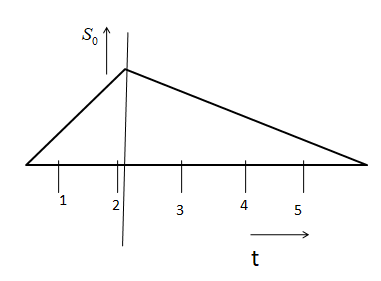
What will be the ratio of speed in the first two seconds to the next four seconds?
(A)$\sqrt 2 :1$
(B)$3:1$
(C) $2:1$
(D)$1:2$
Answer
 Verified
486.9k+ views
Hint: This is a graph between distance and time. The slope of this graph can be used to determine speed. The speed in a particular interval of time can be obtained by calculating the slope in that region of the graph. The slope of a graph of the x-axis vs y-axis has to be known.
Formula used:
The slope of a graph, in general, can be given as:-
$slope = \dfrac{{{y_2} - {y_1}}}{{{x_2} - {x_1}}}$
Complete step by step answer:
The graph will be
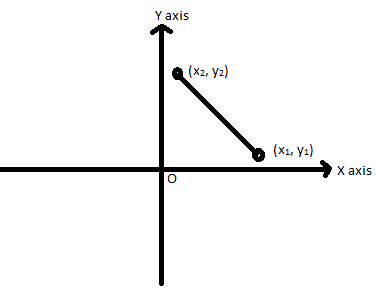
The formula of the slope is $slope = \dfrac{{{y_2} - {y_1}}}{{{x_2} - {x_1}}}$
The graph given in the problem is
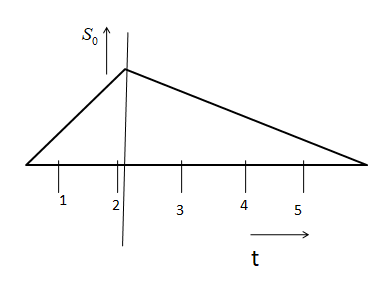
It is shown in the distance-time graph.
The speed is calculated by evaluating the slope.
Let speed in the first two seconds is \[{v_1}\] .
\[{{\text{v}}_1} = \dfrac{{S - 0}}{{2 - 0}} = \dfrac{S}{2}\] ….. (i) (since \[{y_1} = 0\] and \[{y_2} = S\] (distance) and X axis is representing time)
And, speed in the next four seconds is \[{v_2}\] .
\[ \Rightarrow {v_2} = \dfrac{{S - 0}}{{6 - 2}} = \dfrac{{\text{S}}}{4}\] …… (ii) (since \[{y_1} = 0\] and \[{y_2} = S\] (distance) and X axis is representing time)
From the ratio of \[{v_1}\] and \[{v_2}\] we will get
\[\dfrac{{{v_1}}}{{{v_2}}} = \dfrac{{\dfrac{S}{2}}}{{\dfrac{S}{4}}} = \dfrac{2}{1}\]
Therefore, the required ratio is \[2:1\]
Hence, the correct option is (C) .
Note:
Speed is defined by the rate of the total distance covered by an object. It is a scalar quantity. When an object travels its $1st$ half journey with some distance and time that is different from the remaining journey, then the average speed is required. The average speed can be calculated by the ratio of the total distance to the total time of the journey. In the graph of distance vs time, the slope determines the speed.
Formula used:
The slope of a graph, in general, can be given as:-
$slope = \dfrac{{{y_2} - {y_1}}}{{{x_2} - {x_1}}}$
Complete step by step answer:
The graph will be
The formula of the slope is $slope = \dfrac{{{y_2} - {y_1}}}{{{x_2} - {x_1}}}$
The graph given in the problem is
It is shown in the distance-time graph.
The speed is calculated by evaluating the slope.
Let speed in the first two seconds is \[{v_1}\] .
\[{{\text{v}}_1} = \dfrac{{S - 0}}{{2 - 0}} = \dfrac{S}{2}\] ….. (i) (since \[{y_1} = 0\] and \[{y_2} = S\] (distance) and X axis is representing time)
And, speed in the next four seconds is \[{v_2}\] .
\[ \Rightarrow {v_2} = \dfrac{{S - 0}}{{6 - 2}} = \dfrac{{\text{S}}}{4}\] …… (ii) (since \[{y_1} = 0\] and \[{y_2} = S\] (distance) and X axis is representing time)
From the ratio of \[{v_1}\] and \[{v_2}\] we will get
\[\dfrac{{{v_1}}}{{{v_2}}} = \dfrac{{\dfrac{S}{2}}}{{\dfrac{S}{4}}} = \dfrac{2}{1}\]
Therefore, the required ratio is \[2:1\]
Hence, the correct option is (C) .
Note:
Speed is defined by the rate of the total distance covered by an object. It is a scalar quantity. When an object travels its $1st$ half journey with some distance and time that is different from the remaining journey, then the average speed is required. The average speed can be calculated by the ratio of the total distance to the total time of the journey. In the graph of distance vs time, the slope determines the speed.
Recently Updated Pages
Master Class 10 Social Science: Engaging Questions & Answers for Success

Master Class 10 Science: Engaging Questions & Answers for Success
Master Class 10 Maths: Engaging Questions & Answers for Success
Master Class 10 General Knowledge: Engaging Questions & Answers for Success
Master Class 10 Computer Science: Engaging Questions & Answers for Success
Class 10 Question and Answer - Your Ultimate Solutions Guide
Trending doubts
Explain the Treaty of Vienna of 1815 class 10 social science CBSE
In cricket, how many legal balls are there in a standard over?
Why is there a time difference of about 5 hours between class 10 social science CBSE
Who Won 36 Oscar Awards? Record Holder Revealed
What is the median of the first 10 natural numbers class 10 maths CBSE
What is deficiency disease class 10 biology CBSE