




The rate of heartbeat is determined by
(a) Purkinje fibers
(b) Papillary muscles
(c) SA node
(d) AV node
Answer
 Verified
619.8k+ views
Hint: The cardiac conductive system is a complex system of cardiomyocytes that are excitable in nature and take part in the periodic contraction of all muscles of the heart.
Complete step by step answer:
The sinoatrial node (SA) node is present in the upper posterior wall of the right atrium. It performs the role of the pacemaker as the rate of impulse generation is highest (0.85/second) and Thus, has a very important role in determining the rate and rhythm of the heartbeat. AtrioVentricular Node (AVN) is a nodal tissue that controls the heartbeat and exists at the base of the right atrium near the interatrial septum.
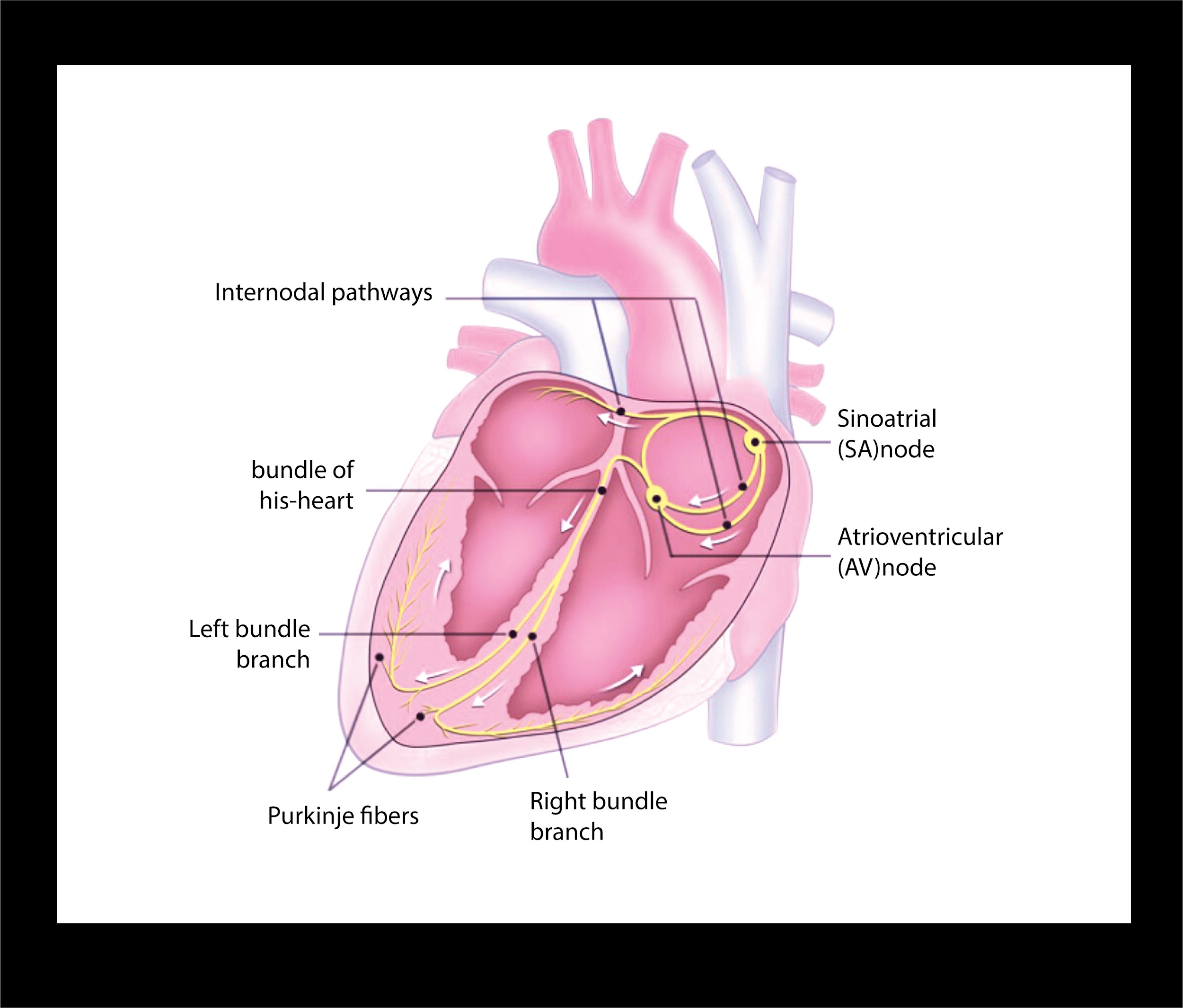
The impulse is generated from the Sinoatrial node (SA node) and carried by the atrial fibers along the right and left atrium which is then distributed to the Bachmann's bundle. Through the internodal tracts, it travels to the Atrioventricular node which delays the pace of transmission, from here the impulse travels to the Bundle of his which is further divided into a left bundle and right bundle branches. The conduction pathways further progress to the thick-walled ventricles through the Purkinje fibers. Which excites the ventricular musculature causing them to contract.
As the wave of excitation spreads across the atrial muscle, it contracts and blood gets filled into the ventricle, the AV nodal delay prevents the simultaneous contraction of the atrium and ventricles and gives the ventricles enough time to be filled with blood prior to contraction.
So, The correct answer is '(c) SA node'
Note: The Sinoatrial Node is also called a pacemaker and the Atrioventricular Node is called the Pace-setter of the heart because the SA node generates the electrical impulses and the AV node delays the reaching of impulses to the ventricles. The rate of impulse generation of AV nodes is 0.45/second which is less than that of the SA node and hence, it is not considered as a pacemaker.
Complete step by step answer:
The sinoatrial node (SA) node is present in the upper posterior wall of the right atrium. It performs the role of the pacemaker as the rate of impulse generation is highest (0.85/second) and Thus, has a very important role in determining the rate and rhythm of the heartbeat. AtrioVentricular Node (AVN) is a nodal tissue that controls the heartbeat and exists at the base of the right atrium near the interatrial septum.
The impulse is generated from the Sinoatrial node (SA node) and carried by the atrial fibers along the right and left atrium which is then distributed to the Bachmann's bundle. Through the internodal tracts, it travels to the Atrioventricular node which delays the pace of transmission, from here the impulse travels to the Bundle of his which is further divided into a left bundle and right bundle branches. The conduction pathways further progress to the thick-walled ventricles through the Purkinje fibers. Which excites the ventricular musculature causing them to contract.
As the wave of excitation spreads across the atrial muscle, it contracts and blood gets filled into the ventricle, the AV nodal delay prevents the simultaneous contraction of the atrium and ventricles and gives the ventricles enough time to be filled with blood prior to contraction.
So, The correct answer is '(c) SA node'
Note: The Sinoatrial Node is also called a pacemaker and the Atrioventricular Node is called the Pace-setter of the heart because the SA node generates the electrical impulses and the AV node delays the reaching of impulses to the ventricles. The rate of impulse generation of AV nodes is 0.45/second which is less than that of the SA node and hence, it is not considered as a pacemaker.
Recently Updated Pages
Master Class 12 Economics: Engaging Questions & Answers for Success

Master Class 12 English: Engaging Questions & Answers for Success
Master Class 12 Social Science: Engaging Questions & Answers for Success
Master Class 12 Maths: Engaging Questions & Answers for Success
Master Class 12 Physics: Engaging Questions & Answers for Success
Master Class 11 Social Science: Engaging Questions & Answers for Success
Trending doubts
One Metric ton is equal to kg A 10000 B 1000 C 100 class 11 physics CBSE
Difference Between Prokaryotic Cells and Eukaryotic Cells
Find the value of the expression given below sin 30circ class 11 maths CBSE
1 ton equals to A 100 kg B 1000 kg C 10 kg D 10000 class 11 physics CBSE
Two of the body parts which do not appear in MRI are class 11 biology CBSE
Draw a diagram of nephron and explain its structur class 11 biology CBSE