




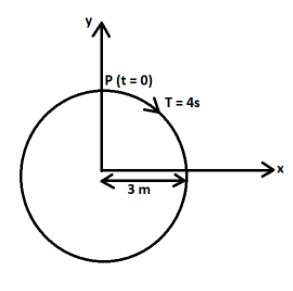
The radius of circle, the period of revolution, initial position and sense of revolution are indicated in the fig., $y$- projection of the radius vector of rotating particle $P$ is:
$A.\,\,y(t)=-3\cos 2\pi t$, where $y$ in $m$
$B.\,\,y(t)=4\sin (\dfrac{\pi t}{2})$, where $y$ in $m$
$C.\,\,y(t)=3\cos (\dfrac{3\pi t}{2})$, where $y$ in $m$
$D.\,\,y(t)=3\cos (\dfrac{\pi t}{2})$, where $y$ in $m$
Answer
 Verified
605.7k+ views
Hint: To find the $y$- projection of the radius vector of rotating particle $P$, can be deduced using the simple harmonic motion equation. The simple harmonic motion equation will be dependent on the type of function that you choose, i.e., sine or cosine, which can be deduced from the question.
Formula used:
$\begin{align}
& \omega =\dfrac{2\pi }{T} \\
& y=a\cos (\omega t) \\
\end{align}$
Complete step by step answer:
Time-period (T) = 4s, is given in the question.
So,
$\omega =\dfrac{2\pi }{T}$
$\Rightarrow \omega =\dfrac{2\pi }{4}=\dfrac{\pi }{2}rad/s$
Now,
At $t=0$, $y$ displacement is maximum, so the equation will be cosine function.
Hence,
$y=a\cos (\omega t)$, where $a$ is the radius of the circle.
$y=3\cos (\dfrac{\pi }{2}t)\,m$
Therefore, the correct answer is Option (D).
Additional Information:
In mechanics and physics, simple harmonic motion is a special type of periodic motion where the restoring force on the moving object is directly proportional to the object's displacement magnitude and acts towards the object's equilibrium position. It results in an oscillation which, if uninhibited by friction or any other dissipation of energy, continues indefinitely.
Simple harmonic motion can serve as a mathematical model for a variety of motions, but is typified by the oscillation of a mass on a spring when it is subject to the linear elastic restoring force given by Hooke's law. The motion is sinusoidal in time and demonstrates a single resonant frequency. Other phenomena can be modeled by simple harmonic motion, including the motion of a simple pendulum, although for it to be an accurate model, the net force on the object at the end of the pendulum must be proportional to the displacement (and even so, it is only a good approximation when the angle of the swing is small; see small-angle approximation). Simple harmonic motion can also be used to model molecular vibration as well.
Note:
The important part in this question is to judge the type of function that needs to be used for getting the answer and to judge the type of periodic motion that is acting on this body. In this question, the type of periodic motion is Simple Harmonic Motion, which acts towards the equilibrium position for the body.
Formula used:
$\begin{align}
& \omega =\dfrac{2\pi }{T} \\
& y=a\cos (\omega t) \\
\end{align}$
Complete step by step answer:
Time-period (T) = 4s, is given in the question.
So,
$\omega =\dfrac{2\pi }{T}$
$\Rightarrow \omega =\dfrac{2\pi }{4}=\dfrac{\pi }{2}rad/s$
Now,
At $t=0$, $y$ displacement is maximum, so the equation will be cosine function.
Hence,
$y=a\cos (\omega t)$, where $a$ is the radius of the circle.
$y=3\cos (\dfrac{\pi }{2}t)\,m$
Therefore, the correct answer is Option (D).
Additional Information:
In mechanics and physics, simple harmonic motion is a special type of periodic motion where the restoring force on the moving object is directly proportional to the object's displacement magnitude and acts towards the object's equilibrium position. It results in an oscillation which, if uninhibited by friction or any other dissipation of energy, continues indefinitely.
Simple harmonic motion can serve as a mathematical model for a variety of motions, but is typified by the oscillation of a mass on a spring when it is subject to the linear elastic restoring force given by Hooke's law. The motion is sinusoidal in time and demonstrates a single resonant frequency. Other phenomena can be modeled by simple harmonic motion, including the motion of a simple pendulum, although for it to be an accurate model, the net force on the object at the end of the pendulum must be proportional to the displacement (and even so, it is only a good approximation when the angle of the swing is small; see small-angle approximation). Simple harmonic motion can also be used to model molecular vibration as well.
Note:
The important part in this question is to judge the type of function that needs to be used for getting the answer and to judge the type of periodic motion that is acting on this body. In this question, the type of periodic motion is Simple Harmonic Motion, which acts towards the equilibrium position for the body.
Recently Updated Pages
Master Class 11 Social Science: Engaging Questions & Answers for Success

Master Class 11 Chemistry: Engaging Questions & Answers for Success
Master Class 9 General Knowledge: Engaging Questions & Answers for Success
Master Class 9 Maths: Engaging Questions & Answers for Success
Master Class 9 Science: Engaging Questions & Answers for Success
Master Class 9 English: Engaging Questions & Answers for Success
Trending doubts
One Metric ton is equal to kg A 10000 B 1000 C 100 class 11 physics CBSE
Difference Between Prokaryotic Cells and Eukaryotic Cells
Two of the body parts which do not appear in MRI are class 11 biology CBSE
1 ton equals to A 100 kg B 1000 kg C 10 kg D 10000 class 11 physics CBSE
10 examples of friction in our daily life
Name the Largest and the Smallest Cell in the Human Body ?