




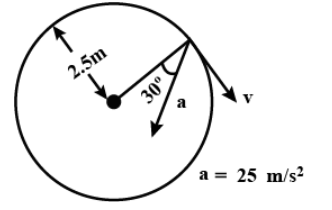
The radial acceleration is
A.$1.65m{{s}^{-2}}$
B.$5.65m{{s}^{-2}}$
C.$11.65m{{s}^{-2}}$
D.$21.65m{{s}^{-2}}$
Answer
 Verified
587.4k+ views
Hint: We have to find radial or centripetal acceleration here.
We need to break the acceleration vector into its two rectangular components.
As we know, centripetal acceleration is always along the centre and radius in a circle.so the horizontal component of the given acceleration vector will be the radial acceleration of the body .Also, radial acceleration is always perpendicular to the velocity vector.
Complete answer:
Centripetal acceleration is responsible for a body’s moment in circular motion.it is the acceleration due to the force which is resultant of all the forces acting on the body.
The radial or centripetal acceleration is perpendicular to the velocity vector.
As the angle between radius vector and net acceleration is given, we will break the given acceleration into its vertical and horizontal components and we will see that the horizontal component is the radial or centripetal acceleration as it is along the centre and radius of the circular path.
It a vector $\overset{\to }{\mathop{c}}\,$ makes an angle $\theta $ with the horizontal then its rectangular components will be,
Horizontal component -$c\,\cos \theta $
Vertical component-$c\,\sin \theta $.
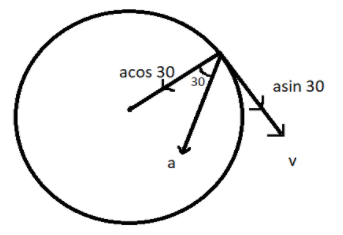
So according to above information, the components of acceleration will be
Horizontal component -$a\cos \,{{30}^{o}}$
Vertical component-$a\sin \,{{30}^{o}}$.
Given value,
a=$25ms{}^{-2}$
Radial acceleration:
$\Rightarrow 25\times \cos \,{{30}^{o}}$
$\Rightarrow 25\times 0.866$
$\Rightarrow 21.65m{{s}^{-2}}$
Hence the radial acceleration has come and the correct option is D.
Note:
The perpendicular component of the acceleration $a\sin \,{{30}^{o}}$is known as tangential acceleration.it is directed in or opposite to the direction of velocity.
It is responsible for change in the magnitude of velocity.
Also, it is present only in the case of non-uniform circular motion.
We need to break the acceleration vector into its two rectangular components.
As we know, centripetal acceleration is always along the centre and radius in a circle.so the horizontal component of the given acceleration vector will be the radial acceleration of the body .Also, radial acceleration is always perpendicular to the velocity vector.
Complete answer:
Centripetal acceleration is responsible for a body’s moment in circular motion.it is the acceleration due to the force which is resultant of all the forces acting on the body.
The radial or centripetal acceleration is perpendicular to the velocity vector.
As the angle between radius vector and net acceleration is given, we will break the given acceleration into its vertical and horizontal components and we will see that the horizontal component is the radial or centripetal acceleration as it is along the centre and radius of the circular path.
It a vector $\overset{\to }{\mathop{c}}\,$ makes an angle $\theta $ with the horizontal then its rectangular components will be,
Horizontal component -$c\,\cos \theta $
Vertical component-$c\,\sin \theta $.
So according to above information, the components of acceleration will be
Horizontal component -$a\cos \,{{30}^{o}}$
Vertical component-$a\sin \,{{30}^{o}}$.
Given value,
a=$25ms{}^{-2}$
Radial acceleration:
$\Rightarrow 25\times \cos \,{{30}^{o}}$
$\Rightarrow 25\times 0.866$
$\Rightarrow 21.65m{{s}^{-2}}$
Hence the radial acceleration has come and the correct option is D.
Note:
The perpendicular component of the acceleration $a\sin \,{{30}^{o}}$is known as tangential acceleration.it is directed in or opposite to the direction of velocity.
It is responsible for change in the magnitude of velocity.
Also, it is present only in the case of non-uniform circular motion.
Recently Updated Pages
Master Class 11 Social Science: Engaging Questions & Answers for Success

Master Class 11 Physics: Engaging Questions & Answers for Success
Master Class 11 Maths: Engaging Questions & Answers for Success
Master Class 11 Economics: Engaging Questions & Answers for Success
Master Class 11 Computer Science: Engaging Questions & Answers for Success
Master Class 11 Chemistry: Engaging Questions & Answers for Success
Trending doubts
One Metric ton is equal to kg A 10000 B 1000 C 100 class 11 physics CBSE
There are 720 permutations of the digits 1 2 3 4 5 class 11 maths CBSE
1 Quintal is equal to a 110 kg b 10 kg c 100kg d 1000 class 11 physics CBSE
State and prove Bernoullis theorem class 11 physics CBSE
Difference Between Prokaryotic Cells and Eukaryotic Cells
Which among the following are examples of coming together class 11 social science CBSE