



The purely motor cranial nerve is _____.
A. Facial
B. Vagus
C. Trigeminal
D. Spinal accessory.
Answer
 Verified
595.5k+ views
Hint:These pairs of nerves connect our brain to different parts of your head, neck, and trunk. Each nerve also has a corresponding Roman numeral between I and XII. This is based on their location from front to back.
Complete answer:
To answer this question, first, we need to know about the motor cranial nerve. The cranial nerves (CN) are twelve pairs of nerves that, with the exception of the spinal accessory nerve (CN XI), originate in the brain and contribute to the peripheral nervous system (PNS), contributing to the neck and head.
Motor and sensory nerves, some have special sensory functions, some have somatic sensory functions, some have autonomic functions, some have somatic motor functions, and some have a combination of the aforementioned functions.
Now, let us find the solution from the option.
The details of following nerves are:
> Facial Nerve: Seventh cranial nerve- mixed nerve (Motor+Sensory).
> Vagus Nerve: it is the tenth cranial nerve- blend nerve (Motor+Sensory).
> Trigeminal Nerve: It is the fifth cranial nerve-mixed (Motor+Sensory).
> Spinal accessory Nerve: It is the eleventh cranial nerve- also known as motor nerve.
>The cranial portion of the accessory nerve is classified as a branchial motor nerve, supplying the muscles of the soft palate. The spinal part is classified as somatic motor supplying sternocleidomastoid and trapezius.
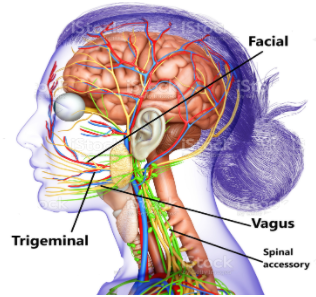
Fig- different cranial nerves.
Thus, the correct answer is option D. i.e. Spinal accessory.
Note:The cranial nerves are recognized as part of the peripheral nervous system (PNS), but on a structural range the trigeminal (V), olfactory (I) and optic (II) nerves are much properly recognized part of the central nervous system (CNS). The cranial nerves are different from spinal nerves, which emerge from segments of the spinal cord.
Complete answer:
To answer this question, first, we need to know about the motor cranial nerve. The cranial nerves (CN) are twelve pairs of nerves that, with the exception of the spinal accessory nerve (CN XI), originate in the brain and contribute to the peripheral nervous system (PNS), contributing to the neck and head.
Motor and sensory nerves, some have special sensory functions, some have somatic sensory functions, some have autonomic functions, some have somatic motor functions, and some have a combination of the aforementioned functions.
Now, let us find the solution from the option.
The details of following nerves are:
> Facial Nerve: Seventh cranial nerve- mixed nerve (Motor+Sensory).
> Vagus Nerve: it is the tenth cranial nerve- blend nerve (Motor+Sensory).
> Trigeminal Nerve: It is the fifth cranial nerve-mixed (Motor+Sensory).
> Spinal accessory Nerve: It is the eleventh cranial nerve- also known as motor nerve.
>The cranial portion of the accessory nerve is classified as a branchial motor nerve, supplying the muscles of the soft palate. The spinal part is classified as somatic motor supplying sternocleidomastoid and trapezius.
Fig- different cranial nerves.
Thus, the correct answer is option D. i.e. Spinal accessory.
Note:The cranial nerves are recognized as part of the peripheral nervous system (PNS), but on a structural range the trigeminal (V), olfactory (I) and optic (II) nerves are much properly recognized part of the central nervous system (CNS). The cranial nerves are different from spinal nerves, which emerge from segments of the spinal cord.
Recently Updated Pages
Master Class 11 Social Science: Engaging Questions & Answers for Success

Master Class 11 Physics: Engaging Questions & Answers for Success
Master Class 11 Maths: Engaging Questions & Answers for Success
Master Class 11 Economics: Engaging Questions & Answers for Success
Master Class 11 Computer Science: Engaging Questions & Answers for Success
Master Class 11 Chemistry: Engaging Questions & Answers for Success
Trending doubts
One Metric ton is equal to kg A 10000 B 1000 C 100 class 11 physics CBSE
There are 720 permutations of the digits 1 2 3 4 5 class 11 maths CBSE
1 Quintal is equal to a 110 kg b 10 kg c 100kg d 1000 class 11 physics CBSE
State and prove Bernoullis theorem class 11 physics CBSE
Difference Between Prokaryotic Cells and Eukaryotic Cells
Discuss the various forms of bacteria class 11 biology CBSE