




The product of light reaction during photosynthesis include
A) ATP and NADPH
B) $O_2$ and $NADP^+$
C) $O_2$ and $H_2O$
D) $NADP^+$ and $H_2O$
Answer
 Verified
651.3k+ views
Hint: The light dependent photosynthesis takes place in the thylakoid membrane of the chloroplast. It transforms light energy into chemical energy.
Complete Answer:
Photosynthesis is the process of conversion of light energy to chemical energy. In this reaction, plants prepare their own food in the presence of sunlight and chlorophyll. The process of photosynthesis occurs in two steps- light dependent reaction and light independent reaction.
Light dependent reaction-
- It takes place in the chloroplast of the leaves. The pigment chlorophyll is the most essential requirement which is present in the thylakoid.
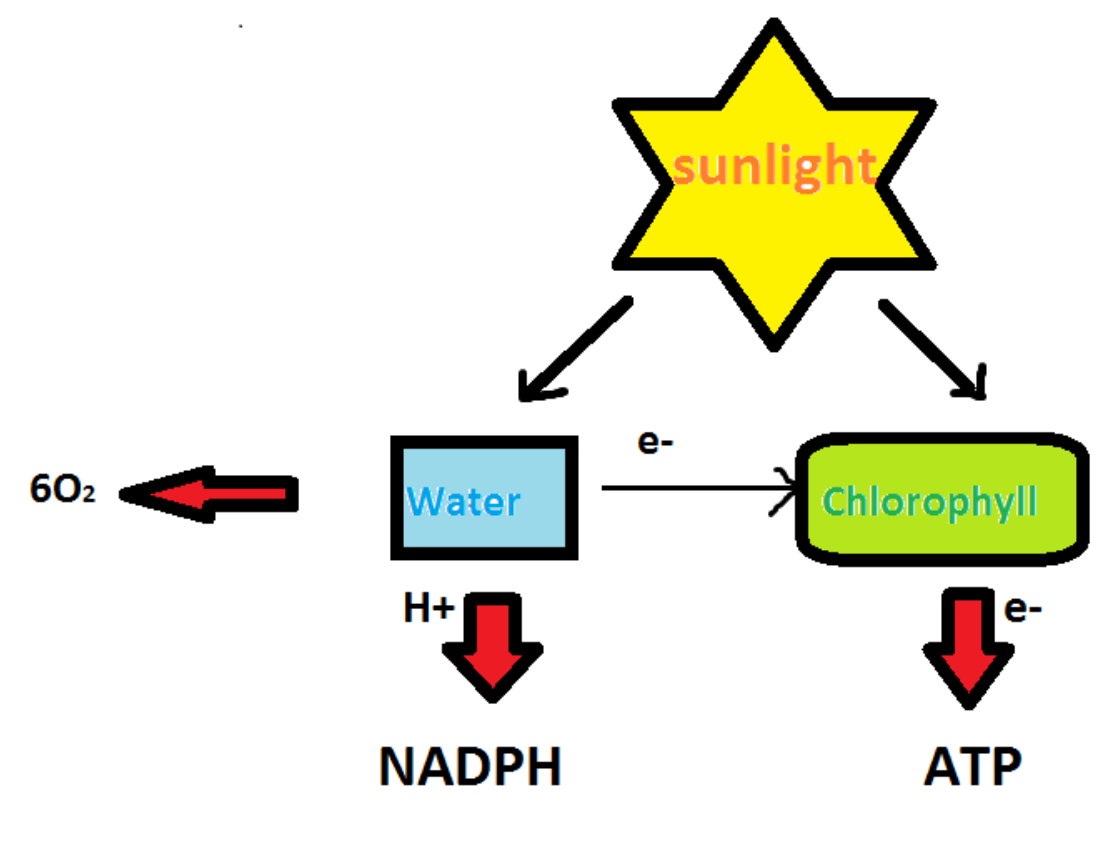
- This light reaction takes place in thylakoids. In this complex photo-system, the electrons are excited as a result of photolysis of water to hydrogen ion and oxygen.
- By the end of the electron transfer chain $NADP^+$ (Nicotinamide Adenine dinucleotide phosphate) is reduced to NADPH.
- Also the ADP is reduced to ATP (Adenosine triphosphate). The oxygen is released to the atmosphere as the by-product.
In the Calvin cycle or dark reaction- It is the light-independent reaction which takes place in stroma of chloroplast. The NADPH and ATP obtained from the light reaction along with carbon dioxide is utilised to form glucose.
Thus the correct answer is (A) NADPH and ATP are the products of light reaction.
Note: For light dependent reactions, $CO_2$, water, sunlight and chlorophyll are essential. NADPH and ATP produced in light reaction are utilised in the dark reaction.
Complete Answer:
Photosynthesis is the process of conversion of light energy to chemical energy. In this reaction, plants prepare their own food in the presence of sunlight and chlorophyll. The process of photosynthesis occurs in two steps- light dependent reaction and light independent reaction.
Light dependent reaction-
- It takes place in the chloroplast of the leaves. The pigment chlorophyll is the most essential requirement which is present in the thylakoid.
- This light reaction takes place in thylakoids. In this complex photo-system, the electrons are excited as a result of photolysis of water to hydrogen ion and oxygen.
- By the end of the electron transfer chain $NADP^+$ (Nicotinamide Adenine dinucleotide phosphate) is reduced to NADPH.
- Also the ADP is reduced to ATP (Adenosine triphosphate). The oxygen is released to the atmosphere as the by-product.
In the Calvin cycle or dark reaction- It is the light-independent reaction which takes place in stroma of chloroplast. The NADPH and ATP obtained from the light reaction along with carbon dioxide is utilised to form glucose.
Thus the correct answer is (A) NADPH and ATP are the products of light reaction.
Note: For light dependent reactions, $CO_2$, water, sunlight and chlorophyll are essential. NADPH and ATP produced in light reaction are utilised in the dark reaction.
Recently Updated Pages
Master Class 11 Social Science: Engaging Questions & Answers for Success

Master Class 11 English: Engaging Questions & Answers for Success
Master Class 11 Accountancy: Engaging Questions & Answers for Success
Master Class 11 Physics: Engaging Questions & Answers for Success
Master Class 11 Computer Science: Engaging Questions & Answers for Success
Master Class 11 Business Studies: Engaging Questions & Answers for Success
Trending doubts
One Metric ton is equal to kg A 10000 B 1000 C 100 class 11 physics CBSE
Find the value of the expression given below sin 30circ class 11 maths CBSE
Draw a diagram of nephron and explain its structur class 11 biology CBSE
10 examples of friction in our daily life
Proton was discovered by A Thomson B Rutherford C Chadwick class 11 chemistry CBSE
The teeth used for biting and cutting food are called class 11 biology CBSE