



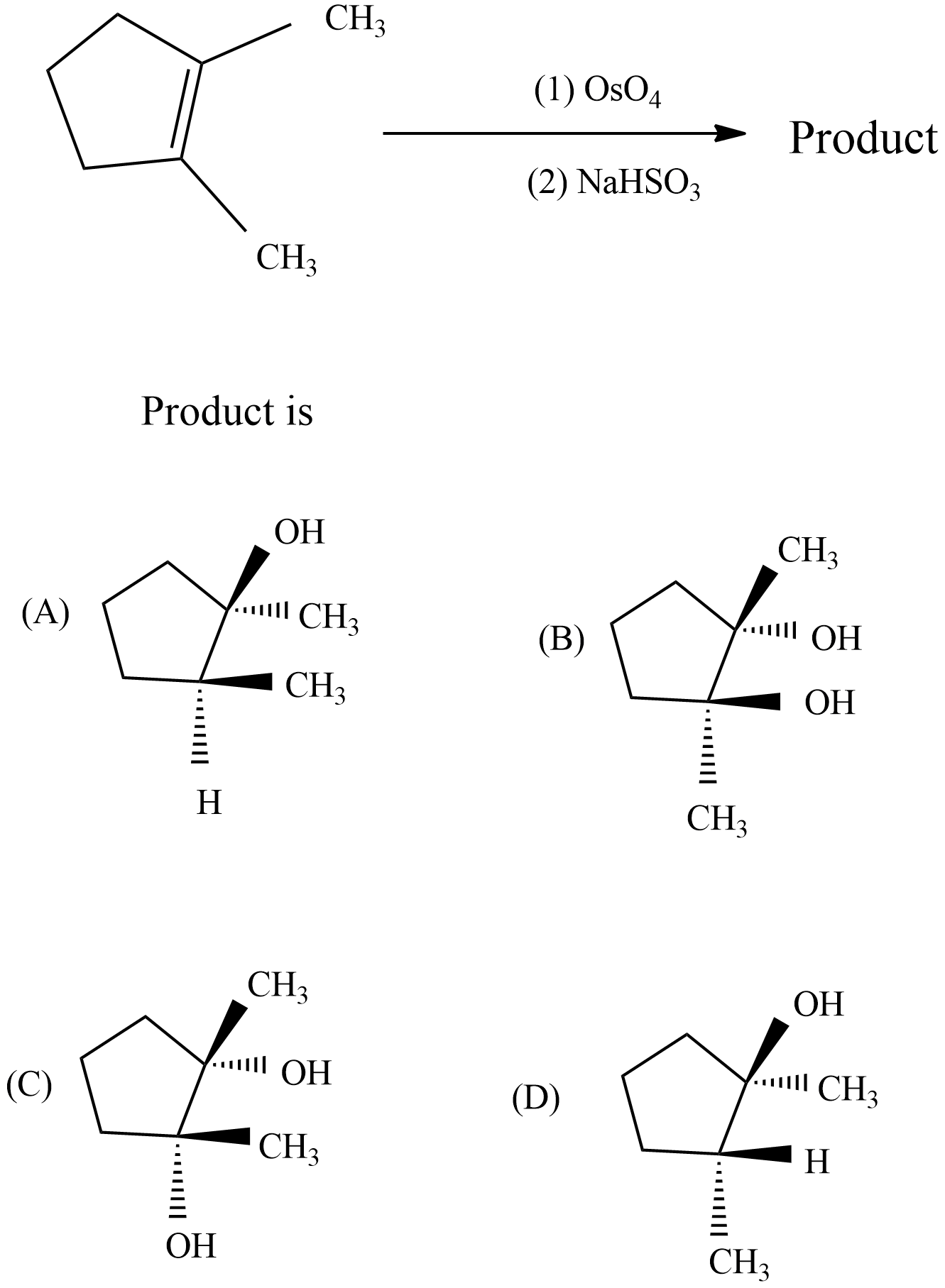
what will be the product for the given reaction?
Answer
 Verified
627.3k+ views
Hint: Dihydroxylation of alkenes can be dihydroxylated by two different stereochemical ways which are anti- dihydroxylation or syn- dihydroxylation. The anti-dihydroxylation mechanism follows the opening of epoxides and potassium permanganate or osmium tetroxide will produce syn-dihydroxylation products. This reaction can also be a two-step process as osmium tetroxide in pyridine solution followed by sodium thiosulfate.
Complete step by step solution:
Syn dihydroxylation: Oxidation of alkenes through Osmium tetroxide to give through syn addition. A vicinal diol is a compound with two –OH groups on adjacent carbons is glycol. Glycols are obtained by reaction with osmium tetroxide in pyridine solution followed by sodium thiosulfate ($NaHC{{O}_{3}}$). The metallic intermediate may be isolated in the osmium reaction and both reactions appear to proceed with the same mechanism.
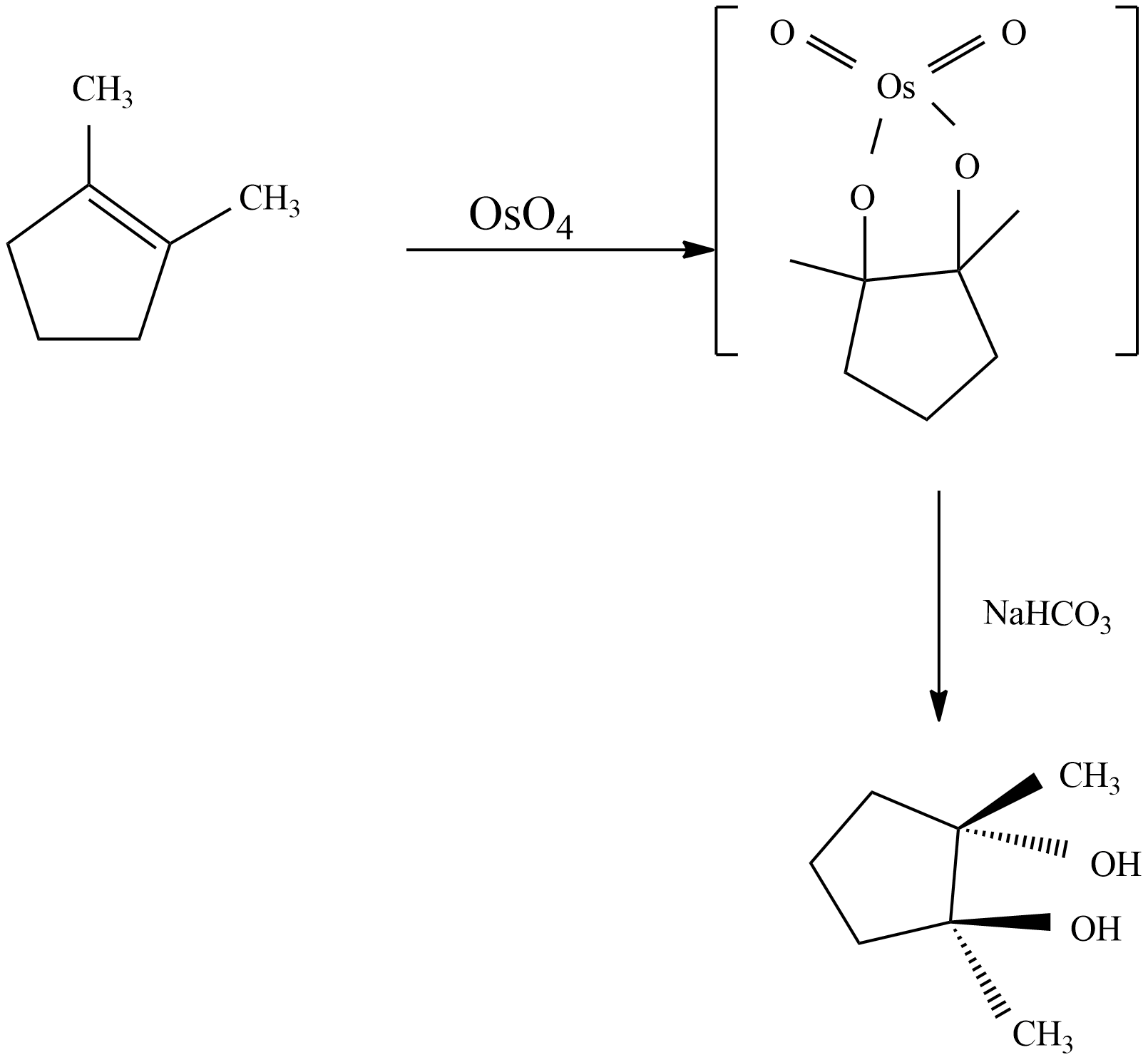
From the mechanism, observed that syn-stereoselectivity in the bonding oxygen and not an issue with region selectivity. The reaction with Osmium tetroxide is a concerted process which has a cyclic intermediate with no rearrangement of vicinal syn dihydroxylation of an alkene. When 1, 2-dimethyl cyclopentene reacts with $Os{{O}_{4}}$ , glycol product will form with stereocenters and the product is option C which is a Meso product from cis-1, 2-dimethyl-cyclopentene.
Note: Syn-hydroxylation of alkenes forms epoxides may be cleared by aqueous acid to give glycols. In contrast to the syn-stereoselectivity of this method is the anti-hydroxylation of the double bond. The given equation is illustrated for a cis-disubstituted epoxide and this hydration of an epoxide does not change the oxidation state of atoms or groups.
Complete step by step solution:
Syn dihydroxylation: Oxidation of alkenes through Osmium tetroxide to give through syn addition. A vicinal diol is a compound with two –OH groups on adjacent carbons is glycol. Glycols are obtained by reaction with osmium tetroxide in pyridine solution followed by sodium thiosulfate ($NaHC{{O}_{3}}$). The metallic intermediate may be isolated in the osmium reaction and both reactions appear to proceed with the same mechanism.
From the mechanism, observed that syn-stereoselectivity in the bonding oxygen and not an issue with region selectivity. The reaction with Osmium tetroxide is a concerted process which has a cyclic intermediate with no rearrangement of vicinal syn dihydroxylation of an alkene. When 1, 2-dimethyl cyclopentene reacts with $Os{{O}_{4}}$ , glycol product will form with stereocenters and the product is option C which is a Meso product from cis-1, 2-dimethyl-cyclopentene.
Note: Syn-hydroxylation of alkenes forms epoxides may be cleared by aqueous acid to give glycols. In contrast to the syn-stereoselectivity of this method is the anti-hydroxylation of the double bond. The given equation is illustrated for a cis-disubstituted epoxide and this hydration of an epoxide does not change the oxidation state of atoms or groups.
Recently Updated Pages
Master Class 12 Economics: Engaging Questions & Answers for Success

Master Class 12 Biology: Engaging Questions & Answers for Success
Master Class 11 English: Engaging Questions & Answers for Success
Master Class 11 Physics: Engaging Questions & Answers for Success
Master Class 11 Computer Science: Engaging Questions & Answers for Success
Master Class 11 Chemistry: Engaging Questions & Answers for Success
Trending doubts
Which are the Top 10 Largest Countries of the World?
Draw a labelled sketch of the human eye class 12 physics CBSE
Why is the cell called the structural and functional class 12 biology CBSE
Draw ray diagrams each showing i myopic eye and ii class 12 physics CBSE
Differentiate between homogeneous and heterogeneous class 12 chemistry CBSE
Which is the correct genotypic ratio of mendel dihybrid class 12 biology CBSE