



The prime number which comes just after 43 is:
A. 49
B. 45
C. 47
D. None of these
Answer
 Verified
644.1k+ views
Hint: In the given option we can simply find factors of given number. When we get a number which has factor only 1 and number itself then we can say that is the correct answer because Prime numbers are that number which has factor only 1 and number itself.
Complete step-by-step answer:
As we know, the prime number has only two factors 1 and number itself. For example 43 has only two factors 1 and 43.
So we can find factors of given numbers.
Factor of 49 is given below:
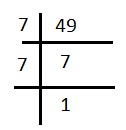
So we can write 49 as
$49=7\times 7\times 1$
So 49 has a factor other than 1. It is not a prime number. This is not a correct answer.
Factor of 45 is given below:
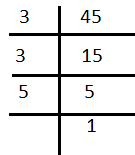
So we can write 45 as
$45=5\times 3\times 3\times 1$
So 45 has a factor other than 1. It is not a prime number. This is not a correct answer.
Factor of 47 is given below
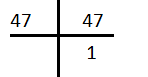
So from this we can say 47 have only 1 and 47 as a factor. So 47 is the next prime number just after 43.
Hence option C is correct.
Note: Composite numbers are numbers which have factors other than 1 and number itself. Composite numbers are not prime numbers.
We can also do this question as an approach of a composite number. In that case we can say which number is a composite number in given options is not a prime number.
Complete step-by-step answer:
As we know, the prime number has only two factors 1 and number itself. For example 43 has only two factors 1 and 43.
So we can find factors of given numbers.
Factor of 49 is given below:
So we can write 49 as
$49=7\times 7\times 1$
So 49 has a factor other than 1. It is not a prime number. This is not a correct answer.
Factor of 45 is given below:
So we can write 45 as
$45=5\times 3\times 3\times 1$
So 45 has a factor other than 1. It is not a prime number. This is not a correct answer.
Factor of 47 is given below
So from this we can say 47 have only 1 and 47 as a factor. So 47 is the next prime number just after 43.
Hence option C is correct.
Note: Composite numbers are numbers which have factors other than 1 and number itself. Composite numbers are not prime numbers.
We can also do this question as an approach of a composite number. In that case we can say which number is a composite number in given options is not a prime number.

Recently Updated Pages
Master Class 11 English: Engaging Questions & Answers for Success

Master Class 11 Social Science: Engaging Questions & Answers for Success
Master Class 11 Maths: Engaging Questions & Answers for Success
Master Class 11 Biology: Engaging Questions & Answers for Success
Master Class 11 Physics: Engaging Questions & Answers for Success
Master Class 11 Chemistry: Engaging Questions & Answers for Success
Trending doubts
Full Form of IASDMIPSIFSIRSPOLICE class 7 social science CBSE
Write in numerals Ten lakh ninety thousand nine hundred class 7 maths CBSE
How many crores make 10 million class 7 maths CBSE
One lakh eight thousand how can we write it in num class 7 maths CBSE
One lakh eight thousand how can we write it in num class 7 maths CBSE
List of coprime numbers from 1 to 100 class 7 maths CBSE