




The polar equation of the line passing through \[\left( {4,\dfrac{{2\pi }}{2}} \right)\] and perpendicular to the line joining origin to this point is
Answer
 Verified
581.4k+ views
Hint: We will locate the point on the graph. We will sketch the required line according to the conditions given in the question. We will convert the equation of the line into the polar form using the formulas for converting rectangular coordinates to polar coordinates.
Formulas used:
We will use following formulas for converting rectangular coordinates to polar coordinates:
\[x = r\cos \theta \]
\[y = r\sin \theta \]
\[\sqrt {{x^2} + {y^2}} = r\]
Complete step-by-step answer:
The point \[\left( {4,\dfrac{{2\pi }}{2}} \right)\] is equivalent to the point \[\left( {4,\pi } \right)\]. The modulus of the point represented by \[\left( {4,\dfrac{{2\pi }}{2}} \right)\] is 4 and it makes an angle of \[\pi \] radians with the positive \[x\] - axis. We will locate this point on the graph:
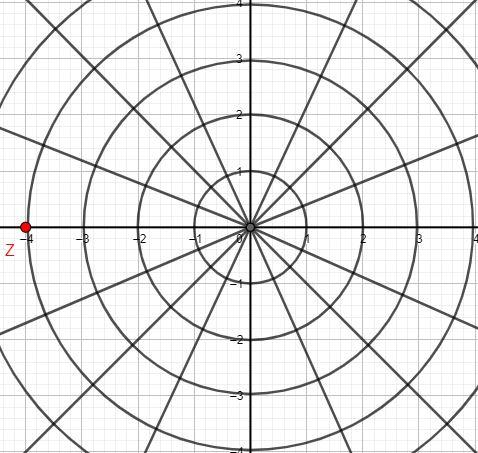
The point Z in red colour represents the required point. The point Z has value \[\left( {4,\pi } \right)\] in polar coordinates and value \[\left( { - 4,0} \right)\] in rectangular coordinates.
We can see from the figure that the line that is joining the point to the origin is the \[x\] - axis. We need a line that is perpendicular to the line joining the origin to this point i.e. our line will be perpendicular to the \[x\] - axis; this means that our line is parallel to the \[y\] - axis.
We need a line that passes through the point \[\left( { - 4,0} \right)\]and is parallel to the \[y\] - axis. We will represent this condition on the graph:
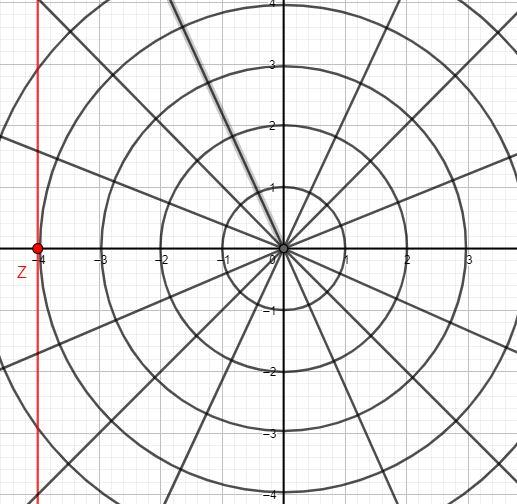
We can see from the graph that the required line is \[x = - 4\].
We will convert the notation of this line to polar coordinates. We will substitute \[ - 4\] for \[x\] in the 1st formula:
\[r\cos \theta = - 4\]
$\therefore $ The polar equation of the line passing through \[\left( {4,\dfrac{{2\pi }}{2}} \right)\] and perpendicular to the line joining the origin to this point is \[r\cos \theta = - 4\].
Note: We can also find the polar equation of the line using the formula \[r\cos \left( {\theta - \alpha } \right) = p\] where \[p\] is the length of the normal to the line from the origin and \[\alpha \] is the angle that the line makes with the polar axis. We will substitute 4 for \[p\] and \[\pi \] for \[\alpha \] in the formula for the polar equation of a line:
\[r\cos \left( {\theta - \pi } \right) = 4\].
We know that \[\cos \left( {\theta - \pi } \right) = - \cos \theta \]:
\[\begin{array}{c} \Rightarrow - r\cos \theta = 4\\ \Rightarrow r\cos \theta = - 4\end{array}\]
Formulas used:
We will use following formulas for converting rectangular coordinates to polar coordinates:
\[x = r\cos \theta \]
\[y = r\sin \theta \]
\[\sqrt {{x^2} + {y^2}} = r\]
Complete step-by-step answer:
The point \[\left( {4,\dfrac{{2\pi }}{2}} \right)\] is equivalent to the point \[\left( {4,\pi } \right)\]. The modulus of the point represented by \[\left( {4,\dfrac{{2\pi }}{2}} \right)\] is 4 and it makes an angle of \[\pi \] radians with the positive \[x\] - axis. We will locate this point on the graph:
The point Z in red colour represents the required point. The point Z has value \[\left( {4,\pi } \right)\] in polar coordinates and value \[\left( { - 4,0} \right)\] in rectangular coordinates.
We can see from the figure that the line that is joining the point to the origin is the \[x\] - axis. We need a line that is perpendicular to the line joining the origin to this point i.e. our line will be perpendicular to the \[x\] - axis; this means that our line is parallel to the \[y\] - axis.
We need a line that passes through the point \[\left( { - 4,0} \right)\]and is parallel to the \[y\] - axis. We will represent this condition on the graph:
We can see from the graph that the required line is \[x = - 4\].
We will convert the notation of this line to polar coordinates. We will substitute \[ - 4\] for \[x\] in the 1st formula:
\[r\cos \theta = - 4\]
$\therefore $ The polar equation of the line passing through \[\left( {4,\dfrac{{2\pi }}{2}} \right)\] and perpendicular to the line joining the origin to this point is \[r\cos \theta = - 4\].
Note: We can also find the polar equation of the line using the formula \[r\cos \left( {\theta - \alpha } \right) = p\] where \[p\] is the length of the normal to the line from the origin and \[\alpha \] is the angle that the line makes with the polar axis. We will substitute 4 for \[p\] and \[\pi \] for \[\alpha \] in the formula for the polar equation of a line:
\[r\cos \left( {\theta - \pi } \right) = 4\].
We know that \[\cos \left( {\theta - \pi } \right) = - \cos \theta \]:
\[\begin{array}{c} \Rightarrow - r\cos \theta = 4\\ \Rightarrow r\cos \theta = - 4\end{array}\]
Recently Updated Pages
Master Class 11 Business Studies: Engaging Questions & Answers for Success

Master Class 11 Computer Science: Engaging Questions & Answers for Success
Master Class 11 Economics: Engaging Questions & Answers for Success
Master Class 11 Social Science: Engaging Questions & Answers for Success
Master Class 11 English: Engaging Questions & Answers for Success
Master Class 11 Chemistry: Engaging Questions & Answers for Success
Trending doubts
Draw a diagram of nephron and explain its structur class 11 biology CBSE
Explain zero factorial class 11 maths CBSE
Chemical formula of Bleaching powder is A Ca2OCl2 B class 11 chemistry CBSE
Name the part of the brain responsible for the precision class 11 biology CBSE
The growth of tendril in pea plants is due to AEffect class 11 biology CBSE
One Metric ton is equal to kg A 10000 B 1000 C 100 class 11 physics CBSE