




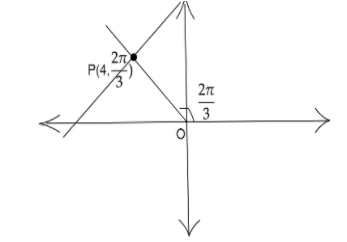
The polar equation of the line passing through \[(4,\dfrac{{2\pi }}{3})\] and perpendicular to the line joining the origin to this point is ?
Answer
 Verified
590.1k+ views
Hint: Equation of a line using its distance from the normal and the angle which normal makes with positive x-axis is known. Here those two values are given. So by simply substituting we can find the equation.
Formula used:
Equation of a line at a distance \[p\] from the normal and the normal make an angle $\alpha $ with the polar axis is
$r\cos (\theta - \alpha ) = p$
Complete step-by-step answer:
Given a point \[(4,\dfrac{{2\pi }}{3})\]
We have to find the polar equation of the line passing through \[(4,\dfrac{{2\pi }}{3})\] and perpendicular to the line joining the origin to this point.
For a point written in polar form with the coordinates, the first coordinate represents the distance of the point from the origin and the second one represents the angle, which the line joining the point and origin, makes with the polar axis (positive x-axis).
So, we can see the given point is $4$ units away from the origin and the line joining this point and origin makes an angle $\dfrac{{2\pi }}{3}$ with the polar axis.
Equation of a line at a distance \[p\] from the normal and the normal make an angle $\alpha $ with the polar axis is
$r\cos (\theta - \alpha ) = p$
So here we have, $p = 4$ and $\alpha = \dfrac{{2\pi }}{3}$
Therefore, required equation is $r\cos (\theta - \dfrac{{2\pi }}{3}) = 4$
Note: Since there are two angles $\theta $ and $\alpha $ in the equation, we may confuse one with another. Actually here $r,\theta $ are variables for the line. They take different values for different points. For each point $r$ is the distance from the origin and $\theta $ is the angle which the line joining origin and that point makes with the positive x-axis.
Formula used:
Equation of a line at a distance \[p\] from the normal and the normal make an angle $\alpha $ with the polar axis is
$r\cos (\theta - \alpha ) = p$
Complete step-by-step answer:
Given a point \[(4,\dfrac{{2\pi }}{3})\]
We have to find the polar equation of the line passing through \[(4,\dfrac{{2\pi }}{3})\] and perpendicular to the line joining the origin to this point.
For a point written in polar form with the coordinates, the first coordinate represents the distance of the point from the origin and the second one represents the angle, which the line joining the point and origin, makes with the polar axis (positive x-axis).
So, we can see the given point is $4$ units away from the origin and the line joining this point and origin makes an angle $\dfrac{{2\pi }}{3}$ with the polar axis.
Equation of a line at a distance \[p\] from the normal and the normal make an angle $\alpha $ with the polar axis is
$r\cos (\theta - \alpha ) = p$
So here we have, $p = 4$ and $\alpha = \dfrac{{2\pi }}{3}$
Therefore, required equation is $r\cos (\theta - \dfrac{{2\pi }}{3}) = 4$
Note: Since there are two angles $\theta $ and $\alpha $ in the equation, we may confuse one with another. Actually here $r,\theta $ are variables for the line. They take different values for different points. For each point $r$ is the distance from the origin and $\theta $ is the angle which the line joining origin and that point makes with the positive x-axis.
Recently Updated Pages
Basicity of sulphurous acid and sulphuric acid are

Master Class 11 Business Studies: Engaging Questions & Answers for Success
Master Class 11 Computer Science: Engaging Questions & Answers for Success
Master Class 11 Economics: Engaging Questions & Answers for Success
Master Class 11 Social Science: Engaging Questions & Answers for Success
Master Class 11 English: Engaging Questions & Answers for Success
Trending doubts
One Metric ton is equal to kg A 10000 B 1000 C 100 class 11 physics CBSE
The largest wind power cluster is located in the state class 11 social science CBSE
Explain zero factorial class 11 maths CBSE
State and prove Bernoullis theorem class 11 physics CBSE
What steps did the French revolutionaries take to create class 11 social science CBSE
Which among the following are examples of coming together class 11 social science CBSE