




The points whose abscissa and ordinate have different signs will lie in
(a) I and II quadrants
(b) II and III quadrants
(c) I and III quadrants
(d) II and IV quadrants
Answer
 Verified
639.9k+ views
Hint: To solve the given question, we will first see what the definition of abscissa and ordinate is. After doing this, we will draw x – y plane. Then we will consider different points in different quadrants and determine in which quadrants, the sign of the abscissa and ordinate will be opposite.
Complete step by step solution:
Before solving the question, we must know what an abscissa and ordinate is. The abscissa is defined as the horizontal coordinate or the x – coordinate of a geometric plane or x – y plane. The ordinate is defined as the vertical coordinate or y – coordinate of a geometric plane or x – y plane.
Now, we have to determine the regions of the x – y plane where x coordinate and y – coordinate have opposite signs. So, first we will draw x – y plane.
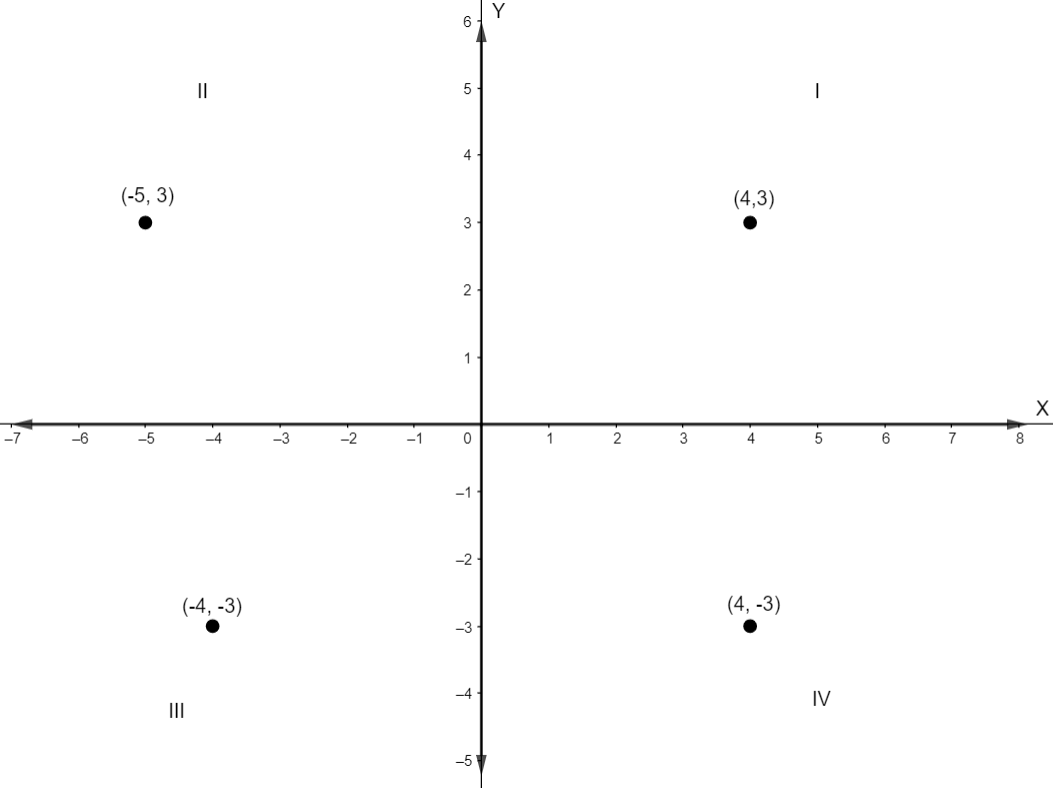
Now, if a point is in the first quadrant, then it will have both x and y coordinates as positive.
If a point is in the second quadrant, then it will have y – coordinate as positive and x – coordinate as negative.
If a point is in the third quadrant, then it will have both x – coordinate and y – coordinate as negative.
If a point is in the fourth quadrant, then it will have x – coordinate as positive and y – coordinate as negative.
Hence, in II and IV quadrants, signs of abscissa and ordinate are different.
Note: Only in the second and fourth quadrants, the sign of the abscissa and the ordinate will be opposite. We cannot say that the point on the negative x – axis, say (– 4, 0) will have different signs of abscissa and ordinate. This is wrong because there is no sign for zero and it is not considered as positive or negative.
Complete step by step solution:
Before solving the question, we must know what an abscissa and ordinate is. The abscissa is defined as the horizontal coordinate or the x – coordinate of a geometric plane or x – y plane. The ordinate is defined as the vertical coordinate or y – coordinate of a geometric plane or x – y plane.
Now, we have to determine the regions of the x – y plane where x coordinate and y – coordinate have opposite signs. So, first we will draw x – y plane.
Now, if a point is in the first quadrant, then it will have both x and y coordinates as positive.
If a point is in the second quadrant, then it will have y – coordinate as positive and x – coordinate as negative.
If a point is in the third quadrant, then it will have both x – coordinate and y – coordinate as negative.
If a point is in the fourth quadrant, then it will have x – coordinate as positive and y – coordinate as negative.
Hence, in II and IV quadrants, signs of abscissa and ordinate are different.
Note: Only in the second and fourth quadrants, the sign of the abscissa and the ordinate will be opposite. We cannot say that the point on the negative x – axis, say (– 4, 0) will have different signs of abscissa and ordinate. This is wrong because there is no sign for zero and it is not considered as positive or negative.
Recently Updated Pages
Master Class 11 English: Engaging Questions & Answers for Success

Master Class 11 Social Science: Engaging Questions & Answers for Success
Master Class 11 Maths: Engaging Questions & Answers for Success
Master Class 11 Biology: Engaging Questions & Answers for Success
Master Class 11 Physics: Engaging Questions & Answers for Success
Master Class 11 Chemistry: Engaging Questions & Answers for Success
Trending doubts
One Metric ton is equal to kg A 10000 B 1000 C 100 class 11 physics CBSE
What is cell theory Who formulated it class 11 biology CBSE
Phyllotaxy is the arrangement of ALeaflets BLeaves class 11 biology CBSE
Difference Between Prokaryotic Cells and Eukaryotic Cells
The symbiotic association of fungi and algae is called class 11 biology CBSE
Cell theory was formulated by A Schleiden and Schwann class 11 biology CBSE