




The ${\text{pKa}}$ of acetyl salicylic acid (aspirin) is $3.5$ . The ${\text{pH}}$ of gastric juice in the human stomach is about $2 - 3$ and the ${\text{pH}}$ in the small intestine is about $8$ . Aspirin will be
A.Unionised in the small intestine and in the stomach
B.Completely ionised in the small intestine and in the stomach
C.Ionised in the stomach and the almost unionised in the small intestine
D.Ionised in the small intestine and almost unionised in the stomach
Answer
 Verified
652.5k+ views
Hint: The ${\text{pKa}}$ value and ${\text{pH}}$ value has a unique relation in them. Basically the ${\text{pKa}}$ is the ${\text{pH}}$ value at which chemical species start accepting and donating protons. The lower the ${\text{pKa}}$ value the stronger is the acid with the ability to donate protons in aqueous solution.
Complete step by step answer:
We have given that the ${\text{pKa}}$ of acetyl salicylic acid (aspirin) is $3.5$ and the ${\text{pH}}$ of gastric juice in human stomach is about $2 - 3$ and the ${\text{pH}}$ in the small intestine is about $8$. This indicates that we have to find out the relation between ${\text{pKa}}$ value and ${\text{pH}}$ value.
And we know that the ${\text{pKa}}$ is the ${\text{pH}}$ value at which a species starts donating or accepting the protons.
Therefore we can say that the higher the ${\text{pKa}}$ value, the more the species are acidic.
The acid with higher ${\text{pKa}}$ value will be ionised in the space having higher ${\text{pH}}$ value and the acid with lower ${\text{pKa}}$ value will be ionised in the space having lower ${\text{pH}}$ value, other than their matching conditions they will remain unionised.
As we all know that aspirin is a weak acid so it will not ionise in medium with lower ${\text{pH}}$ value but it will be ionised in the medium with higher ${\text{pH}}$ .
Hence the human stomach is more acidic than the small intestine so aspirin will remain unionised in the stomach and will ionise in the small intestine.
Hence option (D) is correct.
Note:
The structure of Aspirin:
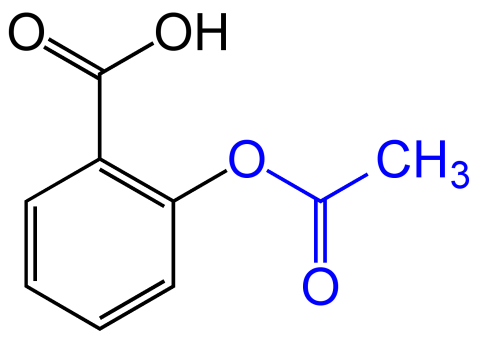
Aspirin is a weak acid therefore it has higher ${\text{pKa}}$ and ${\text{pH}}$ values and this makes it suitable to ionize in small intestine and remain unionised in the stomach.
Complete step by step answer:
We have given that the ${\text{pKa}}$ of acetyl salicylic acid (aspirin) is $3.5$ and the ${\text{pH}}$ of gastric juice in human stomach is about $2 - 3$ and the ${\text{pH}}$ in the small intestine is about $8$. This indicates that we have to find out the relation between ${\text{pKa}}$ value and ${\text{pH}}$ value.
And we know that the ${\text{pKa}}$ is the ${\text{pH}}$ value at which a species starts donating or accepting the protons.
Therefore we can say that the higher the ${\text{pKa}}$ value, the more the species are acidic.
The acid with higher ${\text{pKa}}$ value will be ionised in the space having higher ${\text{pH}}$ value and the acid with lower ${\text{pKa}}$ value will be ionised in the space having lower ${\text{pH}}$ value, other than their matching conditions they will remain unionised.
As we all know that aspirin is a weak acid so it will not ionise in medium with lower ${\text{pH}}$ value but it will be ionised in the medium with higher ${\text{pH}}$ .
Hence the human stomach is more acidic than the small intestine so aspirin will remain unionised in the stomach and will ionise in the small intestine.
Hence option (D) is correct.
Note:
The structure of Aspirin:
Aspirin is a weak acid therefore it has higher ${\text{pKa}}$ and ${\text{pH}}$ values and this makes it suitable to ionize in small intestine and remain unionised in the stomach.
Recently Updated Pages
Difference Between Prokaryotic Cells and Eukaryotic Cells

If x a + bt + ct2 where x is in meters and t is in class 11 physics CBSE
A car covers the first half distance between two places class 11 physics CBSE
The resultant of two vectors overrightarrow P and overrightarrow class 11 physics CBSE
Find the value of cos 135 class 11 maths CBSE
A mass M is held in place by an applied force F and class 11 physics CBSE
Trending doubts
One Metric ton is equal to kg A 10000 B 1000 C 100 class 11 physics CBSE
Find the value of the expression given below sin 30circ class 11 maths CBSE
Draw a diagram of nephron and explain its structur class 11 biology CBSE
10 examples of friction in our daily life
Proton was discovered by A Thomson B Rutherford C Chadwick class 11 chemistry CBSE
Bond order ofO2 O2+ O2 and O22 is in order A O2 langle class 11 chemistry CBSE