




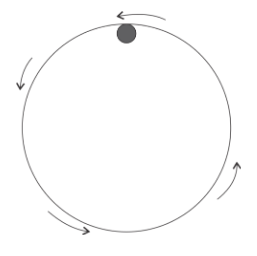
The picture below shows (small brown circle) from above on a playground ride (large grey circle) that spins horizontally the arrows show the direction of rotation of the ride. The ride is not rotating at constant speed, but is slowing down. Which of the following arrows best represent the direction of the tangential acceleration of the child at the location in the picture?
(A) Top
(B) Bottom
(C) Left
(D) Right
(E) All of them
Answer
 Verified
647.1k+ views
Hint:We know that there are two forces acting on a circular body.
The combination of these accelerations gives an overall acceleration.
Acceleration towards centre = Centripetal acceleration.
Acceleration along the circular path = tangential acceleration.
Complete step by step answer:
For the objects that move with uniform circular motion, the acceleration is always directed towards the centre of the circular path and is called Centripetal acceleration\[{a_c}\] which helps the ride to make a proper circular path. Here this acceleration is downwards.
\[{a_c} = \dfrac{{{v^2}}}{r}\]
In this case, the object is showing down as he is moving in a circular path that is an opposite force acting against the acceleration. We can call these forces as frictional forces, braking forces so this retarding force dominates and slowly reaches a velocity zero. Here the ride is moving towards the left and the ride decreases its speed so the retarding force will be in the right of the ride. If the resultant force is in right then its tangential acceleration will also be in right. So the tangential acceleration of the ride will be towards the right in the picture.
The combination of these two accelerations gives him an overall acceleration that is down and to the right in the picture.
The correct answer is \[\left( B \right)\].
Note: If any object is slowing down and moving in a circular path. So the resultant force/ acceleration will be opposite to the original tangential acceleration. Centripetal force always be towards the centre of the circle.
The combination of these accelerations gives an overall acceleration.
Acceleration towards centre = Centripetal acceleration.
Acceleration along the circular path = tangential acceleration.
Complete step by step answer:
For the objects that move with uniform circular motion, the acceleration is always directed towards the centre of the circular path and is called Centripetal acceleration\[{a_c}\] which helps the ride to make a proper circular path. Here this acceleration is downwards.
\[{a_c} = \dfrac{{{v^2}}}{r}\]
In this case, the object is showing down as he is moving in a circular path that is an opposite force acting against the acceleration. We can call these forces as frictional forces, braking forces so this retarding force dominates and slowly reaches a velocity zero. Here the ride is moving towards the left and the ride decreases its speed so the retarding force will be in the right of the ride. If the resultant force is in right then its tangential acceleration will also be in right. So the tangential acceleration of the ride will be towards the right in the picture.
The combination of these two accelerations gives him an overall acceleration that is down and to the right in the picture.
The correct answer is \[\left( B \right)\].
Note: If any object is slowing down and moving in a circular path. So the resultant force/ acceleration will be opposite to the original tangential acceleration. Centripetal force always be towards the centre of the circle.
Recently Updated Pages
Master Class 11 Social Science: Engaging Questions & Answers for Success

Master Class 11 English: Engaging Questions & Answers for Success
Master Class 11 Accountancy: Engaging Questions & Answers for Success
Master Class 11 Physics: Engaging Questions & Answers for Success
Master Class 11 Computer Science: Engaging Questions & Answers for Success
Master Class 11 Business Studies: Engaging Questions & Answers for Success
Trending doubts
Find the value of the expression given below sin 30circ class 11 maths CBSE
One Metric ton is equal to kg A 10000 B 1000 C 100 class 11 physics CBSE
10 examples of friction in our daily life
Draw a diagram of nephron and explain its structur class 11 biology CBSE
The teeth used for biting and cutting food are called class 11 biology CBSE
Proton was discovered by A Thomson B Rutherford C Chadwick class 11 chemistry CBSE