




The perpendicular bisector of the line segment joining the points \[7 + 7i\] and \[7 - 7i\] in the Argand diagram has the equation:
A.\[y = 0\]
B.\[x = 0\]
C.\[y = x\]
D.\[x + y = 0\]
Answer
 Verified
611.7k+ views
Hint: Here, we will first draw the diagram and then by symmetry of the points with respect to the \[x\]-axis, we can say \[x\]–axis is the perpendicular bisector of the line segment joining \[7 + 7i\] and \[7 - 7i\] to find the required equation.
Complete step-by-step answer:
We are given that the perpendicular bisector of the line segment joining the points \[7 + 7i\] and \[7 - 7i\] in the Argand diagram has the equation.
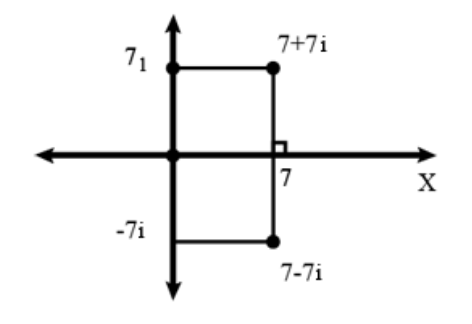
We know that the real part of the complex number has the \[x\]–value and the imaginary part of the complex number has the \[y\]–value.
Since we know that by symmetry of the points with respect to the \[x\]-axis, we can say \[x\]–axis is the perpendicular bisector of the line segment joining \[7 + 7i\] and \[7 - 7i\].
Thus, the required equation is \[y = 0\].
Hence, option A is correct.
Note: In solving these types of questions, students must know about the real and imaginary parts of a complex number. One should know the symmetry of the points with the axis to find the equation, which is the perpendicular bisector of the line segment.
Complete step-by-step answer:
We are given that the perpendicular bisector of the line segment joining the points \[7 + 7i\] and \[7 - 7i\] in the Argand diagram has the equation.
We know that the real part of the complex number has the \[x\]–value and the imaginary part of the complex number has the \[y\]–value.
Since we know that by symmetry of the points with respect to the \[x\]-axis, we can say \[x\]–axis is the perpendicular bisector of the line segment joining \[7 + 7i\] and \[7 - 7i\].
Thus, the required equation is \[y = 0\].
Hence, option A is correct.
Note: In solving these types of questions, students must know about the real and imaginary parts of a complex number. One should know the symmetry of the points with the axis to find the equation, which is the perpendicular bisector of the line segment.
Recently Updated Pages
Master Class 11 Social Science: Engaging Questions & Answers for Success

Master Class 11 Physics: Engaging Questions & Answers for Success
Master Class 11 Maths: Engaging Questions & Answers for Success
Master Class 11 Economics: Engaging Questions & Answers for Success
Master Class 11 Computer Science: Engaging Questions & Answers for Success
Master Class 11 Chemistry: Engaging Questions & Answers for Success
Trending doubts
One Metric ton is equal to kg A 10000 B 1000 C 100 class 11 physics CBSE
There are 720 permutations of the digits 1 2 3 4 5 class 11 maths CBSE
1 Quintal is equal to a 110 kg b 10 kg c 100kg d 1000 class 11 physics CBSE
State and prove Bernoullis theorem class 11 physics CBSE
Difference Between Prokaryotic Cells and Eukaryotic Cells
Which among the following are examples of coming together class 11 social science CBSE